This guide walks through the specific steps, regulatory requirements, and cross-border compliance considerations Indian nationals must navigate to legally establish a 100% foreign-owned company on Dubai Mainland—from choosing the right business activity to managing RBI's Overseas Direct Investment regulations.
Key Takeaways
- Dubai Mainland License from the Department of Economy and Tourism (DET) permits 100% foreign ownership and full UAE market access
- Setup covers activity selection, legal structure, trade name reservation, Ejari-registered office space, and license fee payment
- Indian documents need full legalization through MEA and UAE Embassy; apostille alone does not qualify
- Indian residents must comply with RBI's ODI regulations or Liberalised Remittance Scheme (LRS) capped at USD 250,000 annually
- Total costs start from AED 18,500–20,000 depending on activity type and legal structure
What Is a Dubai Mainland License?
A Dubai Mainland License is a trade license issued by Dubai's Department of Economy and Tourism (DET) that authorizes businesses to operate commercially across the entire UAE without geographic restrictions. The license covers three primary activity categories:
- Commercial License – Permits trading, importing, exporting, and distribution of goods
- Professional License – Covers service providers, consultants, and knowledge-based activities
- Industrial License – Authorizes manufacturing, processing, and assembly operations
Indian entrepreneurs most commonly pursue commercial and professional licenses, particularly in trading, IT services, consulting, and logistics sectors.
Mainland vs. Free Zone vs. Offshore
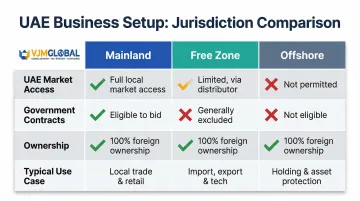
Choosing the right structure depends on where you plan to do business. Here's how the three options compare:
| Structure | UAE Market Access | Government Contracts | Typical Use Case |
|---|---|---|---|
| Mainland | Full UAE access | Eligible to bid | Trading, services, retail |
| Free Zone | Restricted — requires distributor or dual permit | Not eligible | Export-focused, tech startups |
| Offshore | No UAE operations permitted | Not eligible | Holding company, international trade |
Why Indian Entrepreneurs Are Moving to Dubai Mainland
The India-UAE Trade Boom
The India-UAE CEPA, effective May 1, 2022, eliminated customs duties on 97.4% of UAE tariff lines, covering 99% of imports from India. This trade liberalization has driven bilateral merchandise trade to $83.7 billion in FY 2023-24—nearly double pre-agreement levels.
100% Foreign Ownership Reform
Since 2021, Federal Decree-Law No. 26 of 2020 abolished the mandatory 51% Emirati sponsor requirement for most mainland activities. Indian entrepreneurs can now establish Limited Liability Companies with full ownership and control—eliminating the old 49/51 ownership restrictions that previously forced dilution or complex trust arrangements.
Strategic sectors remain restricted: Cabinet Decision No. 55 of 2021 maintains foreign ownership caps in defense, banking, insurance, telecommunications, and certain fisheries services.
Direct Market Access and Government Contracts
Mainland licenses unlock opportunities restricted under Free Zone setups:
- Direct B2C sales to UAE consumers without intermediaries
- Eligibility to bid on federal and emirate government tenders
- Full operational presence across all seven emirates
- Ability to sponsor UAE residency visas for owners and employees
Tax and Residency Advantages
The UAE imposes no personal income tax on individuals. Mainland businesses face a **9% corporate tax** only on profits exceeding AED 375,000 — income below this threshold is taxed at 0%. For Indian entrepreneurs managing operations across both countries, this low-tax environment — paired with straightforward visa sponsorship — makes Dubai Mainland a practical base for running international business without restructuring India-linked operations.
How Indian Entrepreneurs Can Get a Dubai Mainland License (Step-by-Step)
The process flows through DET and may require coordination with additional regulatory bodies depending on your business activity.
Step 1: Choose Your Business Activity
DET maintains a catalog of over 2,000 business activities. Your selection determines:
- License type (commercial, professional, or industrial)
- Legal structure eligibility
- Whether additional ministry approvals are required
Regulated sectors require extra approvals:
- Financial services – Central Bank of UAE (CBUAE) or Securities and Commodities Authority
- Healthcare – Dubai Health Authority (DHA) or Ministry of Health and Prevention
- Education – Knowledge and Human Development Authority (KHDA) or Ministry of Education
Match your intended operations precisely to the correct DED activity code to avoid delays or rejections.
Step 2: Select a Legal Structure
Most common structures for Indian entrepreneurs:
| Legal Structure | Liability | Ownership Rules | Best For |
|---|---|---|---|
| Limited Liability Company (LLC) | Limited to capital contribution | 2-50 partners; single-person LLCs allowed | Commercial trading, manufacturing, multi-partner ventures |
| Sole Establishment | Unlimited personal liability | 100% single natural person ownership | Professional services, consultants, freelancers |
| Branch of Foreign Company | Parent company bears full liability | 100% foreign parent ownership | Indian corporations expanding to UAE |
LLCs offer liability protection and suit most Indian entrepreneurs launching a new business in the UAE.
Step 3: Reserve a Trade Name
Submit your proposed business name through DET for approval. The name must:
- Comply with UAE naming rules (no religious references, no conflicts with existing names)
- Include a legal form suffix (LLC, Establishment, etc.)
- Avoid conflicts with Indian trademark registrations if operating under an existing brand name
Trade name reservation costs AED 620.
Step 4: Apply for Initial Approval
Initial approval is the government's "no objection" to your business setup—it does not authorize trading but unlocks the next steps.
Critical for Indian nationals: Indian residents must confirm FEMA compliance before remitting funds. Investments overseas must be structured under RBI's Overseas Direct Investment (ODI) regulations or the Liberalised Remittance Scheme (LRS).
- LRS route: Capped at USD 250,000 per financial year for resident individuals
- ODI route: Requires filing Form FC through an Authorized Dealer bank to obtain a Unique Identification Number (UIN) before initial remittance
Step 5: Secure Office Space and Get Ejari
All mainland businesses must have a physical address registered through Ejari (Dubai Land Department's rental registration system). A valid Ejari certificate is mandatory for license issuance and annual renewal.
Office options:
- Full dedicated office space
- Shared co-working space
- Flexi-desk arrangements (depending on activity type)
Ejari registration costs approximately AED 100 plus service fees (total ~AED 177–220), in addition to actual rent. The rental contract value determines your visa quota allocation.
Step 6: Pay Fees and Collect the License
Submit your complete document package, pay DET fees, and your license is issued — renewed annually from that date.
Don't delay on banking: Opening a UAE corporate account requires proof of business activity and typically takes several weeks. Banks review mainland company applications closely, so start the process as soon as your license is in hand.
Documents and Costs: What Indian Nationals Need to Know
Core Documents Required
- Passport copy with valid visa/entry stamp
- Passport-size photographs
- Completed DET application form
- Trade name reservation certificate
- Initial approval certificate
- Tenancy contract with Ejari registration
- Memorandum of Association (for LLCs)
India-Specific Documentation and Legalization
The UAE is not a member of the Hague Apostille Convention. Although India joined in 2005, an Indian apostille alone is insufficient for documents used in Dubai — full legalization is required.
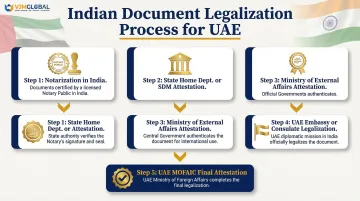
Full legalization chain required:
- Notarization in India
- State Home Department or Sub-Divisional Magistrate attestation
- Ministry of External Affairs (MEA) attestation
- UAE Embassy or Consulate in India legalization
- UAE Ministry of Foreign Affairs (MOFAIC) final attestation
Documents typically requiring full legalization:
- Educational certificates (for professional licenses)
- Company incorporation documents (for foreign branches)
- Power of attorney (if appointing a representative)
- Board resolutions and Memorandum/Articles (for corporate shareholders)
FEMA and RBI Compliance for Outward Investment
Indian residents making outward investments must navigate either the LRS or ODI route:
Liberalised Remittance Scheme (LRS):
- For resident individuals
- USD 250,000 maximum per financial year
- Covers permitted capital and current account transactions
- Suitable for smaller initial investments
When investment crosses ownership thresholds or involves an operating company abroad, the ODI route applies instead.
Overseas Direct Investment (ODI):
- Required when establishing an operating company abroad
- Defined as acquiring unlisted equity or 10%+ of listed equity
- Must file Form FC through Authorized Dealer bank before initial remittance
- Generates Unique Identification Number (UIN) for tracking
Non-compliance with FEMA and RBI regulations creates legal exposure in India, so getting the remittance structure right before incorporating abroad is essential. VJM Global's FEMA advisory team helps Indian entrepreneurs choose the correct route and handle the required filings before the first remittance leaves India.
Cost Breakdown
| Cost Component | Approximate Range (AED) | Notes |
|---|---|---|
| Trade name reservation | 620 | Standard DET fee |
| Initial approval | Varies by activity | Typically 1,000–2,000 |
| Commercial license (basic) | 10,000–15,000 | Varies by activity count |
| Professional license (basic) | 10,000–12,000 | Lower for individual professionals |
| Industrial license | 15,000+ | Plus ministry approvals |
| Ejari registration | 177–220 | Plus actual office rent |
| Knowledge & Innovation fees | 20 total | Per transaction |
| Memorandum of Association | 1,000–2,000 | Notary and attestation |
| Total startup (typical) | 18,500–20,000+ | Excluding rent and visa costs |
Additional costs include office rent (varies widely by location and size), visa processing (AED 2,000–3,000 per person), and corporate bank account setup fees.
Dubai Mainland vs Free Zone: The Right Choice for Indian Entrepreneurs
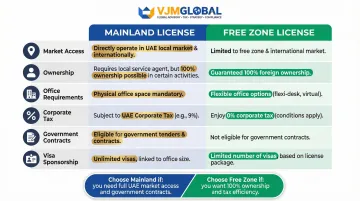
Key Decision Factors
| Factor | Mainland License | Free Zone License |
|---|---|---|
| Market Access | Full UAE; direct B2C sales | Restricted mainland trade; requires distributor |
| Ownership | 100% foreign ownership | 100% foreign ownership |
| Office Requirements | Physical space with Ejari mandatory | Flexi-desk options available |
| Corporate Tax | 9% on profits over AED 375,000 | 0% on Qualifying Income if strict conditions met |
| Government Contracts | Eligible to bid | Generally ineligible |
| Visa Sponsorship | Based on office rent value | Based on license package |
When Mainland Is the Clear Choice
Choose mainland if you:
- Target UAE consumers directly (retail, services, hospitality)
- Operate a trading company with local distribution needs
- Run a professional services firm with UAE-based clients
- Want to hire staff and operate physically in Dubai
- Plan to bid for government or corporate tenders
Common Misconception Among Indian Entrepreneurs
Many assume "mainland = expensive and complex" and default to a Free Zone. Free Zones do offer tax advantages, but their trading restrictions cut off direct UAE consumer sales, local distribution, and government tenders. For businesses targeting the UAE market, a mainland license gives you that full access — and for most active trading or service businesses, that outweighs the 9% corporate tax.
Free Zones are more suitable when:
- Your primary business is international trade (not UAE-focused)
- You want to minimize corporate tax exposure and can maintain substance requirements
- You don't need direct mainland sales or government contracts
- You're comfortable with restricted B2C access
Frequently Asked Questions
What is a mainland license in Dubai?
A mainland license is issued by Dubai's Department of Economy and Tourism (DET) and permits businesses to operate commercially throughout the UAE without geographic restrictions. It covers commercial, professional, and industrial activities with full market access.
Can foreigners set up a company in Dubai?
Yes, foreigners including Indian nationals can establish Dubai mainland companies with 100% ownership. The 2021 reform abolished the requirement for a 51% local UAE sponsor for most business activities.
Can you own 100% of a company in the UAE?
Yes, 100% foreign ownership is permitted for most business activities on the UAE mainland following 2021 reforms. Certain sectors — defense, banking, and telecommunications — may still require local partners.
How much does it cost to set up a mainland company in Dubai?
Costs typically start from AED 18,500 and vary depending on license type, number of business activities, legal structure, and whether additional government approvals are required. Office rent and visa costs are additional.
How do I set up a mainland company in Dubai?
The core steps are: choose a business activity, select a legal structure, reserve a trade name, secure office space with Ejari registration, and collect your license from DET. Indian nationals must also confirm FEMA/RBI compliance for overseas investment under the ODI or LRS routes before remitting funds.
What is the difference between mainland, Free Zone and offshore companies in Dubai?
Mainland companies trade freely across the UAE and bid for government contracts. Free Zone companies benefit from 0% tax on Qualifying Income but face restrictions on direct mainland trade. Offshore companies cannot operate locally and serve only as holding or international trading vehicles.
Setting up a Dubai mainland company involves more than just DET paperwork. VJM Global's cross-border advisory team covers the full process—DET licensing, FEMA compliance, ODI/LRS structuring, and ongoing tax obligations—backed by 30+ years in international tax and business advisory. Contact our specialists to get your India-UAE structure right from the start.