
But many US businesses underestimate what locals call "custo Brasil," the tangle of tax layers, labor rules, and bureaucratic friction that adds cost and time to nearly every transaction. Companies that treat Brazil like a bigger version of Mexico or Canada often hit expensive delays within the first year.
This guide breaks down your entry options, the compliance landmines to avoid, and how to build a phased strategy that balances speed with risk control.
Key Takeaways
- Brazil offers strong FDI potential; export, distributor, subsidiary, or JV choice shapes your full cost structure
- Tax and labor compliance are the top risks—local expertise from day one is essential
- A phased, moderate-risk plan beats both aggressive land-grabs and wait-and-see delays
- Employer of Record can cut setup time, but still requires careful local compliance management
Why Brazil? Understanding the Market Opportunity
Brazil pulled in $77 billion in FDI in 2025, a 23% jump that made it the world's fifth-largest FDI destination [2]. Global capital is already chasing that scale.
Still, "Brazil" isn't one market. São Paulo state alone generates 31.5% of national GDP, and the Southeast region as a whole produces 53% [1]. The North contributes just 5.8%. Launching nationally on day one rarely makes sense. Most successful entrants pick a state or city first.
Three Entry Postures
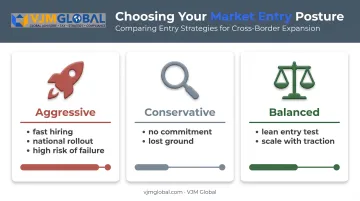
US businesses usually land in one of three camps:
- Aggressive: full subsidiary, national rollout, fast hiring. High risk and upside—and a high failure rate when compliance gets skipped
- Conservative: endless research, no local hire, no commitment. Loses ground to competitors while "still evaluating"
- Balanced: test with a lean entry (distributor, EOR, or small subsidiary), then scale based on real traction
The balanced approach tends to win because it forces early contact with Brazil's actual tax and labor mechanics, without betting the company on unproven assumptions.
Brazil Market Entry Strategies for US Businesses
Exporting Through an Agent or Distributor
Direct exporting with a local agent or distributor is the lowest-investment, fastest way in. But Brazilian commercial-representation law protects agents heavily. Terminating an agent contract without cause can trigger a statutory indemnity of at least 1/12 of total compensation paid over the relationship.
Distributors (who buy and resell on their own account) generally don't carry that same automatic protection. How the relationship functions in practice—not just its label—determines its legal treatment.
Setting Up a Subsidiary
A local subsidiary is the most common route when you want a real, ongoing presence in Brazil.
- Limitada (Ltda.) — quota-based, contractual governance, flexible. The usual choice for a wholly owned operating company.
- Sociedade Anônima (S.A.) — share-based, more formal governance, suited to multiple investors or future capital raises.
Neither structure requires minimum capital outside regulated sectors. One outdated myth worth killing: a Limitada administrator no longer needs to live in Brazil. Since 2021, a nonresident can administer the company, as long as a Brazil-based representative is appointed to receive legal process.
Joint Ventures and Consortiums
For public tenders or large infrastructure-style projects, a consortium with a Brazilian partner pools qualifications without necessarily forming a new company. This spreads risk and satisfies local-content expectations, but liability is shared, and consortium members can each be on the hook for the group's obligations.
Acquisition
Buying an existing Brazilian company gets you market access, staff, and licenses immediately. The catch: you also inherit its tax history and labor liabilities. Given Brazil's litigious labor courts, that due diligence step matters more here than in most markets.
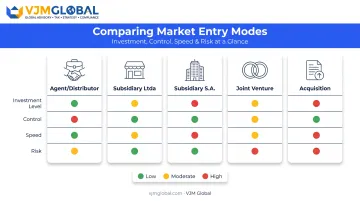
Comparing Your Options
| Entry Mode | Investment Level | Control | Speed | Risk |
|---|---|---|---|---|
| Agent/Distributor | Low | Low | Fast | Moderate (agent indemnity) |
| Subsidiary (Ltda.) | Moderate | High | Moderate | Moderate |
| Subsidiary (S.A.) | Higher | High | Slower | Moderate |
| Joint Venture | Shared | Shared | Moderate | Shared liability |
| Acquisition | High | High | Fast | High (inherited liabilities) |
Navigating Brazil's Tax, Legal and Regulatory Landscape
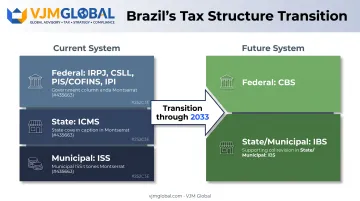
Brazil taxes at three levels:
- Federal: IRPJ, CSLL, PIS/COFINS, IPI
- State: ICMS on goods and transport
- Municipal: ISS on services
That's before you factor in the ongoing 2025 tax reform, which is gradually merging these into two new levies, CBS at the federal level and IBS at the state/municipal level, through a transition running until 2033 [3].
What this means practically: your invoicing, ERP setup, and pricing models need to handle both the old and new systems simultaneously for the next several years, not just the eventual end-state.
Import Complexity Makes Exporting Less Competitive
Physical goods face Mercosur's Common External Tariff, product-specific classification codes, and a cumulative tax stack (import duty, IPI, PIS/COFINS, ICMS). There's no single "average tariff" you can budget against. Rates depend entirely on the product code and origin.
Currency Controls and Fund Transfers
The Brazilian Real doesn't move freely across borders. Foreign direct investment and capital transfers must be registered with the Central Bank through its SCE-IED system, with detailed reporting required for transactions of $100,000 or more. Banks also run their own FX and documentation checks on top of this.
Local Legal Support Isn't Optional
Brazil's civil law system changes frequently enough that "set it and forget it" compliance doesn't work. Entity formation, tax filings, and payroll registrations need teams that track statutory updates as they happen. That ongoing local coordination is what cross-border advisors such as VJM Global provide across multiple jurisdictions—and the same standard applies no matter which firm you hire.
Employment, Hiring and Workforce Considerations
Brazil's labor code (CLT) is one of the most protective in the hemisphere.
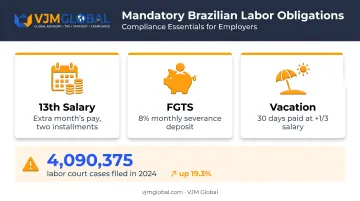
Mandatory obligations include:
- 13th salary: an extra month's pay, typically split into two installments by December
- FGTS: employer deposits equal to 8% of monthly pay into a severance fund
- Vacation: 30 days after 12 months of service, paid at one-third above normal salary
None of this is negotiable through a private employment contract. And the litigation risk is real: Brazilian labor courts received 4,090,375 cases in 2024, up 19.3% from the prior year [4]. That volume reflects a legal culture where employees routinely dispute terminations, overtime, and classification.
Well-drafted Portuguese-language contracts, accurate time records, and defensible worker classification reduce exposure significantly.
For US companies not ready to incorporate, an Employer of Record lets you hire compliant Brazilian staff without setting up a subsidiary first. That path works as an early step, but only when the arrangement is structured carefully. Regulators can treat an EOR relationship as unlawful labor intermediation if the client company directs and supervises workers as if they were direct employees.
Building a Localized Go-to-Market Approach
Portuguese localization isn't a translation exercise. Slang, formality levels, and even color associations shift by region, and a literal translation reads as foreign in a way that hurts trust.
Those nuances matter even more when you choose where to show up. Brazil's digital commerce infrastructure is strong:
- E-commerce is forecast at $36.3 billion with 94 million online buyers in 2025 [5]
- Mercado Livre leads marketplace share, followed by Amazon Brazil and Shopee
- WhatsApp reaches an estimated 169 million users and works as a primary customer-service channel, not only chat
That said, digital reach doesn't replace relationship-building. Brazilian buyers, especially in B2B contexts, still prefer doing business with people they know. Repeated in-person meetings and warm introductions often move deals forward faster than cold digital outreach alone. Plan for both channels, not one instead of the other.
Frequently Asked Questions
What are the main market entry strategies for entering Brazil from the USA?
The four core options are exporting through an agent or distributor, forming a subsidiary (Limitada or S.A.), entering a joint venture, or acquiring an existing Brazilian company. Each trades off speed, cost, control, and risk differently, as outlined in the comparison table above.
What is the best business to start in Brazil from the USA?
Service-based businesses with strong margins tend to adapt faster, since they avoid Brazil's heavy import tariffs and customs complexity. Product or import-based businesses face steeper logistics and duty burdens from day one.
Who is Brazil's #1 trading partner?
China, with bilateral trade reaching roughly $171 billion in 2025, about 27% of Brazil's total trade flow. The United States remains a significant second-tier partner, with US goods exports to Brazil at $54.3 billion.
How long does it take to set up a company in Brazil?
Brazil's federal registry averaged 23 hours to open a company as of mid-2026. That figure covers registration only. Bank KYC, tax registrations for foreign parties, and document translation typically extend the real timeline to several weeks.
Do I need a local partner to do business in Brazil?
No, most sectors allow 100% foreign ownership. Exceptions exist for healthcare, mass media, telecommunications, aerospace, and rural property, plus certain public procurement processes that favor consortium participation.
How can US companies reduce compliance risk when entering Brazil?
Engage local tax, legal, and accounting expertise before you incorporate, not after problems surface. VJM Global supports multi-jurisdiction entity formation and compliance so US businesses can align Brazil entry with their other international operations.