But UAE entrepreneurs eyeing Brazil quickly hit a wall. Brazil's bureaucracy runs across federal, state, and municipal layers simultaneously. Documents need Portuguese translation. Entity types like LTDA and SA don't map neatly onto free zone or mainland structures you're used to in the UAE.
This guide breaks down what actually matters: which entity structure fits your business, the registration steps, realistic costs and timelines, and current visa rules for UAE passport holders. We'll also cover where expert support closes the gap between "interested in Brazil" and "operating in Brazil."
Key Takeaways
- Company registration through the Junta Comercial takes 60-90 days, excluding bank account setup
- LTDA and SA are the two primary entity options for UAE-based foreign investors
- UAE nationals are generally visa-exempt for business trips up to 90 days
- A Brazil-resident legal representative is mandatory for any entity structure
- Cross-border advisory firms reduce compliance risk when you're managing setup remotely
Why Brazil Is a Strategic Market for UAE Businesses
Dubai Chamber didn't launch a Brazilian Business Council on a whim. The council exists to deepen exactly the kind of trade and investment ties reflected in that 35% YoY growth figure. For UAE businesses, this is an active, expanding corridor rather than an untested one.
Brazil itself brings scale few Latin American markets can match:
- Largest economy in Latin America, with GDP near US$2.28 trillion
- Founding member of MERCOSUR, giving businesses established there a gateway into Argentina, Paraguay, and Uruguay
- A domestic market of over 200 million consumers with rising household incomes
Sectors Where UAE Investors Are Finding Traction
Some industries line up particularly well with UAE capital and expertise:
- Agribusiness – Brazil exported over US$167 billion in agribusiness products in the year through July 2024
- Renewable energy – Renewables made up 88.2% of Brazil's 2024 electricity mix, with wind and solar alone contributing 23.7%
- Halal food and consumer goods – Brazil is the world's largest halal-protein supplier, exporting roughly US$6 billion to 57 OIC countries
- Technology – Programs like Lei do Bem offer tax incentives for qualifying R&D investment

Beyond these sector-specific openings, Brazil's broader consumer market is strengthening too: household purchasing power is moving in the right direction. Brazil's statistics agency reported real income growth of 4.7% in 2024, following stronger gains the two years prior. That's a consumer base worth paying attention to, not just a GDP headline.
Choosing the Right Business Structure in Brazil
Your entity choice shapes everything downstream: capital requirements, governance obligations, and how fast you can get operational.
| Structure | Owners | Capital | Best For |
|---|---|---|---|
| LTDA | 1 or more | No fixed minimum | Small to medium businesses, simpler governance |
| SA (Sociedade Anônima) | 2+ subscribers | At least 10% of cash capital paid upfront | Larger ventures planning to raise capital |
| Branch office | Foreign parent | Capital allocated by parent | Companies wanting direct presence without a separate legal entity |
LTDA is the default choice for most UAE entrants. It permits a single foreign owner, doesn't demand a fixed minimum capital, and carries lighter governance duties than an SA. Liability is capped at each partner's quota value.
SA structures suit businesses planning to raise capital publicly or bring in multiple institutional investors down the line. They come with annual meeting requirements, financial statement publication, and CVM oversight if shares go public. That adds more overhead than most first-time entrants need.
A branch office keeps your UAE parent company as the legal entity operating in Brazil, but it requires prior federal authorisation through DREI before Junta Comercial registration proceeds. This path suits companies where a fully separate Brazilian legal entity isn't the goal.
Where Foreign Ownership Gets Restricted
A few sectors carry specific rules worth flagging early:
- Media and broadcasting – At least 70% of capital must sit with Brazilian nationals
- Air transport – Requires a Brazilian-law entity headquartered and managed in Brazil
- Healthcare – Foreign capital is permitted in most facility types, though licensing rules still apply
- Private security – Subject to activity-specific licensing under current law
Whichever structure you pick, one requirement doesn't change: you need a legal representative residing in Brazil authorised to receive official communications and act on the company's behalf. This requirement is separate from local ownership rules: you can still own 100% of an LTDA as a foreign individual.
Step-by-Step Process to Register Your Company in Brazil
Registration spans federal, state, and municipal authorities, but most of it can be handled remotely from the UAE through a Power of Attorney. Here's the sequence.
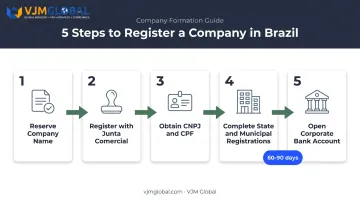
Reserve Your Company Name
Check name availability through the Junta Comercial's online database before drafting anything else. Brazil's naming conventions require the name to reflect the business activity and, for an LTDA, include "Limitada" or "LTDA" in the title.
Register with the Junta Comercial
This is where your Articles of Association get filed. You'll need:
- Articles of Association detailing partners, capital, quotas, and management structure
- Notarized and legalized passport copies of UAE-based directors and shareholders
- Proof of a registered Brazilian address for the company's headquarters
- Power of Attorney if a director won't sign documents electronically
Note that Brazil isn't a party to the Apostille Convention as it applies to UAE-issued documents — UAE MOFA attestation followed by Brazilian consular legalization is the correct path, not an apostille stamp.
Obtain CNPJ and CPF
Every company needs a CNPJ (company tax ID) from Receita Federal, Brazil's federal tax authority. Every foreign shareholder or director also needs an individual CPF, which can be applied for from outside Brazil through Receita's designated process. Skip this step, and banking, invoicing, and tax filing all stall until it's done.
Complete State and Municipal Registrations
Depending on your activity and location, you'll also register for:
- ICMS (state-level tax) if your business trades goods or certain services
- ISS (municipal services tax) for service-based businesses
- Local operating licenses, which vary by municipality and industry classification
Open a Corporate Bank Account
Brazilian banking rules technically allow electronic account requests with no face-to-face requirement. In practice, individual banks apply their own KYC standards, and some request additional verification or in-person steps for foreign-owned entities.
UAE-based directors should prepare certified passport copies, CPF numbers, and company registration documents well in advance to avoid delays. This step is often where remote setups stall the longest.
Costs, Timeline and Visa Requirements for UAE Entrepreneurs
Budget 60-90 days for end-to-end incorporation, according to TMF Group's Brazil market entry benchmark — and that figure excludes bank account opening, which can add further weeks.
Junta Comercial filing fees, notarization charges, and sworn Portuguese translation costs are set at the state level, so there's no single nationwide price sheet. Get quotes directly from your chosen Junta, notary, and a certified sworn translator before budgeting, since these vary significantly by state and document volume.
Visa Requirements for UAE Passport Holders
Here's the good news: UAE nationals are generally exempt from Brazil's business/tourist visa (VIVIS) for stays of up to 90 days. Requirements are straightforward:
- A passport valid for more than six months beyond your travel dates
- No formal visa application needed for a qualifying short business trip
If you're not a UAE national but reside in the UAE, or if your trip exceeds the exemption terms, you'll need to apply through the Brazilian Embassy in Abu Dhabi. There's no Brazilian visa-issuing consulate in Dubai, so plan your application timeline accordingly.
The standard checklist includes your passport, proof of financial means, and a return ticket. Confirm current requirements directly with the embassy before booking travel, since exemption terms can change.
How VJM Global Simplifies Your Brazil Market Entry
Setting up in Brazil while based in the UAE means juggling three layers of bureaucracy in a language you may not read fluently, with document requirements that don't match what you're used to at home. That's exactly the gap cross-border advisory exists to close.
VJM Global delivers entity formation and compliance services across 100+ countries, applying each market's own regulators, entity types, and statutory instruments rather than forcing a one-size-fits-all process. For a market like Brazil, that translates into structured support across:
- Entity selection guidance – working through whether an LTDA, SA, or branch office fits your business model and growth plans
- Registration coordination – managing the document flow between UAE attestation, Portuguese translation, and Brazilian filing requirements
- CNPJ/CPF setup – sequencing state and municipal registration alongside federal tax ID issuance
- Post-incorporation back-office support – bookkeeping, tax filing, and payroll compliance once you're operational

For UAE companies not ready to commit to full incorporation, VJM Global's Employer of Record (EOR) service (available across its 100+ country network) offers a way to hire in a new market and test demand without setting up a local entity first.
This can be the smarter first move if you want boots on the ground in Brazil before deciding whether full incorporation makes sense.
Whichever path fits your timeline, VJM Global brings 30+ years of advisory experience and a 95% client retention rate, and its team can map out exactly what a Brazil market entry requires for your business and connect you with the right in-market resources.
If Brazil is on your roadmap, a direct conversation with their advisory team is the fastest way to get a scoped plan rather than a generic checklist.
Frequently Asked Questions
How can I get a Brazil visa from Dubai?
UAE nationals typically don't need a visa for business visits under 90 days, just a passport valid for six-plus months. If you need to apply, do so through the Brazilian Embassy in Abu Dhabi, since Dubai has no Brazilian visa-issuing consulate.
Which business is profitable in Brazil?
Agribusiness, renewable energy, halal food exports, and technology all show strong momentum, backed by Brazil's growing household incomes. Consumer goods targeting the expanding middle class are another solid entry point.
Do I need a local partner to start a business in Brazil as a UAE investor?
No. An LTDA can be 100% foreign-owned with a single shareholder. You do, however, need a legal representative residing in Brazil to handle official communications.
How long does it take to register a company in Brazil?
Plan for 60-90 days through the Junta Comercial for the full incorporation process. Bank account opening typically adds extra time on top of that.
What is the corporate tax rate in Brazil?
Brazil's combined corporate tax rate sits around 34%, per PwC's 2025 tax summary, comprising 25% IRPJ (including surtax) plus 9% CSLL. Municipal ISS and state ICMS taxes apply on top, depending on your activity.
Can I manage my Brazilian company remotely from the UAE?
Most registration steps can be completed remotely through a Power of Attorney, including document filing and CPF/CNPJ applications. Bank account opening is the step most likely to require additional verification or in-person involvement.