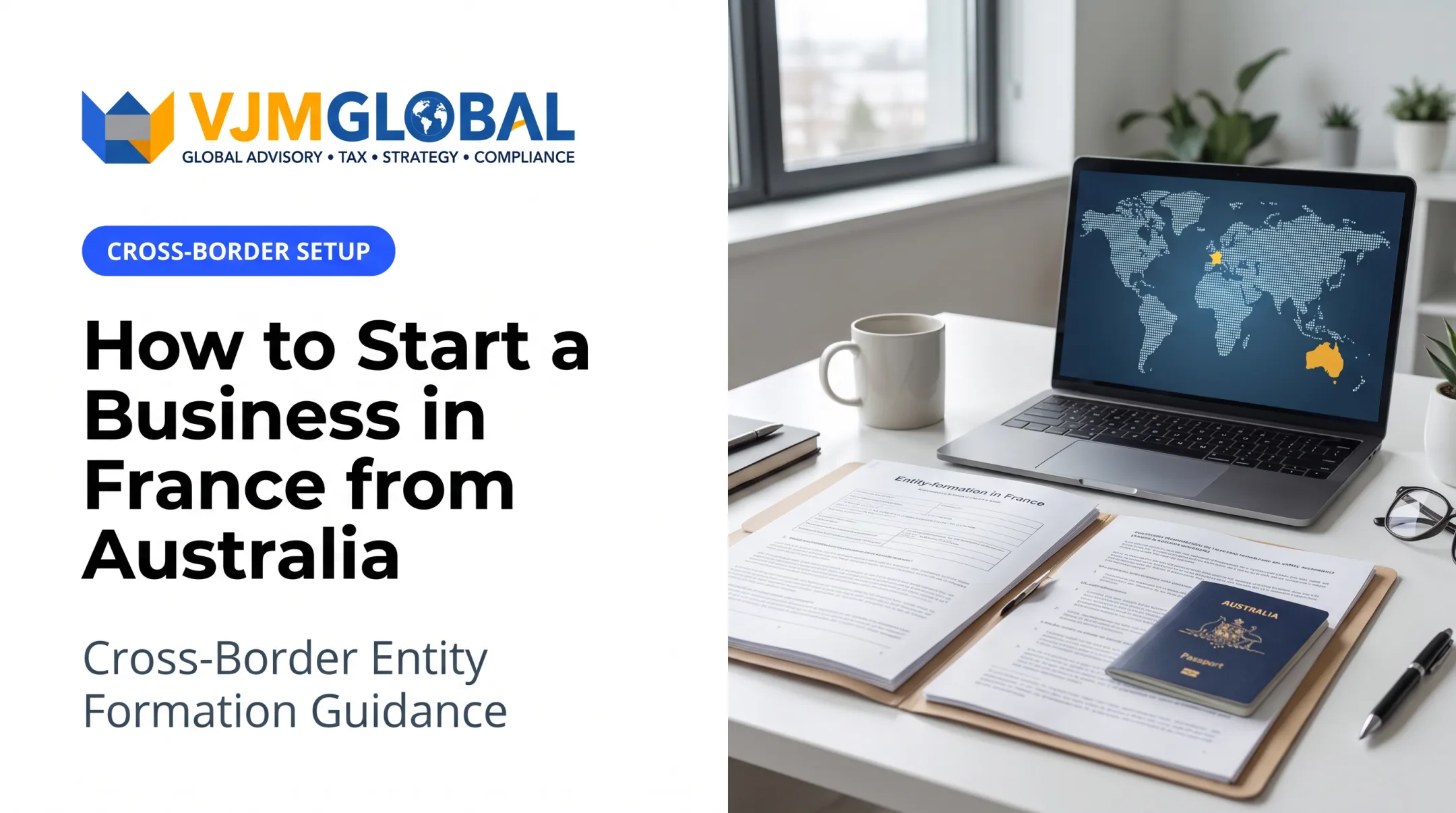
But here's the catch: Australia has no EU trade agreement. That means customs declarations, VAT registration, and French bureaucracy hit you from day one, not after you've settled in.
This guide walks through market research, legal structures, tax obligations, cultural nuances, and realistic entry strategies built specifically for Australian companies looking at France.
Key Takeaways
- Australia sits outside the EU/EEA, so France entry needs both EU-wide and France-specific compliance
- Entity choice (branch, subsidiary, liaison office, or EOR) sets liability, tax exposure, and time to market
- Secure VAT, EORI, and French payroll setup before you trade commercially
- Language and cultural localisation lift conversion and trust with French buyers
- An experienced market-entry partner shortens timelines and cuts compliance missteps
Understanding the French Market and Consumer Behaviour
Consumer Preferences Australian Businesses Need to Know
French shoppers remain price-conscious, and the shift looks structural. Kantar Worldpanel found household FMCG spending grew just 0.3% in 2024, with prices still sitting above 2022 levels. Value-hunting habits formed over two years of inflation have stuck, and private-label brands are outperforming national brands.
What this means for your pricing and messaging:
- Lead with value, not just brand story
- Highlight promotions and transparent pricing
- Expect longer consideration cycles for premium positioning
Delivery flexibility matters more than most Australian businesses expect. According to Fevad, 46% of French e-commerce deliveries go out-of-home, with relay and pickup points making up 45% of that share. If your logistics plan only supports home delivery, you're already behind local competitors.

Influencer-driven discovery continues to grow in France. Translated Australian campaigns rarely land the same way. French audiences respond to local voices, local platforms, and local cultural references, not repurposed content from home-market playbooks.
Business Culture and Etiquette
French business culture runs formal and relationship-driven. Don't expect deals to close over a single video call.
A few non-negotiables:
- French is legally required in contracts, labelling, product descriptions, invoices, receipts, and advertising under the Loi Toubon (Law No. 94-665, 4 August 1994), with limited exceptions
- English fluency among French counterparts does not waive the requirement
- Polished branding and formal written correspondence build credibility faster than the casual, first-name style many Australian businesses default to
Get your contracts and customer-facing materials properly translated. Beyond compliance, accurate French signals respect and builds trust with local partners and customers.
Choosing Your Market Entry Strategy
There's no single "right" way in. Your choice depends on how much control you want, how fast you need to move, and how much risk you can absorb.
Exporting or distance selling is the lowest-risk starting point. You test French demand without setting up any local presence, which is useful for validating whether your product or service actually resonates before committing capital.
Appointing a French distributor or agent gets you local market knowledge and existing retailer relationships fast. You trade some control for speed.
Branch vs. subsidiary is where most companies get stuck. Here's the breakdown:
| Factor | Branch (Succursale) | Subsidiary (Filiale) |
|---|---|---|
| Legal personality | None (extension of parent company) | Separate French legal entity |
| Liability | Parent company fully exposed | Limited to capital contributed |
| Admin burden | Lower initially | Higher (separate accounts, governance) |
| Long-term suitability | Testing phase, limited operations | Serious, long-term commitment |
Joint ventures suit sectors with heavy regulatory or relationship barriers, such as regulated industries where a French partner's licensing and networks are hard to replicate alone.
Employer of Record (EOR) lets you hire French staff without incorporating anything. This is often the practical middle ground: you get boots on the ground in France while you validate the market, without the cost and complexity of a full entity.
VJM Global's EOR coverage spans 100+ countries, so Australian businesses can employ French-based staff while they decide whether a permanent entity makes sense.
Comparing All Six Options
| Strategy | Control | Cost | Speed | Risk |
|---|---|---|---|---|
| Exporting | Low | Low | Fast | Low |
| Distributor/Agent | Medium | Low-Medium | Fast | Medium |
| Branch | Medium | Medium | Medium | High (unlimited liability) |
| Subsidiary | High | High | Slow | Low (limited liability) |
| Joint Venture | Medium | Medium-High | Medium | Medium |
| EOR | High (over staff) | Medium | Fast | Low |

Legal Structures and Business Registration in France
Australian businesses generally choose from four structures:
- SARL — requires at least two partners, capital paid over five years, liability limited to contributions
- SAS — most flexible structure; no statutory minimum capital, with 50% of cash contributions paid upfront and the rest within five years
- Branch office — no separate legal personality; parent company carries full liability
- Representative office — cannot trade commercially; typically used for market research and liaison rather than generating revenue
Registration Process
France runs everything through the Guichet unique, a fully digital portal that's been mandatory since 1 January 2023. Branch registrations also go through the Commercial Court Registry (Greffe du Tribunal de Commerce).
Documentation you'll need:
- Signed M0 form
- Certified French translations of your foreign-register extract (dated less than three months old)
- Proof of French business premises
- Manager identification documents
- Regulatory authorisation, if your activity is regulated
Timeline: INPI states the average SIREN assignment takes two weeks. Full registration timing depends on how ready your documentation is and which entity type you're forming.

Tax, VAT and Compliance Obligations
France's corporate tax rules for financial years starting on or after 1 January 2022 are straightforward to map early:
- Standard rate: 25%
- SME rate: 15% on a portion of profits for businesses with turnover up to €10 million
- Surcharge: 3.3% social contribution may apply when pre-tax sales exceed €7.63 million
VAT and Fiscal Representation
For Australian businesses, the French tax authority lists Australia among countries that do not need a French tax representative for VAT purposes.
You still need a French VAT registration when your transactions require a French VAT number, unless your French customer reverse-charges the VAT.
Customs and Product Compliance
- EORI number is mandatory for any customs clearance — imports, exports, or transit
- Import One-Stop-Shop (IOSS) covers B2C goods valued up to €150, excluding excise goods
- CE marking applies only where EU harmonised rules require it (for example toys, electronics, machinery, PPE, medical devices)
Payroll and URSSAF
Any Australian company employing staff physically in France must register those employees with French Social Security through URSSAF's Foreign Companies service:
- Create an online URSSAF account
- File an EO form to obtain a SIRET number
- Manage ongoing declarations and contributions

Map these tax, VAT, and payroll obligations before your first French sale. VJM Global's cross-border accounting and payroll work across 16+ markets helps surface the right compliance steps early, not after you are already trading.
Building Local Presence and Avoiding Common Pitfalls
Building a French presence starts with treating localisation as a legal requirement, not a branding choice. Language, pricing display, payment methods, and customer service must match local rules and buyer expectations before you scale.
A real-world warning sign: Marks & Spencer reviewed the future of its 20 French stores after post-Brexit customs arrangements caused border delays that disrupted deliveries. Even established retailers with deep pockets get caught out by customs friction when the paperwork isn't sorted properly.
The recurring mistakes we see:
- Underestimating customs complexity for regulated product categories
- Treating localisation as optional rather than compliance-driven
- Locking into a subsidiary or branch structure before testing demand
- Waiting until problems surface to bring in compliance expertise
None of these mistakes are exotic. Test demand, sort customs and consumer-compliance rules, and only then lock your entity structure.
Frequently Asked Questions
What are the foreign market entry strategies?
The core options for entering France are exporting/distance selling, distributor or agent partnerships, branch office, subsidiary, joint ventures, and Employer of Record arrangements. Each suits a different risk and control profile.
What is the 5 to 7 rule in France?
"Cinq à sept" is a French cultural expression referring to the hours between 5pm and 7pm, traditionally associated with an affair rather than any business or retail rule. It has no relevance to commercial operations in France.
Do Australian businesses need a French entity to sell in France?
No. Distance selling and exporting work without any French entity. You only need a local entity or an EOR arrangement once you're hiring staff or establishing a lasting physical presence.
What are the main legal structures for Australian companies entering France?
The main options are a branch office (parent remains fully liable), a SARL (limited liability, at least two partners), or an SAS (flexible capital structure). SAS is the most common choice for growth-focused entities.
Is it necessary to speak French to do business in France?
French is legally required in contracts and consumer-facing content under the Loi Toubon, regardless of English fluency among your French counterparts. Using French properly builds trust even where English works fine in meetings.
How long does it take to register a business entity in France?
INPI reports an average SIREN assignment time of two weeks. Full registration timing beyond that depends on your entity type and how complete your documentation is at filing.