Introduction
UK companies had $738.3 billion invested in the United States by the end of 2025, according to the US Bureau of Economic Analysis. That makes the UK one of the four largest foreign investors in the American economy.
Every one of those businesses faced the same early decision: set up a branch, or form a subsidiary?
That choice shapes personal and corporate liability, and how the IRS taxes your US profits. It also affects whether you can sponsor L-1 visas for UK staff relocating to the US, and what you will spend on compliance for years to come.
This guide breaks down both structures, compares them side by side, and walks through a decision framework so you can move forward with confidence.
TL;DR
- A branch is a US extension of your UK company with no separate legal identity, full parent liability, and quicker setup
- A subsidiary (typically a Delaware LLC or C-Corp) is a separate US entity with limited liability and more compliance
- Branches pay IRC 882 tax plus branch profits tax (5% under the US-UK treaty); subsidiaries are taxed as standalone US companies
- Choose based on risk tolerance, hiring plans, funding goals, and how permanent your US presence will be
- Not ready to commit? An Employer of Record lets you test the US market before incorporating anything
Branch vs Subsidiary in the USA: Quick Comparison
Here's how the two structures stack up across the factors that matter most to UK founders.
| Factor | Branch | Subsidiary |
|---|---|---|
| Setup time | Foreign qualification of your existing UK entity; timing varies by state | New entity created on filing; timing also varies by state |
| Legal liability | UK parent carries full, unlimited liability for US activity | Liability generally limited to the subsidiary's own assets |
| Taxation | Taxed under IRC 882 on effectively connected income, plus branch profits tax | Taxed as an independent US corporation or pass-through entity |
| Compliance | Foreign-entity annual filings in each registered state | Domestic annual report, franchise tax or LLC fee, Form 5472 where applicable |
| Visa sponsorship | Can qualify for L-1 if USCIS's ownership/control tests are met | Can also qualify for L-1; ownership and control tests apply either way |
Cost & Setup Time
Neither structure has a fixed nationwide price tag or timeline. Delaware, for example, offers expedited corporate filing from next-business-day service for $50–$100 to one-hour turnaround for $1,000. Standard processing depends on the state, filing volume, and season.
A branch avoids creating a new entity, but you'll still need to foreign-qualify in every state where you conduct business . That cost adds up if you operate across multiple states.
Legal Liability
This is the sharpest dividing line between the two options:
- Branch: The UK parent company is directly liable for everything the US branch does. A lawsuit against the branch is effectively a lawsuit against the parent.
- Subsidiary: Liability is generally contained within the subsidiary itself, protecting the UK parent's broader assets.
Taxation
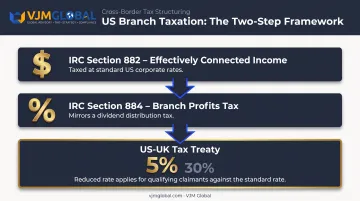
Branch profits face two layers of US federal tax:
- IRC Section 882 taxes effectively connected income at standard corporate rates
- IRC Section 884 adds a branch profits tax meant to mirror the tax on a dividend distribution from a US subsidiary
Subsidiaries skip the branch profits tax entirely. Instead, they're taxed as ordinary US corporations, with dividends to the UK parent taxed separately under different treaty provisions.
Compliance & Reporting
Filing duties differ by structure:
- Branch: Files Form 1120-F annually and may need Form 5472 for related-party transactions
- Subsidiary: Files a domestic corporate return and, if 25% or more foreign-owned, its own Form 5472
State fees vary. Delaware-qualified foreign corporations pay a flat $250 annual report fee by 30 June; Delaware LLCs pay a $400 flat tax with no annual report.
Visa/Immigration Implications for UK Staff
USCIS recognises both branches and subsidiaries as qualifying entities for L-1 intracompany transfer visas, provided ownership, control, and "doing business" tests are satisfied. Neither structure is automatically preferred. The underlying corporate relationship matters more than the label.
What is a US Branch?
A US branch is your existing UK company registered to operate in an American state. Lawyers call this foreign qualification: it is not a new company, just your UK entity obtaining a Certificate of Authority to do business locally.
Because there's no separate legal entity, the IRS treats your UK company as the taxpayer for any US-sourced income. That income falls under IRC Section 882, and the additional branch profits tax under Section 884 can apply on top.
For UK businesses, the US-UK tax treaty caps that branch profits tax at just 5% for qualifying claimants, well below the standard 30% statutory rate. You'll need to meet the treaty's limitation-on-benefits provisions to claim it, so it's worth getting treaty-position advice early.
Core benefits of a branch:
- Faster registration: often days to a few weeks per state
- Lower upfront cost than forming a new entity
- One unified global brand, with no need to explain a separate US company name to customers
- Simpler profit repatriation, since there's no dividend step between entities
One catch: foreign qualification is state-specific. Doing business in California, Texas, and New York means three separate registrations, three sets of annual filings, and three fee schedules to track.
Use Cases of a US Branch
Branches suit UK businesses that want a US foothold without full commitment:
- Short-term market testing before you commit to a permanent presence
- Project-based contracts with a US client that do not warrant a new entity
- Support functions for existing UK customers who have relocated or expanded to the US
Regulated industries use this structure heavily. Foreign banks, for instance, commonly operate through federal branches and agencies licensed and supervised directly by the Office of the Comptroller of the Currency, rather than incorporating a separate US banking subsidiary for every market entry.
Professional and financial services firms follow similar logic. They rely on existing brand trust rather than building a new legal identity from scratch.
What is a US Subsidiary?
A US subsidiary is a brand-new legal entity (typically a Delaware or Nevada LLC or C-Corp) incorporated under state law and wholly owned by your UK parent. Unlike a branch, it exists independently the moment its formation certificate is filed.
That independence brings real advantages:
- Limited liability, since the subsidiary's obligations don't automatically flow back to the UK parent
- Its own EIN, letting it sign contracts, hire staff, and own intellectual property in its own name
- US tax incentives, including R&D credits that often require domestic corporate status
- L-1 intracompany transfer visas for relocating UK employees, once ownership and control tests are met
- US investor access, since most investors prefer a domestic entity over a foreign branch
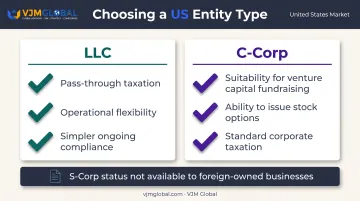
LLC vs C-Corp (and why S-Corp isn't an option)
An LLC offers pass-through taxation and operational flexibility, while a C-Corp is the standard vehicle for businesses planning to raise venture capital or issue stock options. What you can't do, as a foreign-owned business, is elect S-Corp status. The IRS restricts S-Corp shareholders to individuals who are US citizens or residents. A UK corporate parent simply doesn't qualify.
When a US subsidiary makes sense
A subsidiary makes sense when you're building something permanent:
- Long-term US operations with direct hiring on US payroll
- US-based sales contracts, especially with clients or government bodies that require a domestically incorporated counterparty
- Fundraising, where US venture capital firms generally invest in Delaware entities as standard practice
- E-commerce fulfilment, where owning US warehousing or logistics contracts benefits from local incorporation
Delaware remains the default for many international founders. The state recorded 2,287,728 active business entities in 2025 and hosts more than two-thirds of the Fortune 500 and nearly 70% of US IPOs, according to the Delaware Division of Corporations.
That figure is not foreign-ownership-specific, but it still explains the preference: predictable corporate law, a dedicated Chancery Court, and deep investor familiarity.
Branch vs Subsidiary: Which Is Better for UK Businesses?
There's no universal answer. The right structure depends on five factors:
- Liability tolerance: Can your UK parent absorb US legal exposure, or do you need a firewall?
- Tax treaty position: Does your business qualify for the reduced 5% branch profits tax rate?
- Growth timeline: Is this a pilot, or a permanent US operation?
- Hiring plans: Will you need to sponsor visas or run US payroll directly?
- Industry licensing: Do regulators or clients require a locally incorporated entity?
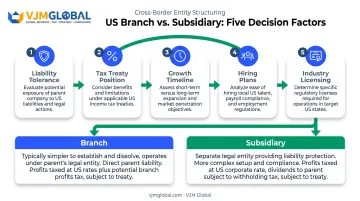
Choose a branch if you're entering the US on a short-term or project basis, exposure is limited, and you don't plan to hire directly in the country yet.
Choose a subsidiary if you're building a permanent US operation, hiring locally, raising capital, or working with clients and regulators who require a domestically incorporated counterparty.
State selection matters too. Delaware's popularity for subsidiaries reflects its established case law and investor familiarity, but Nevada, Wyoming, and other states can suit different priorities around privacy or franchise tax exposure. This is jurisdiction-specific. Get advice before filing.
Not ready to incorporate at all?
If you just want to test US demand or hire one or two people before committing to either structure, an Employer of Record (EOR) lets you do exactly that.
VJM Global's EOR service covers 100+ countries, including the US, acting as the legal employer on your behalf so you can hire compliantly without registering a branch or forming a subsidiary first. It's a practical bridge for UK businesses that want to move fast without locking into a structure prematurely.
Real-World Example: A UK Business Choosing Between a US Branch and Subsidiary
Picture a UK-based professional services firm that started serving American clients remotely, then landed a project requiring an on-the-ground US presence. Initially, foreign qualification as a branch made sense: it was quick to set up, low cost, and suited contract-based work.
Then two things changed. The firm won a larger contract requiring a locally incorporated vendor, and it wanted to relocate a senior UK manager on an L-1 visa to lead the US team.
At that point, the branch structure's downsides became obvious:
- Unlimited liability sat with the UK parent for every US contract
- Cross-border tax filings grew more complex as revenue increased
- Client procurement teams wanted a domestic entity, not a foreign-qualified one
Switching to a Delaware C-Corp subsidiary solved the liability and client-requirement problems in one move. It also created the separate US ownership and control structure often required when relocating key staff under an intracompany transfer.
That path—from testing the market with a branch to committing through a subsidiary once the US pipeline is solid—is a pattern VJM Global sees regularly among UK businesses scaling into America.
If you're weighing the same decision, VJM Global's cross-border formation and compliance team can walk through your liability exposure, tax treaty position, and entity options before you file anything.

The right structure depends on how much liability you will carry, how long you plan to operate in the US, and whether you need local hires or outside capital. Map those factors before you file so you choose once, rather than converting under pressure after a contract, tax, or liability issue appears.
Frequently Asked Questions
What is the difference between a branch and a subsidiary for UK businesses operating in the USA?
A branch is a US extension of your UK company with no separate legal identity, meaning the UK parent carries full liability and is taxed directly. A subsidiary is a separate US legal entity with its own liability shield and independent tax treatment.
Can a foreign subsidiary be a small company?
Yes. A US subsidiary's size is determined by its own revenue and employee count, independent of the UK parent's size. A small UK company can form a subsidiary that starts with just one or two employees.
Does a UK company need a US bank account, EIN, or ITIN to open a branch or subsidiary?
Both structures typically need an EIN for tax filing. An ITIN applies to individuals without an SSN, not to the company itself. Bank accounts are available for either structure, though subsidiaries often face fewer documentation hurdles.
Which US state is best for UK companies to incorporate a subsidiary?
Delaware is the most popular choice thanks to its established corporate law and investor familiarity, hosting over two-thirds of Fortune 500 companies. However, the best state depends on where you'll actually operate, hire, and pay taxes.
How long does it take to set up a branch vs a subsidiary in the US?
Both timelines vary by state, filing method, and processing volume. There's no fixed nationwide figure for either. Expedited services exist in states like Delaware, ranging from next-business-day to one-hour processing for an added fee.
Can a branch or subsidiary help UK employees get a US work visa?
Both structures can support L-1 intracompany transfer visa eligibility, provided USCIS's ownership and control tests are satisfied. Subsidiaries are more commonly used for this purpose since the ownership relationship is often easier to document.