Introduction
France remains the obvious next stop for UK businesses looking beyond home shores. It's the EU's second-largest economy, accounting for 16.4% of EU GDP, and sits as a direct gateway into the wider European single market (CEDEFOP).
But Brexit changed the rules. UK companies now face customs borders, EORI requirements, and a French bureaucracy that doesn't care how fluent your business plan sounds in English. Add in genuine cultural and language differences, and market entry looks a lot more complex than it did in 2019.
This guide walks through market research, legal structures, tax and compliance obligations, cultural nuances, and the entry strategies UK businesses can realistically choose between.
Key Takeaways
- France now requires dual compliance with EU-wide and France-specific rules since the UK sits outside the bloc
- Your legal entity choice (branch, subsidiary, liaison office) shapes liability, tax exposure and speed to market
- VAT registration, EORI numbers and French payroll setup are non-negotiable before you trade
- Language and cultural localisation directly affect conversion and trust with French buyers
- A local market-entry partner shortens timelines and avoids costly missteps
Understanding the French Market and Consumer Behaviour
Consumer Preferences UK Businesses Need to Know
French shoppers are increasingly budget-conscious. BCG's 2024 analysis found French consumers tightening spend while staying hopeful about the future. Price transparency and clear value messaging now weigh heavily in purchase decisions.
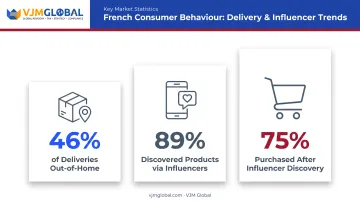
Delivery flexibility is another deciding factor. Fevad reported that out-of-home delivery made up 46% of all deliveries in France in 2024, with pickup points accounting for nearly half of those. If your logistics only offer home delivery, you're already behind local competitors.
Influencer marketing carries real weight. An Ipsos survey found that among French internet users who followed influencers, 89% discovered a product through them, and 75% went on to purchase. UK brands need a local influencer plan, not a translated UK campaign.
Quick snapshot:
- French buyers respond to local-language content over translated copy
- Mobile is a primary shopping channel—design checkout and support for smaller screens first
- Trust signals (reviews, local payment methods) matter more than flashy branding
Buyer habits shape demand. How you negotiate and show up is what gets you in the room.
Business Culture and Etiquette
French business culture leans formal and structured. Meetings matter, relationships take time to build, and the UK government's own market guide notes that regular in-person contact is important for relationship-building in France (UK Government export guide).
A few practical points:
- French language is legally required in contracts, product labelling and consumer-facing content
- English fluency among professionals doesn't remove the expectation of French-language materials
- Presentation matters. Polished branding and formal correspondence build credibility faster than casual, UK-style messaging
Choosing Your Market Entry Strategy: Options for UK Businesses
There isn't one "right" way into France. The best choice depends on how much control you want versus how fast you need to move.
Exporting or distance selling is the lowest-risk starting point. You sell into France without setting up any local presence, testing demand before committing capital. It works well for e-commerce brands but doesn't let you hire staff or build a physical footprint.
Appointing a French distributor or agent gives you local market knowledge without building it in-house. You trade some control for faster traction, since a good distributor already has retailer relationships and understands local pricing norms.
Branch office ("succursale") vs subsidiary ("filiale") is the next big decision:
| Factor | Branch (succursale) | Subsidiary (filiale) |
|---|---|---|
| Legal personality | None - extension of UK parent | Separate French legal entity |
| Liability | Parent company liable | Limited to subsidiary's assets |
| Administrative burden | Lower | Higher (full incorporation) |
| Long-term suitability | Better for testing/short-term | Better for permanent establishment |
Joint ventures or partnerships with French companies split risk and combine local knowledge with your product or capital. This suits sectors where regulatory or relationship barriers are high.
Employer of Record (EOR) suits teams that need French staff without incorporating a local entity. The EOR acts as the legal employer and handles contracts, payroll and statutory contributions. VJM Global's EOR coverage spans 100+ countries, so you can test the market with people on the ground before committing to a full entity.
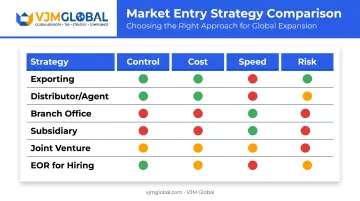
Comparing the options:
| Strategy | Control | Cost | Speed | Risk |
|---|---|---|---|---|
| Exporting/distance selling | Low | Low | Fast | Low |
| Distributor/agent | Medium | Low-Medium | Fast | Medium |
| Branch office | Medium-High | Medium | Medium | Medium |
| Subsidiary | High | High | Slower | Lower long-term |
| Joint venture | Shared | Shared | Medium | Shared |
| EOR for hiring | Medium | Low-Medium | Fast | Low |
Legal Structures and Business Registration in France
UK businesses generally choose between four structures:
- SARL - no minimum capital requirement, but at least 20% of cash capital must be paid at incorporation; suits smaller, closely held operations
- SAS - minimum capital of just €1, though 50% of cash capital must be paid upfront; popular for flexible governance
- Branch office - simpler to set up, but the UK parent remains fully liable
- Representative office - no separate legal personality; cannot invoice or contract, so useful only for market scouting
Registration Process
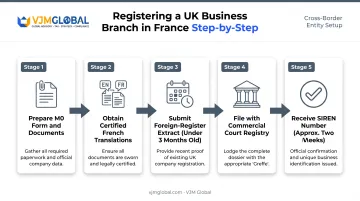
Registration runs through France's national business-formalities portal. Filings then reach the Commercial Court Registry (Greffe du Tribunal de Commerce).
For a foreign branch, the competent registry requires an M0 form, a foreign-register extract no older than three months, and certified French translations of supporting documents.
Post-Brexit specifics to plan for:
- A French business address is required for registration
- You may need a local representative for certain filings
- INPI notes that SIREN number assignment averages two weeks, though this isn't a guaranteed end-to-end incorporation deadline
Have certified translations and the foreign-register extract ready before you file—document gaps are what usually stretch timelines.
Tax, VAT and Compliance Obligations
France's standard corporate tax rate is 25% for all companies, regardless of turnover (French Ministry of Economy). That flat rate is simpler to plan around than the UK's tiered system.
VAT and customs essentials:
- UK businesses are not required to appoint a French fiscal representative for VAT; filings go through the Foreign Business Tax Service
- B2B sales to VAT-registered French customers often shift liability to the customer under reverse charge
- Imported B2C goods valued under €150 fall under the EU's Import One-Stop-Shop scheme
- A GB-prefixed EORI covers UK-side exports, but you'll likely need a separate EU EORI for customs transactions in France
Other compliance checkpoints:
- Product rules: many goods categories, including toys, drones and electrical equipment, need CE marking before sale in France
- Employing staff: any foreign company with people in France must register with URSSAF's Foreign Companies Service, which triggers French payroll tax and social security rules that do not mirror the UK
Dual-jurisdiction gaps are easy to miss once trading has started. VJM Global's cross-border accounting and payroll teams help UK businesses map which French obligations apply before the first sale, so VAT, filings and payroll are set up correctly from day one.

Building Local Presence: Marketing, Partnerships and Distribution
Localisation isn't optional in France. Since the French language is legally mandated in product descriptions and terms of service, translating your website is a compliance step as much as a marketing one.
Practical steps:
- Localise pricing, payment methods and customer service into French, not just the homepage copy
- Vet distributors and agents on their existing retailer network, not just their pitch
- Check joint venture partners' financial standing and past trading history before signing anything
- Invest in French-language SEO and social channels, where influencer content heavily shapes purchase decisions
Channel and distribution partners already active in France save you from building every customer and market-access relationship from scratch.
Common Pitfalls UK Businesses Should Avoid
Brexit-related friction has already burned some well-known brands. Marks & Spencer closed all 11 of its French franchise food stores in 2021 after post-Brexit trade rules disrupted fresh and chilled food supply chains (Reuters).
Around the same time, French seafood processors suspended UK orders over incomplete customs paperwork, disrupting just-in-time supply arrangements.
Recurring mistakes to avoid:
- Underestimating customs complexity, particularly for fresh, perishable or regulated goods
- Skipping localisation and assuming English-language marketing will convert French buyers
- Locking into a branch structure or subsidiary too early, then facing expensive restructuring once volumes grow
- Waiting until problems surface before bringing in tax, legal and compliance expertise
Engaging specialists early, rather than after a shipment gets stuck at customs, is cheaper than fixing problems later. VJM Global's 30+ years of multi-jurisdiction advisory experience helps flag structural and compliance risks during planning, before they become costly fixes.
Frequently Asked Questions
Do UK businesses need a French entity to sell in France?
No. Distance selling or exporting works without a French entity. You'll need a local entity or an EOR arrangement only if you're hiring staff or establishing a lasting physical presence.
What are the main legal structures for UK companies entering France?
The primary options are a branch office, an SARL, and an SAS. Branches suit shorter-term testing, SARLs work for smaller closely-held businesses, and SAS structures offer more governance flexibility.
How has Brexit changed market entry into France for UK businesses?
UK companies now need customs declarations and often a separate EU EORI number, since GB EORIs only cover the UK side of transactions. Automatic EU market access no longer applies.
Is it necessary to speak French to do business in France?
Many French professionals speak English, but French is legally required in contracts and consumer-facing content. Using French builds trust and is often simply non-negotiable for compliance.
How long does it take to register a business entity in France?
INPI reports that SIREN number assignment averages around two weeks, though full registration timelines vary based on entity type and how prepared your documentation is.
What ongoing compliance obligations apply after entering the French market?
Expect VAT filings, annual corporate tax returns, payroll and social security contributions if you employ staff, and statutory annual accounts. The exact mix depends on your chosen entity structure.