Introduction
India and the UAE closed FY2024-25 with merchandise trade worth $100.05 billion, making the UAE India's third-largest trading partner and second-largest export destination (Consulate General of India, Dubai). The India-UAE Comprehensive Economic Partnership Agreement (CEPA) has lowered barriers further by cutting tariffs and opening new sectors to Indian exporters and investors.
But strong trade numbers don't guarantee a smooth entry. Many Indian businesses struggle with:
- A maze of licensing options
- Unclear rules on local sponsorship
- Tax structuring across two jurisdictions
- A business culture that rewards relationships over quick deals
Without a plan, these gaps delay launches, inflate costs, and can derail expansion altogether.
This guide covers why the UAE remains attractive for Indian companies, the entry routes available, the legal and tax compliance you need in both countries, common pitfalls, and how to build a workable roadmap for entry.
Key Takeaways
- CEPA and free-zone tax exemptions give Indian firms fast, low-friction access to the UAE
- Pick mainland, free zone, branch, distributor, or JV based on ownership and control goals
- Most mainland sectors allow 100% foreign ownership—no mandatory local sponsor
- Plan UAE tax (9% CIT, 5% VAT) with India’s FEMA/ODI rules to avoid double taxation
- Dual India–UAE regulatory support shortens setup time and lowers compliance risk
Why UAE Is a Strategic Market for Indian Businesses
The UAE has long been one of India's most important commercial partners. India ranks among the UAE's top trading partners, and the UAE is India's second-largest trading partner overall, according to the UAE Ministry of Foreign Affairs.
That relationship deepened once CEPA took effect on 1 May 2022, giving Indian exporters preferential access that most competitors don't have.
Growth Drivers and Strategic Advantages
The UAE's appeal for Indian businesses rests on a few concrete advantages:
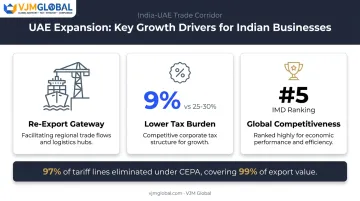
- Re-export gateway: Dubai and Abu Dhabi ports connect Indian goods to markets across Africa, Europe, and the wider GCC, often faster than shipping directly to those regions
- Lower tax burden: A 9% corporate tax rate (0% below AED 375,000 in taxable income) and no personal income tax compare favorably to India's 25-30% corporate bands
- Global competitiveness: The UAE ranked 5th overall and 1st for economic performance in the IMD World Competitiveness Ranking 2026, holding the regional top spot for a tenth straight year
CEPA strengthens the case further. 97% of tariff lines, covering 99% of India's export value to the UAE, are being eliminated, with 90% of that export value already duty-free from day one (Indian Trade Portal).
Sectors and Products in High Demand
Certain sectors see outsized demand from Indian suppliers:
- Petroleum products, gems and jewelry, and telecom equipment dominate export value, together making up close to 40% of India's exports to the UAE
- F&B and agricultural products benefit from CEPA's duty-free access
- IT services, healthcare (pharma and medical devices), construction materials, and renewable energy fall within CEPA's cooperation and duty categories
India's diaspora adds another structural advantage. As of January 2026, more than 4.34 million Indians live in the UAE (Ministry of External Affairs), forming both a ready customer base and a deep talent pool for hiring.
UAE Market Entry Strategies for Indian Companies
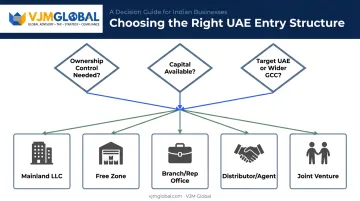
Which route works best comes down to three questions:
- How much ownership control do you want?
- How much capital can you commit?
- Are you targeting the UAE alone or the wider GCC?
Mainland Company Setup
Since Federal Decree-Law No. 32 of 2021 reformed the Commercial Companies Law, most mainland activities allow 100% foreign ownership under a Department of Economic Development (DED) licence, with no local Emirati partner required. A short list of "strategic impact" activities (defence, banking, telecoms, and Hajj/Umrah services among them) still requires special approval or local participation.
Mainland suits businesses that want:
- Direct access to UAE retail customers
- Eligibility for government contracts
- Freedom to operate anywhere in the country without a distributor
Free Zone Company Setup
Free zones remain the fastest on-ramp for Indian traders. Zones like DMCC, JAFZA, and DAFZA all offer 100% foreign ownership, full profit repatriation, and customs duty exemptions within the zone.
The catch: a free zone company generally can't sell directly into the UAE mainland. You'll need a licensed mainland distributor, a mainland branch, or a dual-licence arrangement. Several zones, including DMCC and DAFZA, now offer this through Department of Economy and Tourism (DET) partnerships.
Branch Office, Representative Office, and Distributor Models
For companies not ready to commit to full incorporation:
- Branch or representative offices let you test the market, liaise with customers, and promote your brand without a separate legal entity
- Distributor or local agent models reach the market fastest, provided you verify the agent's compliance history, market reach, and financial standing before signing
Joint Ventures with UAE-Based Partners
A joint venture pairs Indian capital and expertise with a UAE partner's local market knowledge. This works especially well in construction, F&B, and retail, where relationships and local demand patterns matter as much as product quality. JVs share risk, but they also demand careful partner vetting and a tightly drafted agreement to avoid disputes later.
Comparing Your Options
| Entry Route | Ownership | Relative Cost | Best For |
|---|---|---|---|
| Mainland LLC | Up to 100% (most sectors) | Moderate to high | UAE domestic sales, government contracts |
| Free Zone | 100% | Low to moderate | International trade, re-export, holding companies |
| Branch/Rep Office | Parent-owned | Low | Market testing, liaison activities |
| Distributor/Agent | Contractual | Low | Fast market entry, no incorporation |
| Joint Venture | Negotiated | Variable | Sectors needing local relationships |
Legal, Regulatory and Tax Compliance for Indian Businesses in the UAE
Trade Licence Requirements
Every UAE entity needs a trade licence—commercial, industrial, or professional—issued by the DED (mainland) or the relevant free zone authority. The category must match your actual activity; mismatches delay renewals and bank-account opening.
Tax Obligations on Both Sides
- UAE corporate tax: 9% on taxable income above AED 375,000; 0% below that threshold
- Free zone qualifying income: 0% if substance and arm's-length rules are met; non-qualifying income above AED 5 million or 5% of revenue (whichever is lower) forfeits the benefit
- VAT: 5% on most goods and services; registration mandatory above AED 375,000 in taxable supplies
- India-side comparison: Indian corporate tax runs 25–30% (22% under optional Section 115BAA), plus surcharge and cess—versus the UAE’s flat 9%
FEMA, RBI, and the ODI Route
Indian companies investing in or setting up a UAE entity fall under the Foreign Exchange Management (Overseas Investment) Rules, 2022. In practice, that means:
- Routing all Overseas Direct Investment (ODI) transactions through one designated Authorised Dealer (AD) bank
- Filing Form FC before the initial investment to obtain a Unique Identification Number (UIN)
- Providing proof of investment within six months, or repatriating the funds
Avoiding Double Taxation
The India-UAE Double Taxation Avoidance Agreement caps source-country tax as follows:
- Dividends: 10%
- Interest: 5–12.5%
- Royalties: 10%
India also grants a credit for UAE tax already paid, capped at the Indian tax otherwise due on that income. Structure repatriation within this framework so profits are not taxed twice.
Hiring: WPS and Emiratisation
If you're hiring locally:
- All wages must move through the Wages Protection System (WPS); missed deadlines trigger escalating penalties, including possible work-permit suspension
- Companies with 50+ employees must raise Emirati representation in skilled roles by 2% annually
- Firms with 20–49 employees in 14 designated sectors face separate Emiratisation quotas and financial penalties for non-compliance
Common Challenges Indian Businesses Face in UAE Market Entry
Even with the right license and tax plan, execution trips people up. Three problems come up again and again.
Relationship-First Business Culture
UAE business runs on trust built over time, not just signed contracts. Indian companies used to fast, transactional deal-making sometimes push too hard, too early, and lose credibility before the relationship has a chance to form. Face-to-face meetings and patience before discussing terms tend to pay off.
Picking the Wrong Partner or Agent
A distributor or agent with weak market reach, or a questionable compliance history, can damage your brand for years. Before signing anything:
- Verify licensing and trading history with the relevant authority
- Check financial stability and existing client relationships
- Confirm they're not simultaneously representing a direct competitor
Banking and Repatriation Hurdles
Foreign-owned entities often find UAE corporate bank account opening slower than expected. Banks scrutinize beneficial ownership, business activity, and source of funds closely.
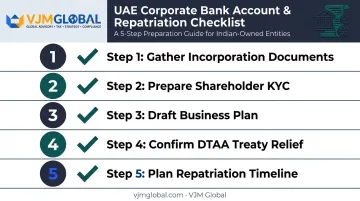
Build extra time into your launch plan, and have incorporation documents, shareholder KYC, and a business plan ready before you approach a bank. Plan profit repatriation early as well—confirm treaty relief and any withholding rules before moving funds out.
How VJM Global Supports Indian Businesses Entering the UAE
Getting from strategy to execution means navigating UAE licensing and tax rules alongside India's FEMA and RBI requirements. That dual-market complexity is where most delays creep in.
Entity Structuring and Licensing Support
VJM Global helps Indian businesses weigh mainland against free zone structures based on target market, capital, and ownership goals. The firm then manages the license application itself, whether a DED trade license or a free zone authority registration.
Compliance, Tax and Accounting Support
Once the entity is live, VJM Global handles ongoing obligations using the UAE's own regulators and statutory instruments rather than a generic template:
- Corporate tax registration and filing
- VAT returns
- Payroll administration through the Wages Protection System
Cross-Border Advisory Between India and UAE
Because VJM Global operates in both markets, it coordinates India-side FEMA and RBI filings alongside UAE incorporation. ODI reporting and repatriation compliance move with the UAE workstream, so neither side waits on the other.
Planning a UAE entry and want a structured roadmap instead of guesswork? Book a strategy call with VJM Global to map out licensing, tax, and cross-border compliance before you commit capital.
Frequently Asked Questions
What are the best market entry strategies for Indian companies?
Mainland, free zone, branch office, distributor, and joint venture each fit different goals. Mainland suits direct UAE sales, free zones suit trade and re-export, branches support limited local presence, distributors reduce setup cost, and JVs help where local relationships matter most.
What is the UAE's trade strategy?
The UAE runs an open-market economy built around a global re-export hub and an extensive free zone network. Its location between Asia, Africa, and Europe, combined with low tariffs, makes it a natural trade and logistics center.
Which products do Indian companies export most to the UAE?
Petroleum products lead India's exports to the UAE at roughly 17% of export value, followed closely by gold and precious-metal jewelry, and telecom equipment.
Do Indian companies need a local sponsor to set up in the UAE mainland?
No, not for most activities. Post-2021 reforms allow 100% foreign ownership in the majority of mainland sectors; only a short list of strategic activities, like defense and banking, still require special approval or local participation.
How long does it take to register a company in the UAE from India?
Free zone setups typically take 10–14 working days once documents are complete (DMCC around 10 days; JAFZA 3–14 days). Mainland licenses can issue quickly once approvals are in place, but securing approvals and premises usually adds several weeks.
Is a UAE free zone or mainland company better for Indian businesses?
If your goal is international trade, re-export, or holding structures, a free zone is usually simpler and cheaper. If you need direct UAE mainland sales or government contracts, a mainland license fits better.