But demand doesn't equal access. Many UAE businesses assume entering China means shipping a container and signing a distributor agreement. In practice, it means choosing a legal structure, understanding tax exposure, and navigating labour rules that look nothing like the UAE's zero-corporate-tax environment.
This article walks through the four core entry strategies, the compliance landmines, and a practical roadmap for getting it right the first time.
Key Takeaways
- Enter China via exporting, licensing, a WFOE, or a joint venture—weighing control against capital for each route
- China's 2024 Negative List reforms opened manufacturing access, but sector-specific permits still apply
- Map labour, tax, and IP rules early; Chinese requirements diverge sharply from UAE norms
- Filing trademarks before any distributor conversation protects you under China's first-to-file system
Why UAE Businesses Are Looking at China
China's 2024 national Negative List dropped to 29 entries, removing the last manufacturing-sector restrictions on foreign investment, per a Shanghai government summary. That's a meaningful shift for UAE manufacturers and traders who previously faced ownership caps.
Add growing bilateral trade momentum, and logistics, renewable energy, technology, and manufacturing firms have clear reasons to move.
The "China +1" Angle
"China +1" gets misread often. Most firms keep their China base and add a second manufacturing location beside it. Reuters reported that companies are building capacity outside China without abandoning Chinese suppliers or market presence.
For a UAE business, this separates two decisions:
- Should we sell in China? A demand and regulatory question
- Should we diversify sourcing? A supply-chain resilience question
Keep these separate. Bundling them leads to muddled strategy.
What Is a Market Entry Strategy (and Why It Matters for China)
A market entry strategy is a structured plan covering distribution channels, legal structure, market research, and compliance before you commit capital abroad.
For UAE businesses entering China, that plan must account for:
- Regional demand differences (Shanghai buying power doesn't mirror Chengdu)
- Industry-specific restrictions that survive the Negative List
- Regulatory approval pathways that vary by sector and city
Skip this step and you're guessing. Do it properly and you can match your model to one of the four entry routes below.
The Four Core China Market Entry Strategies for UAE Businesses
Exporting Directly or Indirectly
Direct exporting means your UAE company contracts straight with a Chinese buyer or importer. Indirect exporting routes through an agent, distributor, or trading company that owns the channel relationship.
Indirect exporting is faster to set up but carries a real risk: your distributor owns the customer data, not you. If the relationship ends, you often start from zero. Contracts should lock down IP ownership and customer information rights before signing.
Licensing, Franchising and Partnerships
Licensing your brand or IP lets a Chinese partner operate under your name without you setting up an entity. Two details matter here:
- A registered trademark licence should be recorded with CNIPA. Without recordal, it can't be enforced against a bona fide third party
- China's franchise rules apply a "two stores, one year" operating-history test plus MOFCOM filing before you can franchise
Certain "restricted" or "prohibited" industries limit these structures further, so check your sector against the Negative List first.
Establishing a Local Entity (WFOE)
A Wholly Foreign-Owned Enterprise gives you full operational control: your staff, your IP, your brand decisions. It suits UAE businesses with long-term ambitions who need direct market access rather than a partner intermediary.
The trade-off is commitment. Under China's revised Company Law, shareholders of a new LLC generally must pay subscribed capital in full within five years, per IBA's analysis. Set that figure from a real operating budget, not a nominal headline number.
Joint Ventures and Acquisitions
A JV or acquisition buys you local relationships, distribution networks, or regulated-sector access you couldn't get alone. Saudi Aramco's $3.6 billion acquisition of a 10% stake in Rongsheng Petrochemical is a useful (if Saudi, not UAE) illustration of how Gulf industrial players use equity stakes to secure feedstock and channel alignment in China, per Reuters.
The risk sits in governance: veto rights, deadlock clauses, and IP leakage through a partner who now has visibility into your operations.
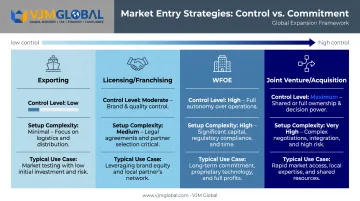
Quick comparison:
| Strategy | Control Level | Setup Complexity | Typical Use Case |
|---|---|---|---|
| Exporting | Low | Low | Demand testing, minimal investment |
| Licensing/Franchise | Medium | Medium | Brand scaling through partners |
| WFOE | High | High | Long-term direct market access |
| JV/Acquisition | Shared | High | Regulated sectors, asset access |
Legal, Tax and Compliance Considerations for UAE Businesses Entering China
China consolidated business registration into a 5-in-1 licence under State Council Notice Guobanfa No. 53.
The single code combines the business licence, organisation code, tax registration, social-insurance registration, and statistics registration. That simplifies identifiers. It does not replace sector permits.
Sector-specific permits still apply for:
- Telecom (a value-added telecom licence from MIIT; pilot approvals extended to select cities like Beijing and Shanghai)
- Finance (NFRA approval for banking activities, CSRC for securities)
- Food and beverage (SAMR licensing plus GACC registration for imported goods)
Labour Law Differences UAE Businesses Must Plan For
China's employment rules differ substantially from the UAE's:
- Written contracts are mandatory, not optional
- Social insurance contributions are a legal employer obligation, not a benefit
- No at-will termination; statutory grounds and notice periods apply
- Unlawful dismissal creates compensation liability
Budget for this before your first hire, not after a dispute.
Tax and Cross-Border Compliance
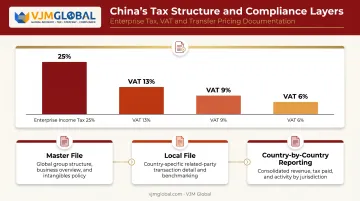
China's standard enterprise income tax rate is 25%, with VAT bands at 13%, 9%, and 6% depending on activity, per MOFCOM's tax portal. That's a different world from the UAE's low-tax structure.
Transfer pricing adds another layer. China introduced a three-tier documentation framework (Master File, Local File, Country-by-Country Reporting) under STA Announcement 42. UAE-China royalty, service, and goods transactions all need arm's-length support, not just treaty reliance.
Cross-border tax and labour rules at this level need jurisdiction-specific handling. VJM Global supports entity formation, tax compliance, and payroll by applying each target market's own regulators and statutory instruments.
For a UAE business assessing China exposure, that means treating Chinese tax and labour rules on their own terms, not as a variation of UAE practice.
A Practical Roadmap: Steps to Enter the Chinese Market from UAE
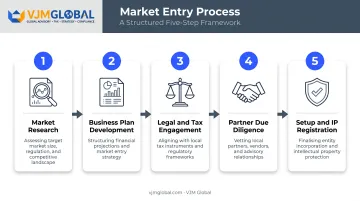
Conduct market research on regional demand. Shanghai's per-capita disposable income reached RMB 88,366 in 2024, per Shanghai's government release. The Chengdu-Chongqing corridor offers a catchment above 96 million people at a lower cost base. Treat Tier 1 and Tier 2 cities as separate markets.
Develop a business plan with financial projections, target city, and your chosen entry mode from the four options above.
Engage legal and tax experts for entity registration, licensing, and regulatory compliance before you sign anything locally.
Vet local partners through proper due diligence, whether a distributor, franchisee, or JV counterpart.
Set up operational infrastructure and register IP early. China uses a first-to-file trademark system: whoever files first generally wins, even if another party used the mark first elsewhere.
Common Challenges UAE Businesses Face in China Market Entry
China isn't one market. Consumer behaviour, regulatory enforcement, and even permit processing speed vary by province. A strategy built for Shanghai often needs rework for Chengdu.
Rules shift without much warning. A 2026 European Chamber survey found 32% of respondents had been affected by Chinese export control changes, per Reuters. Ongoing compliance monitoring is operational protection, not optional overhead.
IP infringement is an operational reality. Chinese authorities handled 40,400 trademark-violation cases in 2024, according to Lexology's enforcement summary. File your trademarks, including Chinese-language versions, before any distributor or franchise conversation starts.
Frequently Asked Questions
What are the main market entry strategies for a UAE company entering China?
The four core routes are exporting (direct or indirect), licensing/franchising, establishing a WFOE, and joint ventures or acquisitions. Each trades off control against capital commitment and setup complexity.
What does 'market entry strategy' mean?
It's a structured plan covering how you'll distribute your product, which legal structure you'll use, and what market research and compliance steps precede your investment in a new country.
What is China's '+1' strategy?
It refers to adding manufacturing capacity outside China while retaining your existing China presence, not abandoning it. For UAE businesses, it's a supply-chain diversification decision, separate from whether you sell in China.
How long does it take to set up a company in China from the UAE?
There's no fixed national timeline. In Shanghai, eligible applications may finish within one working day, but bank account activation, tax registration, and sector permits usually extend the timeline significantly.
Do UAE businesses need a local Chinese partner to enter the market?
Not always. It depends on your chosen entry mode and industry. Exporting and WFOEs typically don't require one, while certain regulated sectors still mandate local partnership.
Can VJM Global help UAE businesses register and stay compliant in China?
VJM Global provides entity formation, tax compliance, and payroll support across its global service markets, applying each jurisdiction's own regulatory framework. UAE businesses assessing China entry can use that cross-border advisory for structure, compliance sequencing, and ongoing filings.