But familiarity breeds a specific mistake. Many Singapore businesses assume regional proximity means an easy entry. They underestimate Vietnam's regulatory layers, provincial variation, and relationship-driven negotiating style, only to hit delays six months into a project they thought would take six weeks.
This guide covers why Vietnam matters for Singapore businesses, what the market actually looks like on the ground, how to structure your entry legally, the mistakes to avoid, and where expert support speeds things up.
Key Takeaways
- Singapore is Vietnam’s largest foreign investor, giving firms a credibility edge and infrastructure to build on
- ATIGA and CPTPP eliminate or sharply cut tariffs on most goods traded between the two countries
- Vietnam’s three regional economies each have different industry strengths and cost profiles
- Relationship-building still takes time, even for culturally close markets like Singapore
- Use a Representative Office or EOR to test the market before forming a full entity
Why Vietnam Is a Strategic Market for Singapore Businesses
Singapore's position as Vietnam's top FDI source isn't a recent blip. A 2022 joint statement between the two governments already described Singapore as Vietnam's largest ASEAN investor, with more than US$66 billion in cumulative registered capital. The 2024 figure, up 31.4% on 2023, confirms the momentum is still building.
Cultural distance is smaller than most entrants expect. Hofstede's cultural dimensions data puts Singapore at 74 and Vietnam at 70 on power distance, with both scoring 20 on individualism. In plain terms: both societies are collectivist, hierarchy-aware, and consensus-driven.
A Singapore executive walking into a Hanoi boardroom faces a shorter learning curve than a counterpart from London or Chicago.
Trade terms reinforce the advantage. Under ATIGA, tariffs on nearly all product lines traded within ASEAN have already been eliminated, provided goods meet origin rules such as 40% ASEAN regional value content. CPTPP adds further cuts:
- Electric-motor saws (HS 8467.22.00): dropped from 10% to 0% at entry into force
- Digital relays (HS 8536.41.10): dropped from 3% to 0%
- Ampicillin salts (HS 2941.10.20): dropped from 5% to 0%
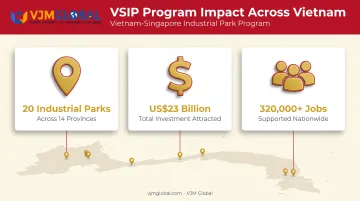
The Vietnam-Singapore Industrial Parks (VSIP) programme is physical proof this relationship works. According to figures cited at the Singapore Prime Minister's Office, VSIP now includes:
- 20 parks across 14 provinces
- More than US$23 billion in investment attracted
- Over 320,000 jobs supported
Scale strengthens the case further. Vietnam's economy grew 8.0% in 2025, according to the World Bank, against a population of roughly 102.3 million, of which nearly 68% are working age.
For Singapore firms already running a regional headquarters at home, a Vietnam entity opens a gateway into the wider Mekong and ASEAN consumer base.
Understanding Vietnam's Market Landscape Before You Enter
Vietnam isn't one market. It's three, and treating it as a single economic zone is one of the fastest ways to misallocate resources.
Vietnam's Three Regional Economies
| Region | Key cities | Strength |
|---|---|---|
| North | Hanoi, Hai Phong, Bac Ninh | Electronics and precision manufacturing; near China supply chains |
| South | Ho Chi Minh City, Dong Nai | Largest consumer base, mature commercial ecosystem, startup hub |
| Central | Da Nang | Cost-competitive, lower congestion, strong for early movers |
Northern Vietnam suits hardware and electronics manufacturers—Bac Ninh alone drew US$5.12B in 2024 FDI. The south fits consumer-facing businesses and services. Da Nang works for companies testing a lower-cost foothold before scaling.
Region choice is only half the entry decision. How you build local relationships determines whether deals move at all.
Business Culture & Etiquette Singapore Investors Should Know
Vietnam runs on relationships first, contracts second. Deals rarely close in one or two meetings; expect several rounds of discussion before anything is signed. That's slower than most Singapore businesses are used to.
Practical norms that affect deal pace:
- Decisions are consensus-based, especially in state-linked firms. The person leading the meeting may not hold final approval authority.
- Skip the cold call. Warm introductions through mutual contacts carry far more weight.
- Hierarchy matters. Business cards are exchanged with both hands, and the eldest person present is greeted first.
- Plan around Tet. Business activity slows to a near standstill during the Lunar New Year week, and travel during that period rarely produces results.
Small, inexpensive gifts at the close of a meeting are common and appreciated. Singapore firms will recognize much of this etiquette, but the relationship cycle still runs longer than a typical domestic deal.
Market Entry Strategies & Legal Structures for Foreign Investors
Getting the structure right the first time saves months of rework later.
Comparing the Core Entry Models
| Structure | Best for | Limitation |
|---|---|---|
| Distributor arrangement | Testing demand with minimal investment | Limited brand control |
| Representative Office (RO) | Market research, supplier oversight | Cannot invoice or sign local commercial contracts |
| Wholly Foreign-Owned Enterprise (WFOE) | Long-term investors wanting full control | Higher upfront setup and compliance cost |
| Joint Venture | Regulated sectors (logistics, telecom, education, distribution) | Shared governance, slower decisions |
Distributor arrangements let Singapore firms test demand without incorporating, at the cost of brand and pricing control.
A Representative Office requires the parent company to have operated for at least one year, with at least one year remaining on its own registration. It's licensed for up to five years but can't generate revenue directly, which makes it a research tool, not an operating entity.
A Wholly Foreign-Owned Enterprise gives full ownership and is now the default choice for serious investors in most open sectors, including trading, manufacturing, and IT. Joint ventures remain necessary only where sector rules require a local partner, such as certain telecom services capped at 49-65% foreign ownership depending on classification.
Licensing, Registration & Tax Essentials
Vietnam's investment framework changed in 2026. Under Law 143/2025/QH15, effective 1 March 2026, foreign investors can now establish an economic entity before completing Investment Certificate procedures in many cases, subject to market-access conditions. The old assumption of "IRC first, ERC second" no longer applies universally. Confirm current sequencing for your sector before filing.
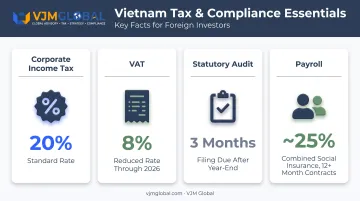
Key tax and compliance figures to plan around:
- Corporate Income Tax: standard rate of 20%, with reduced rates of 15% and 17% for smaller revenue bands
- VAT: temporarily reduced from 10% to 8% for eligible goods and services through 31 December 2026
- Statutory audit: required annually for foreign-owned entities, generally due by the end of the third month after year-end
- Payroll: foreign employees on contracts of 12 months or more are generally covered by social insurance at combined contribution rates around 25%
None of these are one-time tasks. Quarterly CIT payments, monthly or quarterly VAT filings, and annual audits continue for as long as the entity operates, so budget for ongoing compliance capacity, not just the initial setup.
Common Vietnam Market Entry Mistakes Singapore Businesses Should Avoid
Cultural proximity creates a false sense of ease. Here's where that overconfidence tends to bite:
- Skipping relationship-building because Vietnam "feels" familiar. Regional closeness doesn't shorten the trust-building timeline. Deals still take several meetings, sometimes several trips.
- Choosing the wrong structure for the stage you're at. Setting up a wholly foreign-owned enterprise (WFOE) before validating demand ties up capital; staying with a distributor too long caps brand control and growth.
- Assuming regulation is uniform nationwide. Provincial rules and sector-specific restrictions in logistics, education, telecom, and distribution can shift your timeline depending on where you land.
EuroCham's Q1 2025 survey found 68% of businesses cited administrative burdens as a market obstacle, and 40% flagged inconsistent enforcement. A follow-up survey found similar friction into 2026, with around a third of respondents saying regulatory delays slowed project delivery. Treating Vietnam as regulatorily uniform is a planning error, not bad luck.
How VJM Global Supports Singapore Businesses Expanding into Vietnam
Expanding into Vietnam isn't only a Vietnam-side challenge. You also need Singapore-side coordination—keeping your home entity's tax position, reporting, and compliance aligned while the new operation gets off the ground.
VJM Global works with Singapore businesses on that dual-jurisdiction coordination. A team of Chartered Accountants, CPAs, and multi-jurisdiction compliance professionals delivers entity formation, tax, accounting, and compliance across 100+ countries, with clear attention to how a Singapore structure interacts with obligations in the new market.
Support typically covers:
- Entity formation and registration in the target market
- Tax structuring and ongoing filing for both jurisdictions
- Accounting, payroll, and corporate governance
- Employer of Record (EOR) hiring without local incorporation
If you are not ready for full incorporation in Vietnam, VJM Global's Employer of Record (EOR) service is a practical middle step. You can hire on the ground and test the market before you commit capital to a local entity:
- Place staff in Vietnam without incorporating first
- Validate customer response, sales traction, and operational fit
- Pay per employee, per month—scaled to pilot size, not fixed entity-maintenance costs

Once the market case is validated, the same team supports the move to a fully established presence—accounting, tax structuring, and payroll included—so the handoff from pilot to permanent setup stays under one roof.
Frequently Asked Questions
Why is Vietnam attractive for Singapore businesses specifically?
Singapore is Vietnam's largest foreign investor. Cultural proximity and shared ASEAN ties shorten the learning curve most Western firms face when building local relationships and operations.
What is the fastest way for a Singapore company to enter the Vietnamese market?
A distributor arrangement or Representative Office both offer faster, lower-commitment entry than a full Wholly Foreign-Owned Enterprise (WFOE). They're suited to testing demand before you invest in a permanent structure.
Do Singapore businesses get any trade advantages when entering Vietnam?
Yes. Shared ASEAN membership under ATIGA and CPTPP eliminates or sharply reduces tariffs on most product categories, provided goods meet the applicable origin rules.
What is the difference between a Representative Office and a WFOE in Vietnam?
A Representative Office can only conduct research, liaison, and promotion, and cannot invoice or sign commercial contracts. A WFOE offers full foreign ownership and complete commercial operating rights.
How long does it take to set up a company in Vietnam?
Simple setups often take roughly 1–3 months, but timelines vary by sector, province, and whether an Investment Registration Certificate is required. Confirm current sequencing for your specific case before you lock plans or budgets.
What are the biggest risks Singapore businesses face when entering Vietnam?
The main risks are underestimating relationship-building time, choosing a mismatched entry structure, and assuming regulation is consistent nationwide when provincial and sector rules vary substantially.