Introduction
For Singapore businesses looking beyond Asia, the UAE has become the default launchpad into the Middle East, Africa, and South Asia. Bilateral trade between the two countries reached SGD 27.9 billion in 2025 — a figure that reflects how deeply the two economies are now connected.
Yet many Singapore companies arrive underprepared. The UAE's investor-friendly reputation can obscure the real complexity underneath: choosing the wrong license category, missing VAT registration deadlines, or underestimating banking timelines can each trigger costly delays or force expensive restructuring later.
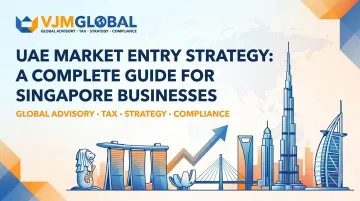
This guide walks through the UAE market opportunity, your three main structure options, legal and tax obligations, a step-by-step entry roadmap, and the pitfalls most commonly tripping up Singapore entrants.
Key Takeaways
- The Singapore-UAE Comprehensive Partnership gives Singapore businesses preferential conditions for UAE market entry
- Three main entry routes are available: a Mainland LLC (full market access), a Free Zone company (100% foreign ownership, tax advantages), or a Representative Office for market testing
- UAE corporate tax stands at 9% on profits above AED 375,000; VAT registration at 5% is mandatory above the same revenue threshold
- Company registration typically takes 2–8 weeks; banking setup adds 1–3 months due to stringent KYC requirements
Why the UAE is a Strategic Market for Singapore Businesses
The UAE serves as the primary gateway into the broader Middle East, Africa, and South Asia (MEASA) region — a corridor spanning over 2 billion consumers across some of the world's fastest-growing emerging markets. For Singapore businesses already comfortable operating as a regional hub, the UAE offers a structurally familiar environment: strong logistics infrastructure, mature financial services, and a government actively courting foreign investment.
The bilateral relationship also provides a practical foundation. The Singapore-UAE Comprehensive Partnership, signed in 2019, established a framework for cooperation across trade, investment, and professional mobility. It has since enabled over 600 Singaporean firms to establish UAE operations, with approximately 3,000 Singaporeans living and working across the Emirates.
That existing business community matters. It means there are established networks, tested service providers, and on-the-ground knowledge Singapore companies can tap before they commit to a market entry decision.
The macroeconomic picture reinforces that momentum. Key indicators from 2024:
- FDI inflows: UAE ranked 2nd globally, attracting USD 45.6 billion (UNCTAD World Investment Report)
- Non-oil GDP growth: Abu Dhabi's non-oil sector grew 6.2% in 2024, reflecting steady diversification beyond hydrocarbons
- Business environment: English as the dominant business language, common law contracts widely used in free zones, and 100% foreign ownership now permitted across most sectors

For Singapore companies in fintech, logistics, technology, or professional services, these conditions translate into a market that rewards early movers — with fewer bureaucratic barriers than most emerging market entries.
UAE Business Structure Options: Free Zone, Mainland, and Representative Office
Mainland LLC Structure
A Mainland Limited Liability Company allows full trading rights across all seven UAE emirates, access to government contracts, and direct business with UAE-based clients. Following the UAE's updated Commercial Companies Law (Federal Decree-Law No. 32/2021), 100% foreign ownership is now permitted in most sectors — Singapore businesses no longer need a local majority shareholder.
- Full market access across the UAE
- Ability to bid on government contracts
- License fees typically range from AED 45,000–80,000+
- Companies with 50+ employees must meet Emiratisation quotas (2% annual increase in UAE national hiring)
- Longer setup timeline (4–8 weeks) compared to Free Zones
Free Zone Company
Free Zone entities enable 100% foreign ownership within sector-specific ecosystems. Examples include DIFC and ADGM for financial services (both operating under English common law), Dubai Internet City for technology, and JAFZA for logistics and trade.
Free Zone companies have limited direct access to the UAE mainland market. To sell to mainland clients, you must use a local distributor or agent. This makes Free Zones best suited for businesses focused on international clients, re-export operations, or services delivered within the Free Zone ecosystem.
- Setup fees start from AED 35,000–50,000 for license alone
- Additional costs for office space, visa allocations, and renewals
- Setup timeline: 1–2 weeks (significantly faster than Mainland)
One practical approach for Singapore companies: establish a Free Zone entity for speed and tax efficiency, then reach UAE mainland clients through a vetted local distributor or agent. This gives you mainland market access without delaying your operational launch.
Representative Office
A Representative Office is a non-commercial extension of the Singapore parent company, restricted to marketing, research, and liaison activities only. You cannot invoice clients, sign contracts, or conduct revenue-generating activities through this structure.
2024 legislative changes abolished the Local Service Agent (LSA) requirement and the AED 50,000 bank guarantee. That reform makes this a lower-barrier option for Singapore businesses looking to test the UAE market before committing to full commercial operations.
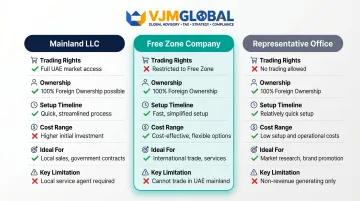
Quick Comparison Table
| Criteria | Mainland LLC | Free Zone Company | Representative Office |
|---|---|---|---|
| Trading Rights | Full UAE market access | International/Free Zone only | None (non-commercial) |
| Ownership | 100% foreign ownership | 100% foreign ownership | Extension of parent company |
| Setup Timeline | 4–8 weeks | 1–2 weeks | 2–4 weeks |
| Cost Range | AED 45,000–80,000+ | AED 35,000–50,000+ | Lower (no LSA/guarantee) |
| Ideal For | Direct mainland sales, government contracts | International clients, tax efficiency | Market research, testing |
| Key Limitation | Emiratisation for 50+ staff | Cannot sell directly to mainland | Cannot generate revenue |
Legal, Tax, and Compliance Requirements You Must Know
Corporate Tax Framework
The UAE introduced a 9% corporate tax on taxable profits above AED 375,000, effective from June 2023. This applies to all entities, including Free Zone companies.
Free Zone entities can claim a 0% rate only if they meet strict "Qualifying Income" conditions — income must come from qualifying activities, and transactions with mainland UAE clients or related parties must be at arm's length.
For multinational groups with annual revenue above €750 million, the 15% Global Minimum Tax (Domestic Minimum Top-up Tax/DMTT) applies from January 2025.
Singapore businesses should review the Singapore-UAE Double Taxation Avoidance Agreement (signed 1995, in force 1996, updated by protocol 2015) to optimize tax structuring. The treaty provides 0% withholding on dividends and interest, and 5% on royalties.
VAT Obligations
Beyond corporate tax, VAT compliance is an immediate operational concern. A 5% VAT applies to most goods and services in the UAE, with mandatory registration triggered once annual turnover exceeds AED 375,000. VAT registration is tied to your trade license — without it, you cannot issue legally valid tax invoices, which blocks your ability to operate commercially.
Critical: Register for VAT as soon as you meet the threshold. Delays create compliance gaps and prevent proper invoicing from day one.
UAE Labor Law Differences
Singapore businesses must prepare for key employment law differences:
- Fixed-term contracts only: Unlike Singapore's open-ended employment norm, UAE employment contracts under Federal Decree-Law 33/2021 are fixed-term
- End-of-service gratuity: Mandatory payment of 21 days' salary per year (first 5 years), 30 days per year thereafter, capped at 2 years' wages maximum
- Emiratisation quotas: Mainland companies with 50+ employees must hire a minimum percentage of UAE nationals, with 2% annual increases. Non-compliance carries financial penalties
Corporate Governance Obligations
Two compliance obligations catch Singapore businesses off guard most often:
- UBO disclosure: All UAE entities must identify and register individuals who own or control 25% or more of the company
- Economic Substance Regulations (ESR): Entities conducting relevant activities — banking, insurance, fund management, financing, leasing, headquarters, shipping, holding companies, intellectual property, or distribution/service centers — must file annual ESR notifications demonstrating adequate economic substance in the UAE. Non-compliance triggers fines or license suspension
Selecting the Correct Trade License Category
Misclassifying your license type is one of the most common — and expensive — errors at the registration stage. The UAE issues distinct license categories, each with separate regulatory approval chains and permitted activity codes:
- Commercial — trading, import/export, distribution
- Professional — consultancy, services, freelance
- Industrial — manufacturing, processing
- Financial — regulated financial services
- Technology — tech startups, software, digital services
Choosing the wrong activity code can block your application or force a costly amendment after registration. Define your revenue model and client base before you apply.
A Step-by-Step UAE Market Entry Roadmap for Singapore Companies
Phase 1 — Market Validation and Strategic Decision (Weeks 1–6)
Before registering anything, conduct on-the-ground market validation. Speak with potential UAE clients, test pricing, and benchmark competitors. This phase should answer:
- Who are your target clients (mainland entities, international clients, or both)?
- What business model will you operate (direct sales, distribution, services)?
- Which jurisdiction best serves your client base (Mainland, specific Free Zone, or Representative Office)?
This upfront work reduces the risk of costly structural errors after setup. Advisory partners like VJM Global — with experience across 15+ industries — can help Singapore companies run strategic assessments and choose the right structure before committing to any registration.
Phase 2 — Document Preparation and Attestation from Singapore (Weeks 1–4)
Singapore company documents required for UAE registration must go through a multi-step attestation process:
- Notarize documents in Singapore (Certificate of Incorporation, Memorandum & Articles of Association, Board Resolution authorizing UAE setup, director/shareholder passports)
- Attest with Singapore Ministry of Foreign Affairs (MFA)
- Legalize at the UAE Embassy in Singapore
- Final attestation by UAE Ministry of Foreign Affairs upon arrival in the UAE
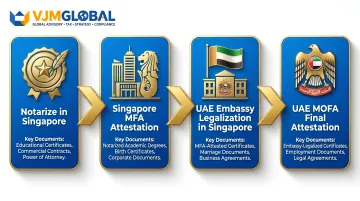
This attestation chain is time-sensitive and a common source of delays. Start this process early and in parallel with other steps.
Phase 3 — Trade Name Reservation, License Application, and Office Leasing (Weeks 2–8)
Submit your license application to the relevant authority:
- Mainland: Department of Economic Development (DED) in the relevant emirate
- Free Zone: The specific Free Zone authority (DIFC, ADGM, JAFZA, Dubai Internet City, etc.)
All UAE entities must maintain a physical address. Virtual offices are accepted in some Free Zones, but Grade A office space is expected in sectors like finance or professional services.
Office leases in Dubai must be registered via the Ejari portal — mandatory since 2010 and required for bank account opening.
Phase 4 — Corporate Bank Account Opening (Weeks 8–16)
Bank account opening routinely takes 1–3 months — plan for it early. UAE banks require:
- Valid commercial license
- Proof of physical office (Ejari certificate)
- Comprehensive KYC documentation and UBO disclosure
- Detailed business plan
- Source-of-funds evidence
- At least one authorized signatory with UAE residency (speeds up approval)
Major UAE banks serving international corporate clients include Emirates NBD, First Abu Dhabi Bank (FAB), and HSBC UAE. Submitting a complete, compliant documentation package from the start is the single most effective way to avoid extended timelines.
Phase 5 — Visa Processing and Team Mobilization (Weeks 10–14, overlapping with banking)
UAE residency visa options for Singapore business owners and staff:
- 10-year Golden Visa: For executives earning AED 30,000+/month or investors meeting capital thresholds
- 5-year Green Visa: For skilled professionals with self-sponsorship
- 2-year employment visas: Standard work permits

Visa quotas are linked to your trade license and office size, making early planning essential. Factor visa processing into your team mobilization timeline.
Key Sectors, Pitfalls, and What Singapore Businesses Often Get Wrong
Top UAE Sectors for Singapore Companies
Singapore companies hold natural competitive advantages in these UAE priority sectors:
1. Fintech and Digital Financial Services DIFC and ADGM operate under English common-law frameworks — familiar ground for Singapore-regulated firms. The ADGM-MAS MoU signed in 2017 formalizes regulatory cooperation and fintech collaboration between the two financial centers, creating a clearer path for licensed firms expanding westward.
2. Logistics, Trade, and Supply Chain Singapore's port expertise and regional distribution experience translate directly to the UAE's re-export economy and its MEASA regional hub role. Companies with established trade infrastructure are particularly well-positioned.
3. Technology, AI, and Cybersecurity The UAE AI Strategy 2031, announced in 2018 with a target of AED 335 billion in economic gains, drives strong government and enterprise demand for AI solutions, cybersecurity, and digital infrastructure.
4. Healthcare and Life Sciences UAE medical tourism growth and diagnostics investment align directly with Singapore's globally recognized healthcare capabilities — particularly in specialized diagnostics, hospital management, and health-tech.
Understanding which sectors offer genuine opportunity is the starting point. What determines success, however, is how you structure and execute the entry — and this is where most Singapore companies run into trouble.
Most Common Mistakes Singapore Businesses Make
Choosing a Free Zone that restricts target market access If your primary clients are UAE mainland entities or government agencies, a Free Zone structure forces you to use a distributor — adding cost and complexity. Validate your client base before choosing jurisdiction.
Delaying VAT registration Without VAT registration, you cannot issue legal invoices. Some Singapore companies delay this step and find themselves unable to operate commercially despite having a valid license.
Underestimating banking KYC timelines Many businesses run out of operating capital before their UAE bank account activates. Budget 2–4 months for banking and arrange bridge financing if needed.
Selecting a local distributor without proper due diligence If you adopt the hybrid model (Free Zone + distributor), vet your distributor carefully. Assess financial health, legal compliance, and strategic fit before signing any distribution agreement — a poorly chosen partner is far harder to exit than it is to avoid.
Assuming UAE processes operate at Singapore speed The UAE has simplified business setup considerably, but document attestation, license approvals, and banking onboarding still take longer than comparable processes in Singapore. Build in buffers — not optimistic estimates.

How Advisory Partners Reduce Risk
Each of these mistakes shares a common cause: under-preparation before registration. Working with an advisory firm that has navigated international market entries across multiple sectors helps Singapore companies get the structure right before committing to it.
VJM Global has supported businesses across 15+ industries through international market entries. For Singapore companies entering the UAE, that typically means:
- Ensuring the right structure is chosen before registration
- Meeting compliance obligations from day one
- Preparing accurate documentation for banking and licensing
- Planning realistic operational timelines with built-in buffers
Frequently Asked Questions
How to enter the UAE market?
Entering the UAE involves choosing between a Mainland LLC, Free Zone company, or Representative Office based on your target client base and business model, then completing document attestation from Singapore, obtaining a trade license, leasing office space, and activating a corporate bank account — a process that typically takes 3–5 months in total.
Can Singapore companies own 100% of a UAE business?
Yes. Following the UAE's updated Commercial Companies Law (Federal Decree-Law No. 32/2021), 100% foreign ownership is permitted in most sectors for both Mainland and Free Zone entities, with limited exceptions in strategic industries such as defense, banking, and certain utilities.
Does Singapore have a trade agreement with the UAE?
Yes. The Singapore-UAE Comprehensive Partnership (signed 2019) provides Singapore businesses with enhanced investment protections and facilitated entry for professionals — giving them a structural advantage over companies from countries without a comparable bilateral framework.
What is the difference between a UAE Free Zone and Mainland company for Singapore businesses?
A Mainland LLC allows full trading rights across the UAE including with government entities, while a Free Zone company offers faster setup and tax incentives but is restricted to international or Free Zone-to-Free Zone business unless a mainland distributor is used. The choice depends on who your primary UAE clients will be.
How long does it take to set up a business in the UAE from Singapore?
Company registration itself takes 2–8 weeks, but factoring in document attestation in Singapore (2–4 weeks), office leasing, and bank account activation (1–3 months), Singapore businesses should plan for a 3–5 month timeline from decision to full operational readiness.
How much does it cost to set up a company in the UAE?
Free Zone licenses start from AED 35,000–50,000, while Mainland LLC setup runs AED 45,000–80,000+. Adding office leasing, visa processing (AED 3,000–5,000 per visa), and professional fees, a realistic all-in Year 1 budget is AED 80,000–150,000+ depending on structure.
Choosing the right structure from the outset — and building in time for attestation, banking, and compliance — is what separates a smooth UAE launch from a costly one.