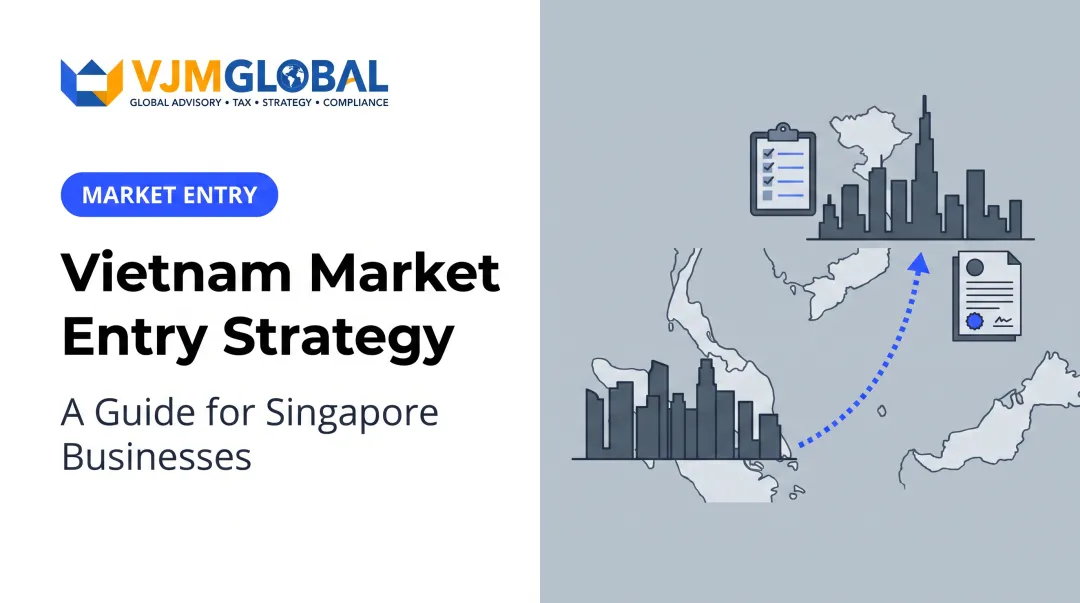
But moving from Singapore's single-step ACRA filing to Vietnam's system is a shock for most first-timers. Vietnam runs a two-stage licensing process — an Investment Registration Certificate (IRC), followed by an Enterprise Registration Certificate (ERC) — layered with sector restrictions and document authentication rules that catch even experienced operators off guard.
This guide covers entity options, the registration process step by step, documentation, tax obligations, common pitfalls, and how an Employer of Record lets you test the market before committing to a full entity.
Key Takeaways
- Singapore is Vietnam's top FDI source (2024), but entry needs two license certificates
- Most SMEs choose an LLC for full foreign ownership and simpler governance than a JSC
- IRC and ERC registration take 18-40 working days before post-licensing steps
- The Singapore-Vietnam treaty caps withholding tax on dividends, interest, and royalties
- An Employer of Record lets you hire staff in Vietnam without incorporating first
Why Singapore Businesses Are Expanding into Vietnam
Singapore's investment in Vietnam isn't a one-off spike. Cumulative registered capital sits around US$66 billion, making Singapore the country's largest ASEAN investor and one of its biggest overall sources of foreign capital. That's a decade-long trend of Singapore money flowing into Vietnamese manufacturing, real estate, and services.
Proximity That Actually Matters
Geography helps more than most people expect:
- Flights from Singapore to Ho Chi Minh City take about 2 hours; Hanoi is roughly 3.5 hours
- Both countries sit in the same ASEAN bloc, easing regulatory familiarity
- Vietnam is just one hour behind Singapore, so a single working day covers both offices
A Singapore-based founder can run board calls, sign documents, and manage a Vietnam team without the fatigue of juggling distant time zones.
Tax Relief Under the Singapore-Vietnam DTA
The Singapore-Vietnam Double Taxation Agreement caps withholding tax on money repatriated back to Singapore, according to IRAS:
| Payment type | Treaty rate |
|---|---|
| Dividends (50%+ ownership or US$10M+ stake) | 5% |
| Dividends (25-50% ownership) | 7% |
| Dividends (other cases) | 12.5% |
| Interest | Up to 10% |
| Royalties (industrial/IP, know-how) | 5% |
| Royalties (other) | 10% |
Without this treaty, Vietnam's standard withholding rates would eat further into profits sent home.
Cost Advantages: Vietnam vs Singapore
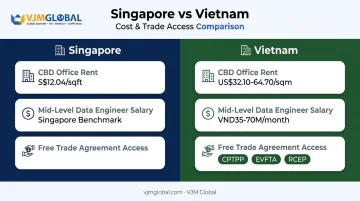
Grade-A office space in Hanoi runs around US$32.10 per sqm/month, and Ho Chi Minh City's CBD averages US$64.70 per sqm/month, both well below Singapore's CBD rate of roughly S$12.04 per sq ft/month, per JLL market data.
Salaries follow the same pattern. A mid-level data engineer in Ho Chi Minh City earns roughly VND35-70 million a month, notably below comparable Singapore compensation.
Beyond labor and real estate savings, trade access adds another layer of appeal. Vietnam's membership in CPTPP, EVFTA, and RCEP gives Singapore companies a manufacturing and export base with preferential access to markets across Asia-Pacific and Europe. Singapore, meanwhile, remains the natural regional HQ for treasury, IP holding, and investor relations.
Choosing the Right Business Structure for Your Vietnam Entry
Your structure choice determines how much liability you carry, how much capital you need upfront, and what activities you're legally permitted to run. Most Singapore SMEs entering Vietnam default to a Limited Liability Company for its simplicity, but it isn't the only option worth weighing.
Limited Liability Company (LLC)
A single-member or multi-member LLC (up to 50 members) is the standard vehicle for Singapore companies entering Vietnam. It offers:
- 100% foreign ownership in most non-restricted sectors
- Liability capped at committed charter capital
- Simpler governance than a joint-stock structure
- No requirement to issue tradeable shares
This is the right starting point for first-time Vietnam entrants: it balances control with manageable compliance overhead.
Joint-Stock Company (JSC)
A JSC needs at least three shareholders, with no upper limit, and its charter capital is divided into shares. It suits larger Singapore corporations planning to:
- Raise capital from multiple investors
- Eventually list on a Vietnamese stock exchange
- Bring in institutional or private equity partners
For a straightforward trading or services operation, a JSC adds governance complexity most SMEs simply don't need.
Representative Office vs. Branch Office
These two often get confused, but they serve very different purposes.
| Feature | Representative Office | Branch Office |
|---|---|---|
| Revenue-generating activity | Not permitted | Permitted, within licensed scope |
| Purpose | Market research, liaison | Direct business operations |
| Parent track record typically required | 1+ year | 5+ years |
| Regulatory appetite | Widely used | Discouraged, sector-limited |
A Representative Office is a low-cost way to test the waters before committing capital. A Branch Office is rarely the right call — regulators limit it to a handful of sectors, and most foreign investors find an LLC more practical anyway.
Employer of Record (EOR): Entering Without a Legal Entity
If you're not ready to incorporate at all, an Employer of Record lets you hire Vietnamese staff and start operating without setting up a local entity. The EOR becomes the legal employer on paper; you retain full control over the person's day-to-day work.
This matters because it removes the upfront cost and risk of incorporation while you validate demand. VJM Global, for example, offers Employer of Record capability across 100+ countries, so a Singapore company can use the same compliant hiring mechanism in Vietnam while it finalises a longer-term entity strategy.
Step-by-Step Process to Register a Company in Vietnam from Singapore
Once you've picked a structure, registration generally follows this sequence:
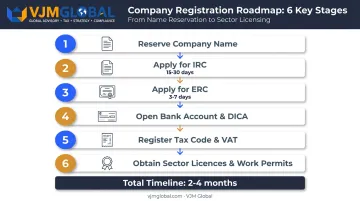
- Reserve a company name and confirm your structure: the name must comply with Vietnam's naming rules and not duplicate an existing registration.
- Apply for the Investment Registration Certificate (IRC): filed with the provincial Department of Planning and Investment. Submit an apostilled or notarised ACRA profile, a board resolution, and a bank reference letter. Processing typically takes 15-30 working days.
- Apply for the Enterprise Registration Certificate (ERC): required for every entity regardless of foreign ownership percentage. This step usually clears in 3-7 working days.
- Open a corporate bank account and Direct Investment Capital Account (DICA): then deposit your charter capital, commonly within 90 days of ERC issuance, per your company charter.
- Register for a tax code and VAT: complete post-licensing steps such as seal registration, e-invoice setup, and labour registration with local authorities.
- Obtain sector-specific licences and work permits: needed for regulated activities (F&B, education, e-commerce) and for any Singapore staff relocating to manage the Vietnam operation.
Factor in document preparation and legalisation, and a realistic timeline runs 2 to 4 months from start to finish, well beyond the 18-40 working days the certificates alone suggest.
Documents & Practical Requirements for Singapore Investors
Singapore parent companies typically need to prepare:
- ACRA business profile or certificate of incorporation
- Board resolution authorising the Vietnam investment
- Power of attorney for the appointed representative
- Passport copies of directors and authorised signatories
- Recent financial statements or a bank reference letter
Most of these documents require notarisation, then authentication by the Singapore Academy of Law, followed by Vietnamese consular legalisation and certified translation. Vietnam's accession to the Apostille Convention doesn't take effect until 11 September 2026, so this multi-step legalisation chain still applies for now.
Registered address: Most entity types need a genuine physical lease address in Vietnam. Virtual offices may work for pure service businesses, but manufacturing, retail, and other premises-based activities need a qualifying physical site.
Legal representative: At least one legal representative must reside in Vietnam regularly. This can be a relocating Singaporean or a trusted local appointee. Firms like VJM Global help clients source nominee directors or local advisory partners when relocating staff isn't practical.
Tax & Compliance Obligations After Incorporation
Vietnam's core tax framework looks like this:
| Tax | Standard rate | Notes |
|---|---|---|
| Corporate Income Tax | 20% | 15-17% preferential rates possible for smaller revenue bands or encouraged sectors |
| VAT | 10% | Reduced to 8% for eligible goods/services through end of 2026 |
| Personal Income Tax | Progressive, 5-35% | Applies to resident employees, including relocated Singapore staff |
The Singapore-Vietnam DTA (covered earlier) reduces withholding tax on dividends, interest, and royalties flowing back to Singapore, directly shaping your cash repatriation planning.
Beyond treaty benefits, staying compliant means managing several recurring obligations:
- Quarterly CIT provisional payments, totalling at least 80% of the final annual liability
- Annual financial statement audits, mandatory for foreign-invested LLCs and JSCs
- Social insurance (17% employer contribution), health insurance (3% employer), and mandatory registration for local employees
Common Challenges & How to Avoid Costly Mistakes
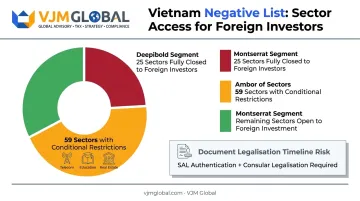
Document delays catch people off guard. Because Vietnam's Apostille Convention membership only starts in September 2026, Singapore-issued documents still need SAL authentication plus consular legalisation — a process that can stretch weeks longer than founders budget for.
Sector restrictions add another layer of risk. Beyond paperwork delays, Vietnam's negative list limits foreign investment in specific industries:
- Closes roughly 25 sectors to foreign investors outright
- Applies conditions to another 59, including telecommunications, education, and real estate
- Permits full foreign ownership in some conditional sectors once requirements are met
- Requires a joint venture structure for others
Verify this before committing capital, not after.
Engaging a cross-border advisory partner experienced in multi-jurisdiction entity setup, tax compliance, and payroll makes a measurable difference here. VJM Global, for instance, supports company formation and back-office compliance across 100+ countries. The firm helps Singapore businesses navigate document authentication, sector checks, and payroll setup without the trial-and-error most first-time entrants go through.
Frequently Asked Questions
Can a foreigner start a business in Vietnam?
Yes. Foreigners, including Singapore nationals, can own up to 100% of a company in most sectors, subject to obtaining an IRC and ERC and meeting any conditional sector requirements.
Which business is most profitable in Vietnam?
Manufacturing and electronics, e-commerce, F&B, and tech services currently rank among Vietnam's most profitable sectors for foreign investors, driven by strong export demand and rising domestic consumption.
How long does it take to register a company in Vietnam from Singapore?
The core process typically takes 18-40 working days combined for IRC and ERC. Factor in additional time for document legalisation and post-licensing steps like tax registration and e-invoicing.
Do I need a local partner or resident director in Vietnam?
Most sectors don't require a local partner. However, at least one legal representative must reside in Vietnam — met either by a relocating Singaporean or a trusted local appointee.
Can I run my Vietnam operations without setting up a local entity?
Yes. An Employer of Record arrangement lets Singapore companies hire and pay staff in Vietnam compliantly without incorporating, which is ideal for testing market demand first.
What is the minimum capital required to start a business in Vietnam?
There's no fixed minimum for ordinary sectors, except regulated industries like banking, real estate, and education. Declared capital needs to be credible for your project's scope.