Here's what causes confusion: many directors think their company structure disqualifies them, or that a Pvt Ltd company somehow needs different documentation. Neither is true. Eligibility depends entirely on financial thresholds, not legal form.
This guide covers eligibility, required documents, the exact registration steps, and how to verify your certificate once it's issued.
Key Takeaways
- Udyam registration is voluntary for Pvt Ltd companies but unlocks credit, tender, and payment-protection benefits
- Eligibility hinges only on investment and turnover—not on company structure
- No documents are uploaded; PAN, GSTIN, and Aadhaar data are auto-validated
- Buyers must pay MSME-registered suppliers within 45 days under Section 15 of the MSMED Act
- Registration is free and typically takes a few hours to a week
What is MSME (Udyam) Registration for a Private Limited Company?
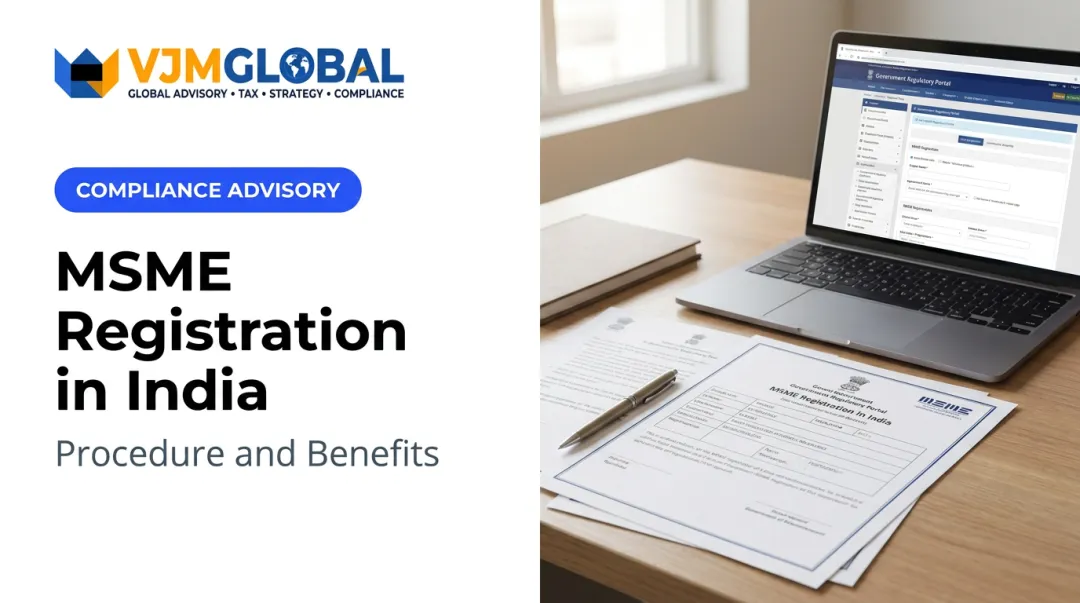
MSME registration is officially called Udyam Registration, managed through the Udyam Registration Portal under the Ministry of MSME, Government of India. A private limited (Pvt Ltd) company uses the same portal and process as any proprietorship, partnership, or LLP.
Before July 2020, businesses registered under a system called Udyog Aadhaar Memorandum (UAM). That system was replaced by Udyam, and old UAM registrations made before 30 June 2020 needed re-registration on the new portal.
The registration is self-declaration-based:
- You do not upload certificates, incorporation documents, or financial statements
- The portal pulls PAN, GST, and Aadhaar data from government databases and validates it automatically
Why This Matters for Pvt Ltd Companies Specifically
A company has multiple shareholders and directors, unlike a sole proprietorship. This raises a practical question: who applies on behalf of the company?
One authorised director, nominated through a board resolution, completes the Aadhaar and PAN verification steps on the company's behalf.
Eligibility Criteria and MSME Classification for Companies
Eligibility is purely a numbers game. If your Pvt Ltd company's investment in plant, machinery, or equipment and its annual turnover fall within the prescribed limits, it qualifies as a Micro, Small, or Medium enterprise. Entity structure doesn't change the test — a Private Limited company is judged on the same investment and turnover limits as any other enterprise.
Revised MSME Classification Limits (2025)
The Ministry of MSME revised classification thresholds effective 1 April 2025, through notification S.O. 1364(E), dated 21 March 2025. Current thresholds:
| Category | Maximum Investment (Plant & Machinery/Equipment) | Maximum Annual Turnover |
|---|---|---|
| Micro | ₹2.5 crore | ₹10 crore |
| Small | ₹25 crore | ₹100 crore |
| Medium | ₹125 crore | ₹500 crore |

Confirm figures against the current Ministry notification before filing — classification directly controls which benefits your company can claim.
Calculating Net Investment and Net Turnover
Two terms trip up most founders:
- Net investment — taken from ITR data where available, or self-declared for new companies with no prior filings; items excluded under Explanation I to Section 7(1) of the MSMED Act do not count
- Net turnover — export turnover of goods or services is excluded from the MSME turnover calculation
If your company exceeds Medium enterprise limits on either metric, it no longer qualifies as an MSME and must exit Udyam registration. There's no grandfathering — classification is reassessed against current-year figures.
Documents Required for MSME Registration of a Pvt Ltd Company
The paperwork list is short because most details are auto-verified rather than manually submitted.
You'll need:
- Company PAN (mandatory for entity verification)
- Authorised director's Aadhaar, linked to an active mobile number for OTP validation
- GSTIN, if the company is registered under GST
- Bank account details for the company
Since a Pvt Ltd company has multiple directors, a board resolution authorising one specific director as the Udyam applicant should be passed internally. This resolution isn't uploaded to the portal, but it establishes clear authority for whoever completes the Aadhaar verification step.
No physical documents are uploaded on the portal. PAN, GST, and Aadhaar details are validated in real time against government databases.
Step-by-Step Process to Register a Private Limited Company as MSME
Follow these steps in order:
- Pass a board resolution authorising one director to act as the Udyam applicant. This resolves internal ambiguity before you even touch the portal.
- Visit the Udyam Registration Portal and select "New Entrepreneurs not registered yet as MSME."
- Enter the authorised director's Aadhaar number, then validate it via an OTP sent to the Aadhaar-linked mobile number.
- Select "Private Limited Company" as the organisation type. Enter the company PAN, validate it, and confirm GSTIN/ITR status as prompted.
- Fill in enterprise details — company name, plant or office address, NIC business activity code, employee count, and bank account information.
- Self-declare investment and turnover figures, accept the declaration, complete the final OTP validation, and submit. The Udyam Registration Certificate arrives by email.

That's the entire process. No fees, no physical visits, no paperwork to courier.
If classification is borderline, or the wrong NIC code could trigger rejection, get the filing checked before you submit. VJM Global manages incorporation-linked filings, including MSME/Udyam registration, alongside broader compliance support for companies in India.
Checking MSME Status, Downloading Certificate & Is It Mandatory?
Verify Status and Download Your Certificate
Once submitted, you can verify your registration anytime using the "Verify Udyam Registration Number" section on the portal. Enter your URN and the CAPTCHA, and the system displays your enterprise name, organisation type, NIC code, incorporation date, and registration details.
To download or reprint your certificate, authenticate with the OTP sent to your registered mobile number or email.
Is Udyam Registration Mandatory?
No. MSME registration is not legally mandatory for a Private Limited company. But skipping it means forfeiting credit access, payment protections, and tender eligibility that registered companies get automatically.
Understanding the 45-Day Rule
Under Section 15 of the MSMED Act, once a buyer accepts goods or services from a registered MSME supplier, payment is due:
- By the date agreed in a written contract, or
- Within 45 days from acceptance if no written agreement exists
- No written agreement can push payment beyond this 45-day ceiling
If the buyer raises no written objection within 15 days of delivery, acceptance is deemed automatic and the payment clock starts. That protection alone is why many Pvt Ltd companies register even when they do not need the loan benefits.

Benefits of MSME Registration for Private Limited Companies
Registration opens doors that unregistered companies simply don't have access to.
Financial Access
- Collateral-free credit under CGTMSE for eligible facilities up to ₹10 crore per borrower (Udyam registration mandatory at application)
- Priority sector lending classification, with banks relying on your Udyam certificate for eligibility
- Lower interest rates on business loans compared with unregistered enterprises
Payment and Market Access
- 45-day payment protection under the MSMED Act for supplies to buyers covered by the Act
- Government tender eligibility and preferential access on the GeM portal for registered MSEs
- Interest on delayed payments when buyers miss the statutory timeline, strengthening cash-flow recovery
Tax and Subsidy Concessions
- 75% reimbursement of ISO certification costs (ISO-9000, ISO-14001, HACCP), capped at ₹75,000 per certification
- Patent and trademark fee concessions, including reimbursements up to ₹1 lakh for Indian patents (lower caps apply to trademarks)

Registration is only the starting point. A Pvt Ltd company still carries full ROC filing obligations, GST returns, and statutory audit requirements regardless of MSME status.
Firms like VJM Global help Indian companies manage incorporation, ROC compliance, GST, and audit alongside MSME registration on an ongoing basis.
Frequently Asked Questions
How do I get MSME (Udyam) registration for a private limited company in India?
Authorise a director through a board resolution, then complete registration on the Udyam portal. Validate the director's Aadhaar and company PAN, enter enterprise and investment details, and submit to generate the certificate.
What documents are required for Udyam/MSME registration for a private limited company?
You need the company PAN, the authorised director's Aadhaar, GSTIN if applicable, and bank account details. No physical document uploads are required.
Who is eligible for MSME (Udyam) registration as a private limited company?
Eligibility depends on investment in plant/machinery and annual turnover under the revised 2025 MSME classification limits, not on entity type. Any Pvt Ltd company within these thresholds qualifies.
Is Udyam (MSME) registration free and how long does the registration process take?
Yes. Udyam registration has no government fee. The certificate is usually issued within a few hours to about a week.
What is the 45 days rule for MSME registration?
Under the MSMED Act, buyers purchasing goods or services from a registered MSME supplier must pay within 45 days of acceptance, even without a written agreement specifying that timeline.
Is Udyam registration mandatory for a private limited company?
No, it's voluntary. However, it's strongly recommended for credit access, tender eligibility, and payment-protection benefits under the MSMED Act.