Introduction
India's MSME sector is anything but small. According to a PIB report from May 2026, over 7.9 crore enterprises are now registered under Udyam and Udyam Assist, collectively contributing over 31% of GDP, supporting nearly 32.8 crore livelihoods, and accounting for 48.58% of India's exports. That scale means MSME status carries real weight — in credit access, government contracts, and compliance protections.
Yet many eligible businesses — startups, small manufacturers, service providers, and even foreign-owned Indian entities — delay or skip Udyam Registration altogether. The most common barrier is simply not knowing where to start — or assuming it's more complicated than it is.
It isn't. Registration is free, fully online, and takes under 10 minutes with an Aadhaar and PAN in hand.
This guide walks through who qualifies under the revised 2025 classification limits, how the registration process works step by step, and which benefits are worth acting on once you're registered.
Key Takeaways
- Udyam Registration is free, paperless, and requires only Aadhaar and PAN — no document uploads
- Budget 2025 raised investment limits by 2.5x and turnover limits by 2x, making more businesses eligible from 1 April 2025
- Registration is voluntary but necessary for collateral-free credit, government subsidies, and procurement access
- A permanent registration number and QR-coded e-certificate are issued upon successful submission
- Registered MSMEs gain statutory protection under the MSMED Act for delayed payments
What Is MSME Registration and How Are MSMEs Classified?
MSME Registration — officially called Udyam Registration — is the government process through which Micro, Small, and Medium Enterprises get recognised under the MSMED Act, 2006. Registration happens entirely on the Udyam Registration Portal, and the resulting certificate unlocks access to government schemes, priority lending, and procurement platforms.
How Classification Has Evolved
MSME classification thresholds have been revised twice in recent years:
- Pre-2020: Based solely on investment in plant and machinery, with separate limits for manufacturing and services
- 2020 revision (Notification S.O. 2119(E), 26 June 2020): Introduced a composite test using both investment and annual turnover; removed the manufacturing/services distinction
- Budget 2025 (effective 1 April 2025): Raised investment thresholds by 2.5x and turnover thresholds by 2x
Revised MSME Classification Limits (Effective 1 April 2025)
| Enterprise Category | Investment Limit | Turnover Limit |
|---|---|---|
| Micro | Up to ₹2.5 crore | Up to ₹10 crore |
| Small | Up to ₹25 crore | Up to ₹100 crore |
| Medium | Up to ₹125 crore | Up to ₹500 crore |
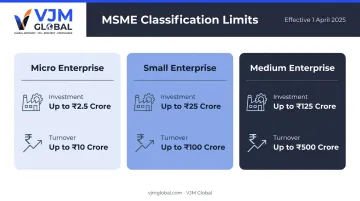
Source: Ministry of MSME / PIB Budget 2025 Notification
Both criteria must be satisfied simultaneously: a business that meets the investment limit but exceeds the turnover limit will not qualify at that category level. The Udyam portal automatically fetches investment and turnover data from Income Tax and GST databases, so no manual uploads are required.
Upon successful registration, the enterprise receives a permanent registration number along with a QR-coded e-certificate. This certificate serves as official MSME proof for banks, government portals, and procurement platforms.
MSME Registration Eligibility: Who Can Apply?
Any enterprise engaged in manufacturing, services, wholesale trade, or retail trade that falls within the revised classification limits is eligible. Wholesale and retail traders were included from 2 July 2021, though their access to benefits is primarily limited to Priority Sector Lending — they do not automatically qualify for every MSME scheme.
Eligible Entity Types
- Sole proprietorships
- Partnership firms
- Limited Liability Partnerships (LLPs)
- Private limited companies
- Public limited companies
- One Person Companies (OPCs)
- Startups (including those with foreign co-founders, if incorporated in India)
- Self-help groups (SHGs)
- Co-operative societies
- Trusts engaged in commercial activity
Foreign-Owned and NRI/OCI-Managed Entities
Indian entities owned or managed by foreign nationals, NRIs, or OCIs are eligible for Udyam Registration — provided the business is incorporated and operating in India, and its investment and turnover fall within the applicable thresholds.
Foreign-owned entities must meet the following requirements before registering:
- Comply with the Companies Act 2013, FEMA, and RBI regulations during incorporation
- Appoint at least one resident director (present in India for 120+ days in the preceding financial year)
- Ensure the entity is incorporated and operationally active in India before applying
VJM Global assists foreign companies and NRIs in setting up compliant Indian entities — private limited companies, LLPs, and wholly owned subsidiaries — that are structured to pursue Udyam Registration once operational.
Documents Required for MSME Registration
The Udyam portal is minimal in its documentation requirements. No physical documents are uploaded at any stage — the system pulls data automatically from Income Tax and GST databases.
Mandatory identifiers:
- Aadhaar number of the proprietor, managing partner, or authorised signatory
- PAN of the business entity or owner
Business details to have ready:
- Business name and address
- Active bank account number and IFSC code
- NIC code for your primary business activity
- GSTIN (mandatory only if the business is required to be GST-registered)
- Approximate investment and turnover figures
The entire process runs on self-declaration — the portal cross-checks your financial data against government records automatically.
How to Register as an MSME: Step-by-Step Udyam Registration Process
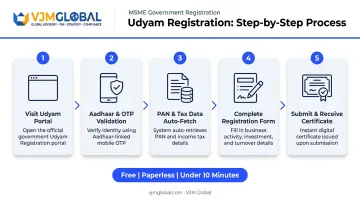
The official portal is udyamregistration.gov.in. Registration is free, the process takes under 10 minutes, and you receive the certificate digitally upon submission.
Registration for New Entrepreneurs (Not Previously Registered as MSME)
- Visit the Udyam portal and select "For New Entrepreneurs not yet registered as MSME"
- Enter your Aadhaar number and name, then validate via OTP sent to your Aadhaar-linked mobile number
- Select organisation type and enter PAN — the system auto-fetches relevant tax data
- Complete the registration form with enterprise name, address, bank details, NIC code, and employee count
- Enter investment and turnover figures, accept the declaration, and submit with a final OTP — the Udyam Registration Certificate is generated immediately
Registration for Businesses with Existing UAM (Udyog Aadhaar)
Businesses registered under the older Udyog Aadhaar Memorandum (UAM) system must migrate to Udyam to stay compliant. Use the dedicated migration option on the portal:
- Go to the Udyam portal and select the UAM migration option
- Enter your existing UAM number and complete OTP verification
- Your updated Udyam Registration Certificate is issued upon successful migration
How to Verify Status and Download the Certificate
- Verify registration: Udyam portal → Print/Verify section → "Verify Udyam Registration Number" → enter your registration number and captcha
- Download certificate: Select "Print Udyam Certificate" → enter your registration number and registered mobile → complete OTP verification → download the digital certificate
Key Benefits of MSME Registration in India
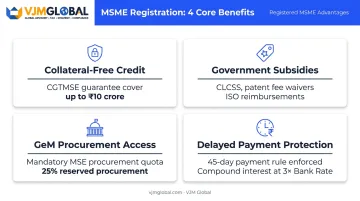
Collateral-Free Credit via CGTMSE
The Credit Guarantee Fund Trust for Micro and Small Enterprises (CGTMSE) allows eligible MSEs to access credit facilities up to ₹10 crore per borrower without collateral or third-party guarantees. Budget 2025 doubled this ceiling from the previous ₹5 crore limit. For businesses that lack significant fixed assets to pledge as security, this is a meaningful financing pathway.
RBI guidelines do not specify a fixed interest rate differential for MSME borrowers, but banks are directed to follow board-approved lending rate policies. In practice, MSME borrowers with a valid Udyam certificate and CGTMSE coverage often access credit on more favourable terms than unsecured commercial borrowers.
Government Schemes and Subsidies
Registration unlocks access to a wide range of central and state-level programmes:
- Credit-Linked Capital Subsidy Scheme (CLCSS) for technology upgradation
- Interest subvention schemes on working capital loans
- Patent and trademark registration fee subsidies
- ISO certification reimbursements
- Export promotion assistance
- State-level benefits: electricity tariff concessions, stamp duty exemptions, and faster regulatory clearances (vary by state)
VJM Global's tax advisory team works with MSME clients to identify applicable schemes from registration — many businesses register successfully but never claim the benefits they qualify for.
Government Procurement via GeM
The Udyam portal integrates with the Government e-Marketplace (GeM), India's centralised public procurement platform. GeM recorded over ₹4 lakh crore in order value in FY2025-26 (up to February 2026), with MSEs accounting for over 39% of Gross Merchandise Value and 49% of total orders.
Key procurement advantages for registered MSEs:
- Central ministries and CPSUs must procure at least 25% of annual requirements from MSEs
- Sub-targets: 4% for SC/ST-owned MSEs, 3% for women-owned MSEs
- Exemption from Earnest Money Deposit (EMD)/bid security on government tenders
- Note: Security Deposit and Performance Bank Guarantees are not exempted
Beyond procurement access, MSME registration also provides statutory protection on the payment side — directly addressing one of the most persistent cash flow challenges for small suppliers.
Delayed Payment Protection Under the MSMED Act
Under Section 15 of the MSMED Act, buyers purchasing from registered MSMEs must pay within the agreed contractual period — capped at 45 days. Where no written agreement exists, payment is due within 15 days.
If payment is delayed, Section 16 triggers compound interest at three times the RBI-notified Bank Rate, compounded monthly. For MSME sellers, this is a direct cash flow tool — particularly valuable when dealing with large corporate buyers who may otherwise treat payment timelines as flexible.
Tax-Related Benefits
- MAT credit carry-forward: Companies liable to Minimum Alternate Tax can carry forward MAT credit for up to 15 assessment years (extended from 10 years by Finance Bill 2017, effective AY 2018-19). Note: this applies to MSMEs organised as companies, not all Udyam registrants.
- Potential eligibility for direct and indirect tax concessions depending on sector, location, and scheme
- Structuring your entity correctly at registration determines which of these concessions you can actually claim
The 45-Day Payment Rule and Post-Registration Compliance
Section 43B(h): What Buyers Must Know
Section 43B(h) of the Income Tax Act applies from 1 April 2024 (AY 2024-25 onward). It covers purchases from micro and small enterprises specifically — not medium enterprises.
The rule is simple in structure but significant in impact:
- If a buyer pays a registered micro or small enterprise within the Section 15 MSMED Act deadline (45 days with agreement, 15 days without), the expense is deductible normally
- If payment is delayed beyond that deadline, the deduction is disallowed in that assessment year — it can only be claimed in the year actual payment is made
- The standard proviso (allowing deduction if paid before the return filing due date) does not apply to Section 43B(h) payments
This creates two simultaneous risks for buyers: compound interest liability under the MSMED Act and tax deduction disallowance under the Income Tax Act. Businesses purchasing from registered MSME suppliers need to audit their payment cycles and vendor contracts to confirm compliance.
Keeping Your Udyam Registration Current
MSME classification is not permanent. If investment or turnover figures change significantly — upward or downward — businesses must update their Udyam details. Reclassification directly affects scheme eligibility, and exceeding Medium Enterprise thresholds means losing MSME status entirely.
That interdependence matters for buyers too: the Section 43B(h) payment protections only apply when a supplier's MSME registration is active and correctly classified.
Ongoing compliance responsibilities include:
- Annual returns and accurate financial record-keeping
- Timely Udyam portal updates when investment or turnover figures change
- For foreign-owned or overseas-managed entities: GST filings, TDS compliance, FEMA/RBI reporting (SMF filings, FC-TRS, and downstream investment declarations)
VJM Global supports overseas-owned Indian MSMEs with post-registration compliance — handling GST, TDS, FEMA advisory, transfer pricing, and RBI reporting as a coordinated package rather than piecemeal engagements.
Frequently Asked Questions
What is the cost of MSME registration in India?
MSME registration through the official Udyam portal is completely free, with no government fees at any stage. Any third-party website or service charging a fee for Udyam Registration is not affiliated with the official process.
How do I get MSME registration?
Visit udyamregistration.gov.in and complete the free online process using your Aadhaar and PAN. The entire registration takes minutes, and the Udyam certificate is generated digitally upon successful submission.
What is the 45-day rule for MSME?
Under Section 43B(h) of the Income Tax Act, buyers purchasing from registered micro or small enterprises must pay within 45 days (or 15 days without a written agreement). Late payment disallows the buyer's expense deduction for that financial year. It also triggers compound interest under the MSMED Act.
Who is eligible for MSME registration in India?
Any manufacturing, service, wholesale, or retail trade entity is eligible — including sole proprietorships, partnerships, LLPs, private/public limited companies, OPCs, and startups. The entity's investment and turnover must fall within the Budget 2025 revised limits, effective 1 April 2025.
Is MSME registration mandatory in India?
Registration is not legally mandatory, but it is practically necessary to access collateral-free loans, government subsidies, procurement preferences on GeM, and delayed payment protections. Most banks and government schemes require the Udyam certificate as proof.
What is the validity of the Udyam Registration Certificate?
The Udyam certificate does not have an expiry date. It remains valid as long as the enterprise continues to meet the MSME classification criteria and keeps its Udyam portal details updated. There is no renewal requirement.