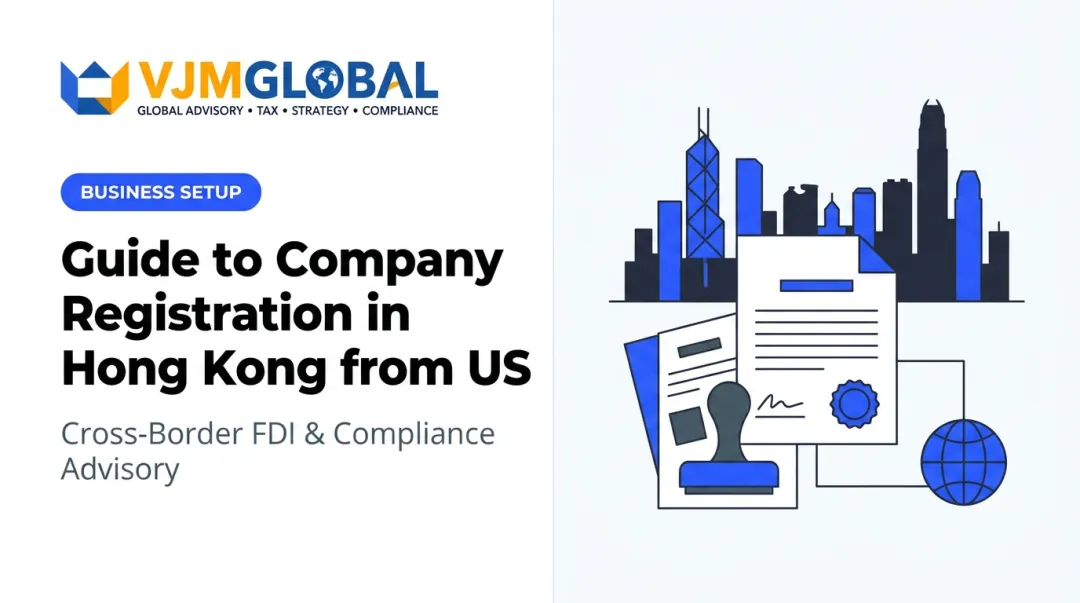
Here's the catch: incorporating in Hong Kong is genuinely easy. Getting real "offshore" tax status, and staying compliant as a US person while you hold it, is a different exercise entirely. Hong Kong wants proof, not just paperwork. The IRS wants disclosure, regardless of what Hong Kong decides.
This guide walks through the formation process step by step, what "offshore" actually means legally, the parallel US reporting obligations you can't skip, and the mistakes that trip up American founders most often.
TL;DR
- Hong Kong allows 100% foreign ownership, no minimum capital, and fully remote setup
- "Offshore" is an annual tax claim—not a company type you register
- US owners add FBAR, FATCA, and IRS Forms 5471/8858 on top of Hong Kong filings
- Local company secretary, registered address, and IRD offshore claim are mandatory
- Banking—not incorporation—is usually the slowest step
How to Form an Offshore Company in Hong Kong from the USA
Step 1: Choose a Company Name and Structure
Start by checking name availability through the Companies Registry's e-Search tool. Your name can't duplicate an entry already in the Registrar's index.
Most US founders choose a private company limited by shares. It's the standard vehicle for this structure, and it comes with a key advantage: no residency requirement for directors or shareholders.
- One person can hold both director and shareholder roles
- There's no statutory minimum share capital
- Shareholders don't need to live in Hong Kong, or even visit
Step 2: Prepare and Submit Incorporation Documents
You'll need three core items:
- Articles of Association — model articles work fine for most small companies
- Form NNC1 — the incorporation application itself
- ID and address proof for every director and shareholder
Submission happens entirely online. Processing is normally fast: online applications for incorporation and business registration are typically processed within one hour, while hard-copy filings take about four working days. You never need to set foot in Hong Kong for this part.

Step 3: Appoint a Local Company Secretary and Registered Office
This is where "remote" incorporation hits its first real requirement. Hong Kong law mandates a company secretary who ordinarily resides in Hong Kong (or a licensed corporate secretary), plus a physical registered office address in Hong Kong.
A sole director cannot also serve as company secretary. US founders almost always outsource both requirements to a local provider, since they aren't things you can DIY from New York or Denver.
Providers such as VJM Global arrange the Hong Kong company secretary and registered office for US founders and handle ongoing statutory filings. Neither role can be self-served from abroad.
Step 4: Obtain the Business Registration Certificate
Once incorporated, the Inland Revenue Department (IRD) issues your Business Registration Certificate. You'll need it for:
- Opening a bank account
- Signing contracts with clients or vendors
- Filing any tax return
You can choose a one-year or three-year certificate. Renewal notices arrive around mid-month before expiry, and the paid demand note becomes your renewed certificate.
Step 5: Open a Corporate Bank Account
Expect this to be the slowest step. Traditional Hong Kong banks apply strict know-your-customer (KYC) checks, often requesting business plans, proof of substance, and sometimes in-person verification. For a non-resident US founder who can't fly out on short notice, that's a real bottleneck.
Practical alternatives:
- EMI and fintech platforms (multi-currency business accounts) often onboard entirely online
- Some fintech providers complete onboarding in around 48 hours rather than weeks
- Several platforms charge no account-opening fee, unlike the documentation-heavy process at traditional banks
No option guarantees approval. HKMA advises applicants to approach multiple banks since requirements vary by institution and by the bank's own group policies.

When Should a US Entrepreneur Consider This Structure?
This setup fits a specific profile: location-independent businesses with no Hong Kong footprint.
Typical fits include:
- E-commerce sellers shipping from outside Hong Kong
- Consultants serving clients in the US, Europe, or elsewhere
- SaaS founders with no Hong Kong staff, office, or customers
The structure breaks down quickly if you have a Hong Kong office or staff, US-based operations that need integrated tax planning, or heavy Subpart F/GILTI exposure. Handle that US tax structuring before you incorporate.
If you expect multiple entities, outside investors, or a complex cap table, get professional structuring advice before filing Form NNC1—not after.
What You Need Before Incorporating
Preparation on the Hong Kong side and the US side determines whether your offshore claim and your IRS filings go smoothly later.
Hong Kong-Side Requirements
- At least one director and one shareholder (same person is fine)
- A local company secretary
- A registered office address in Hong Kong
US-Side Requirements
- A US tax ID (EIN, where applicable)
- Valid passport or personal ID
- A working understanding of foreign entity reporting obligations
Know these reporting rules before you file—not after your accountant asks why you never mentioned a Hong Kong company.
Documentation Readiness
Start collecting proof now that income is sourced outside Hong Kong. Keep records that show where decisions are made and where clients sit, including:
- Contracts
- Invoices
- Client and decision-location correspondence
You will need this evidence to support your offshore claim every year, not just at formation.
Tax & Compliance Considerations for US Owners
Hong Kong applies a two-tiered Profits Tax: 8.25% on the first HKD 2 million of assessable profits, 16.5% on everything above that. Offshore-sourced income can be claimed exempt, but only if you meet the criteria.
The Offshore Claim Isn't Automatic
The IRD's operations test looks at where your profit-producing activities actually happen, not where your company is registered. To support a claim, you'll need to show:
- No Hong Kong-based clients
- Key business decisions made outside Hong Kong
- No local staff or suppliers doing the actual work
This is a fact-based determination, re-evaluated annually. Incorporating in Hong Kong doesn't grant offshore status by itself.

Mandatory Hong Kong Filings
Regardless of your offshore status, you still owe:
- Annual Return (NAR1) — due within 42 days of your return date
- Profits Tax Return with financial statements and tax computation
- Audited accounts (with limited exceptions, such as dormant companies)
Parallel US Obligations
Being offshore in Hong Kong changes nothing for the IRS. US persons owning foreign accounts or entities generally face:
- FBAR — required when foreign account balances exceed an aggregate $10,000 at any point during the year, filed through FinCEN's BSA E-Filing System
- FATCA reporting via Hong Kong financial institutions under the US-Hong Kong intergovernmental agreement
- Form 5471 for US officers, directors, or certain shareholders of the foreign corporation
- Form 8858 if the entity is treated as a disregarded entity or foreign branch for US tax purposes
Hong Kong also participates in the Common Reporting Standard (CRS), meaning account data can be shared across dozens of reportable jurisdictions. Any assumption that a Hong Kong account stays out of view is outdated.
VJM Global's cross-border tax teams support US filings such as Forms 1040, 1065, and 1120, plus foreign tax credit analysis on Form 1116. Coordinating those returns with Hong Kong entity compliance helps you meet deadlines under both tax authorities.

Common Mistakes and Alternatives to Consider
Four mistakes show up repeatedly among US founders going the offshore route:
- Assuming incorporation equals offshore status. It doesn't. You file a claim, with evidence, every year.
- Skipping the annual re-filing of the exemption claim. One good year doesn't lock in future exemptions.
- Underestimating bank account difficulty. Opening and keeping a workable account is often harder than incorporation itself.
- Skipping IRS disclosure. Missed FBAR or Form 5471 filings create real legal exposure.
Alternative Jurisdictions Worth Comparing
Hong Kong isn't the only option. Two alternatives come up often beside it:
| Jurisdiction | Corporate Tax | Notable For |
|---|---|---|
| Hong Kong | 8.25% / 16.5% two-tier | Territorial system, offshore claim required |
| Singapore | 17% flat rate | Broader banking access, stricter substance rules |
| UAE Free Zones | 0% qualifying income / 9% above AED 375,000 | No personal income tax, evolving treaty network |
Singapore often suits founders who want more predictable banking. UAE free zones appeal to those prioritizing zero personal tax exposure. Substance rules and treaty networks differ in each case—compare those before you lock in a jurisdiction.

Frequently Asked Questions
How much money do I need to have an offshore account?
Minimum deposit requirements vary by bank. Some Hong Kong banks have no stated minimum, others expect substantial balances. Fintech alternatives often waive minimums entirely.
Is Hong Kong still a tax haven?
Not in the classic zero-tax sense. Hong Kong runs a territorial system where only Hong Kong-sourced income gets taxed, and you need an approved offshore claim to exempt foreign-sourced profits.
Do US citizens have to report a Hong Kong company to the IRS?
Yes. US persons must disclose foreign corporate ownership and accounts through FBAR, FATCA, and IRS entity forms like 5471 or 8858, regardless of your Hong Kong tax outcome.
How long does it take to incorporate a company in Hong Kong from the US?
Incorporation itself is fast, often within a day. Offshore status approval and bank account setup typically take much longer.
Can a US resident be the sole director and shareholder of a Hong Kong company?
Yes. Hong Kong has no residency requirement for either role, and one person can hold both.
Is it hard for Americans to open a Hong Kong business bank account remotely?
Traditional banks often want in-person verification. Digital banks and EMI providers offer remote onboarding built for non-resident founders, which makes them the more realistic first option for most US owners.