But the speed hides real friction. Registered office rules, new identity verification requirements, and a parallel set of US tax filings often surface only after the certificate of incorporation lands in your inbox. Many American founders discover these gaps too late.
This guide covers whether a UK Ltd actually fits a US-run business, the exact Companies House filing steps, what to prepare beforehand, and the costs, deadlines, and mistakes that trip up US founders most often.
TL;DR
- No UK residency required for directors, shareholders, or persons with significant control (PSCs); one US person can hold all three roles
- Online registration through Companies House costs £100 and usually completes within 24 hours
- A compliant UK registered office and identity verification are mandatory before Companies House accepts your IN01
- US owners holding 10%+ of the company generally have separate IRS Form 5471 obligations
- UK Corporation Tax registration is due within 3 months of starting to trade, not from the incorporation date
How to Register a UK Company from the USA via Companies House
Companies House enforces a fixed sequence. Miss a step, or fill one in incorrectly, and the filing gets rejected outright rather than flagged for correction. Here's the order that actually works.
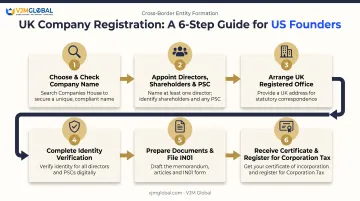
Step 1: Choose and Check Your Company Name
Companies House rejects names that are "same as" an existing company, meaning the only differences are punctuation, special characters, or common filler words.
Run your proposed name through the free Companies House name-availability checker before you do anything else.
Certain words trigger extra scrutiny:
- "Royal," "Chartered," "Institute," "Association" and similar terms need written permission from a relevant body
- Names implying a government or local-authority connection require separate approval
Run a parallel search on the UK IPO trademark database too. Companies House will let you register a name that infringes someone's trademark, but that company won't survive a legal challenge later.
Step 2: Decide Your Structure and Appoint Directors, Shareholders and PSCs
A UK Ltd needs a minimum of one director and one shareholder. These can be the same person, and that person can live anywhere, including the USA. There's no residency requirement for either role.
Anyone holding more than 25% of shares or voting rights counts as a Person with Significant Control (PSC) and must be disclosed. For a solo US founder owning 100% of the company, that's simple: you're the director, the shareholder, and the PSC.
For multi-founder setups, map out ownership percentages before filing. Companies House wants exact figures, not estimates.
Step 3: Arrange a UK Registered Office Address
This is where most US founders stumble. The address must meet Companies House's "appropriate address" standard, meaning someone at that address can receive post, become aware of it, and confirm delivery when asked.
A few things automatically fail this test:
- A US home or office address
- A standard PO Box or virtual mailbox with no physical mail handling
- Any address where nobody actually checks incoming post
Most American founders use a formation partner or accountancy firm rather than arranging this independently.
VJM Global provides a UK registered office address that keeps your home address off the public register. That privacy matters, because registered office details are publicly searchable.
Step 4: Complete Identity Verification for Directors and PSCs
Since 18 November 2025, identity verification has been a legal requirement under the Economic Crime and Corporate Transparency Act, not an optional add-on. You need a verification code at the point of filing, not afterward.
Two routes exist:
- GOV.UK One Login: free, and it accepts a biometric US passport
- Authorised Corporate Service Provider (ACSP): an accountant or formation agent verifies your identity on your behalf
If you have multiple directors or PSCs, each one needs their own code. Skipping this step is one of the fastest ways to have an IN01 bounced back.
Step 5: Prepare Governing Documents and File Form IN01
Most new companies adopt Companies House's model Articles of Association rather than drafting custom ones, paired with a short signed Memorandum.
The IN01 filing itself pulls together:
- Company name and registered office
- SIC code describing your business activity
- Registered email address
- Director and PSC details, including verification codes
- Statement of capital and initial share allocation
- The £100 registration fee
Get any of these wrong, particularly the SIC code or PSC details, and the filing is rejected outright.
Step 6: Receive Your Certificate of Incorporation and Register for Corporation Tax
Once approved, you'll receive a certificate of incorporation confirming your company legally exists, complete with a company number and formation date. Online incorporation usually registers you for Corporation Tax automatically, unless you flag the company as dormant.
Here's the part that catches founders off guard: HMRC needs to be notified within 3 months of starting to trade, not 3 months from incorporation. If you incorporate in January but don't start trading until June, your clock starts in June.
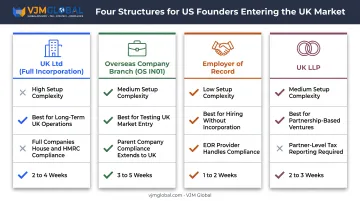
Is a UK Ltd the Right Structure for Your US Business?
Full incorporation earns its overhead when you need:
- A physical UK presence
- To invoice UK clients in GBP
- Credibility with European partners who expect a local entity
Occasional UK sales or a short-term project rarely justify the compliance workload a UK Ltd brings. Annual accounts, confirmation statements, and Corporation Tax returns don't pause just because your UK revenue is modest.
Alternative: Overseas Company Branch (Form OS IN01)
If your US company already exists and you just need limited UK activity, registering a UK establishment extends your existing entity rather than creating a new legal one. This suits founders testing the UK market before committing to full incorporation.
File within one month of opening the establishment.
Alternative: Employer of Record (EOR) or UK LLP
Two lighter-weight options cover common scenarios:
- Employer of Record (EOR): Hire one or two UK-based staff without incorporating—covering local contracts, payroll, statutory deductions, and offboarding.
- UK LLP: Often fits consultancies that prioritise partner profit-sharing over a traditional shareholder structure.
VJM Global provides EOR support for founders who need UK talent but not a UK legal entity.
What You Need Before You Register From the USA
Gather these before you start the IN01:
- A valid passport or photo ID for every director, shareholder, and person with significant control (PSC)
- A compliant UK registered office address (see Step 3)
- An accurate SIC code matching your actual business activity
- PSC disclosure details for anyone owning more than 25% of shares or voting rights
You'll also need a company-specific Government Gateway ID later, once you register for VAT or PAYE with HMRC. That's a separate step from incorporation itself.
Talk to a US accountant before you file. A UK entity triggers EIN considerations and cross-border filing obligations on the American side—far easier to plan for up front than to untangle after the company exists.
Costs, Taxes and Ongoing Compliance for US-Owned UK Companies
Incorporation is only the first invoice. US founders also need a clear picture of Companies House fees, UK Corporation Tax and VAT, recurring filing deadlines, IRS reporting, and how they will hold GBP day to day.
Companies House fees vary by filing method:
| Filing Method | Fee | Processing Time |
|---|---|---|
| Online (standard) | £100 | Usually within 24 hours |
| Software incorporation | £100 | Usually within 24 hours |
| Same-day software | £156 | Same day |
| Paper IN01 | £124 | 8 to 10 days |
UK Corporation Tax, VAT and Filing Deadlines
Corporation Tax uses a tiered structure:
- 19% small-profits rate on profits up to £50,000
- 25% main rate above £250,000
- Marginal relief between those thresholds
VAT registration is mandatory once UK taxable turnover exceeds £90,000 over 12 months, or you expect to hit that level in the next 30 days. You can still register voluntarily below the threshold.
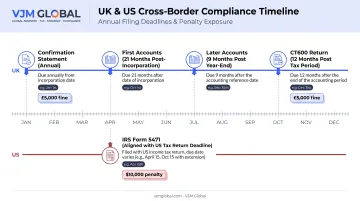
Miss these annual deadlines and penalties stack quickly:
- Confirmation statement: every 12 months; late filing risks a fine up to £5,000 and strike-off
- First accounts: 21 months after incorporation
- Later accounts: 9 months after each financial year-end
- CT600 return: 12 months after the tax period ends; penalties start at £200 on day one and escalate
The US Side: IRS Form 5471
US owners holding 10% or more of the company generally must file Form 5471 separately, with possible GILTI or Subpart F exposure depending on the company's income. That return is independent of anything you file with Companies House or HMRC. Miss it, and the penalty starts at $10,000 per accounting period, rising further after 90 days of IRS notice.
VJM Global's cross-border practice coordinates UK Companies House and HMRC filings with US IRS reporting, so founders are not juggling two disconnected compliance calendars.
A UK company also needs a working GBP account. Challenger banks (Wise, Revolut, Airwallex) generally allow remote opening for US-resident founders. Traditional UK banks often want an in-person branch visit or a UK-based signatory. For most US founders without a UK address yet, a challenger bank is the faster path to a usable GBP account.
Common Mistakes US Founders Make When Registering a UK Company
A handful of filing and compliance errors show up again and again when US founders incorporate in the UK. Catching them early avoids rejected applications and surprise IRS penalties.
- Using a non-compliant address. A virtual mailbox or standard PO Box fails the "appropriate address" test and triggers rejection at filing, not later.
- Miscounting the Corporation Tax deadline. The 3-month clock starts from when you begin trading, not from the incorporation date. These are rarely the same day.
- Forgetting Form 5471 entirely. UK compliance gets handled, the parallel US filing obligation doesn't, and the founder finds out only when the IRS penalty notice arrives.
Frequently Asked Questions
Can a non-resident register a company in the UK?
Yes. There's no UK residency requirement for directors, shareholders, or PSCs, provided the company has a compliant UK registered address and completed identity verification.
How do I register a company with UK Companies House?
Registration runs entirely online through the IN01 filing. You'll need a checked company name, appointed officers, a UK registered office, completed ID verification, and the filing fee.
Do I need to visit the UK to register my company or open a bank account?
No. Both incorporation and identity verification can be completed remotely from the USA. Several challenger banks also support fully remote account opening for non-residents.
How much does it cost to register a UK company from the USA?
Online Companies House registration costs £100. Ongoing costs typically include the confirmation statement fee and a registered office service, which varies by provider.
What US tax forms do I need to file after forming a UK company?
US owners holding 10%+ of the company generally must file IRS Form 5471, and should assess GILTI and Subpart F exposure with a cross-border advisor.
Can I open a UK business bank account while living in the USA?
Digital-first banks like Wise and Airwallex generally support remote onboarding for US-resident founders. Traditional UK banks often require an in-person visit or a UK-based signatory.