Introduction
US companies keep expanding into the UK, drawn by shared language, deep trade ties, and a straightforward legal system. But there's a snag many founders hit early: confusing "registering an overseas company" with "incorporating a UK Ltd."
These are legally distinct paths with different liability outcomes, filing requirements, and tax treatment. Get the structure wrong, and you could expose your US parent company to UK liabilities you didn't intend to take on.
This guide explains what an overseas company means under UK law and walks through branch registration step by step. It also covers the tax, compliance, and banking realities US founders need to plan for.
Key Takeaways
- An "overseas company" is a foreign-incorporated business with a physical UK presence, not mere US ownership of a UK entity
- Two routes: register a UK establishment (branch) or incorporate a new UK Ltd subsidiary
- Branches must file Form OS IN01 within one month of opening a UK place of business
- Identity verification is mandatory from 18 November 2025 for directors and PSCs, including overseas founders
- Coordinate UK filings with US IRS rules such as Form 5471 through cross-border advice
What Is an "Overseas Company" Under UK Law?
Under Section 1044 of the Companies Act 2006, an overseas company is simply one incorporated outside the UK. That's the legal starting point.
Registration obligations only kick in once that company establishes a UK establishment—a genuine place of business or branch operating in the UK.
Companies House guidance is clear that a "degree of physical presence" triggers the requirement. That typically means an office, warehouse, or branch where business is actually carried out.
What does NOT trigger registration:
- Occasional business trips or hotel stays in the UK
- Working through an independent UK agent
- Simply having UK-based customers
Here's the part US founders often miss: registering as an overseas company **does not create a new UK legal entity**. Your US parent company remains directly liable for everything the branch does. Contrast that with a UK Ltd subsidiary, which is a separate legal entity from day one, even if you own 100% of it.

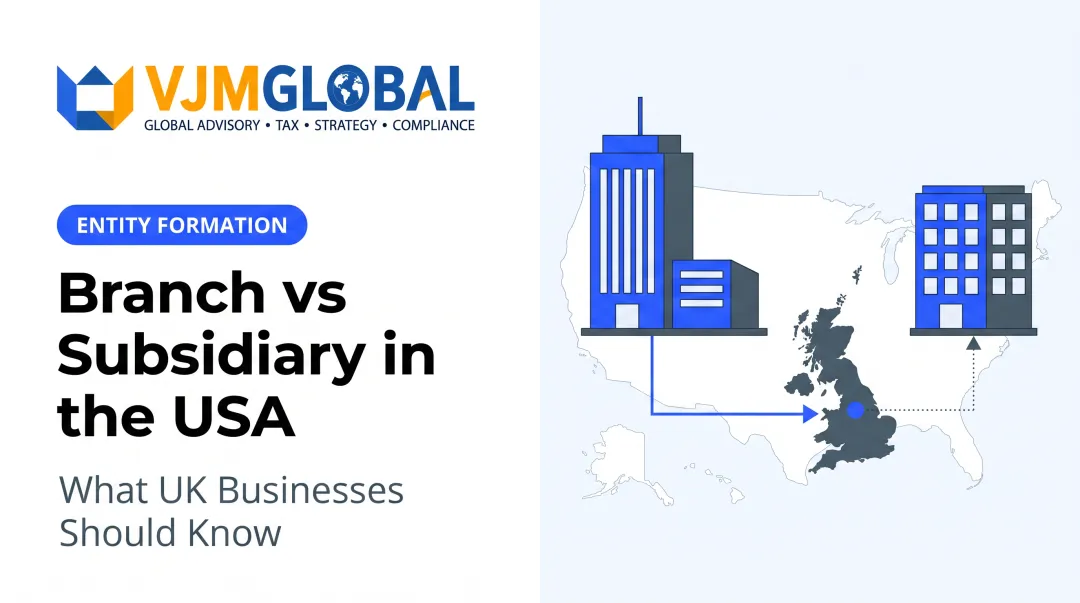
Branch vs. Subsidiary: Choosing the Right Structure
This is the decision that shapes everything downstream, so get it right before you file anything.
Registering a UK Branch (Overseas Company Establishment)
A branch is simply an extension of your existing US company. No new entity gets created. Your American parent stays fully liable for every UK debt, contract, or lawsuit tied to the branch, according to Lexology's cross-border structuring guidance.
This route tends to suit:
- Companies testing the UK market before committing long-term
- Businesses that want a simple, low-overhead operational presence
- Businesses not yet ready to build separate UK corporate infrastructure
Incorporating a UK Ltd Subsidiary
A subsidiary is a genuinely separate legal entity. Under GOV.UK's limited company guidance, owners are generally liable only up to the value of their investment, not the full debts of the business.
A subsidiary suits businesses that plan to:
- Establish permanent UK operations
- Hire UK staff at scale
- Raise investment from UK-based backers, who often prefer dealing with a UK-incorporated entity
Quick guidance: Branch for fast, low-commitment market entry. Subsidiary for long-term liability protection and growth.
VJM Global's cross-border formation teams help US businesses weigh both structures against real growth plans, liability tolerance, and hiring needs.
Step-by-Step: Registering a UK Branch as a US Business
Once you've confirmed a branch is the right fit, here's the process:
- Confirm a registrable UK presence exists. You need an actual office, staff, or fixed place of business, not just UK sales, before registration is legally required.
- Gather your documents. This includes your company's constitutional documents, director details, your home-country registered office address, and certified English translations for any non-English paperwork.
- File Form OS IN01 with Companies House. This is due within one month of opening the UK establishment, with a filing fee of £124.
- Complete mandatory identity verification. Directors must verify identity under the 2025-2026 Economic Crime and Corporate Transparency rules.
- Display your company name and country of origin. Show both on all UK correspondence and signage, as required by law.
- Set up ongoing filing routines. Notify Companies House of director or address changes within the required timeframes.

Per OS IN01 guidance, the form's Parts 1-4 cover your overseas company details, while Parts 5-7 cover the UK establishment itself.
Any director, secretary, or permanent representative can certify the constitutional documents as true copies.
Tax, Compliance and Identity Verification Obligations
Branch profits attributable to UK activity fall under UK Corporation Tax. GOV.UK's corporation tax guidance confirms that a foreign company with a UK branch pays tax on UK-sourced profits, even without full UK tax residency.
The UK-US Double Taxation Convention helps prevent you from paying tax twice on the same income. Article 24 provides relief mechanisms, including a US credit for UK income tax paid.
Other obligations to plan for:
- VAT registration becomes mandatory once UK taxable turnover exceeds £90,000, or is expected to do so shortly
- Identity verification is now compulsory for directors and PSCs; overseas directors must submit passports or national ID with certified translations where needed
- IRS Form 5471 may apply to US owners of foreign corporations, depending on ownership thresholds and control categories laid out in the IRS's December 2025 instructions
Form 5471 applicability is fact-specific. It depends on stock ownership percentages, control thresholds, and CFC status, not a blanket rule for every US owner. Coordinated UK-US advice matters here: a filing that satisfies Companies House can still leave a gap on the IRS side if nobody tracks both sets of obligations together.

Banking and Practical Challenges for US Businesses
UK banks tend to scrutinize branch accounts more heavily than subsidiary accounts. Expect requests for parent company financials and detailed director documentation before the bank approves the account.
Traditional high-street banks often add friction for non-resident applicants:
- Barclays: Usually needs at least one UK-resident applicant and three years of residential address history
- HSBC: Small-business accounts typically require UK tax residency
- Documentation load: Parent financials, director IDs, and proof of UK company registration are common asks
Fintech options are usually more workable for overseas founders:
- Wise Business: Accepts overseas-owned UK companies after verification, photo ID, and proof of registration
- Revolut Business: Offers remote-friendly onboarding for non-resident founders
- Trade-off: Faster remote setup, with the same KYC checks banks still expect
One planning note that trips people up: a UK bank account is required to trade, not to register. Build your account-opening timeline separately from your incorporation timeline, since the two don't have to happen in lockstep.
Common Mistakes US Businesses Make
A few recurring errors show up when US companies set up a UK entity:
- Assuming a branch limits liability like a subsidiary does. It doesn't. The US parent stays fully exposed to UK claims.
- Missing the one-month OS IN01 deadline after opening a UK place of business, which can trigger penalties.
- Overlooking identity verification requirements for overseas directors, leading to filing rejections at Companies House.
- Failing to coordinate UK filings with US-side reporting, which creates dual compliance gaps that are harder to unwind later.
VJM Global's cross-border teams align UK filing obligations with the parallel reporting requirements US owners face at home.
Frequently Asked Questions
Can a US citizen open a company in the UK?
Yes. There are no nationality or residency restrictions for UK company directors or shareholders. You can incorporate a new UK Ltd or register an overseas branch of your US company.
What is the difference between a UK branch and a UK subsidiary?
A branch keeps your US parent company fully liable and is the same legal entity operating in the UK. A subsidiary is a separate UK legal entity with its own limited liability protection.
Do I need to register as an overseas company if I only have UK customers?
No. Having UK-based customers alone doesn't trigger registration. You need an actual fixed place of business, such as an office or branch, operating in the UK.
How long does it take to register a UK branch or subsidiary?
Online UK Ltd incorporation is usually completed within 24 hours, while postal applications take 8-10 days. OS IN01 paper filings for branches generally take around a week, though this can extend during peak periods.
Will my UK branch or subsidiary be taxed in both the UK and US?
The UK-US double tax treaty helps prevent double taxation through credit mechanisms, but you'll still need to file separately in both countries. Plan treaty relief and dual filings together so neither side is missed.
Do I need a UK bank account before registering my overseas company?
No. A bank account is only required for trading, not for registration itself. Remote-friendly options like Wise Business and Revolut Business exist for non-resident founders.