Here's the catch: opening a UK account as a UAE-based business isn't as straightforward as it is for someone already living in London or Manchester. Approval depends heavily on your company structure, the documents you can produce, and which type of provider you approach.
This guide walks through the exact process, the documents you'll need, how to weigh traditional banks against digital providers, and the mistakes that most often cause delays or outright rejection.
Key Takeaways
- Choose UK digital/EMI providers for fast remote opening, or traditional banks if you have a UK connection
- Gather your UAE trade licence, passport/Emirates ID, and proof of business activity before you apply
- Digital accounts can open in days; traditional banks often take weeks and may want a UK director or address
- Structure your UK entity correctly first—with support from a firm like VJM Global—to cut rejection risk
How to Open a UK Business Bank Account from the UAE: Step-by-Step Process
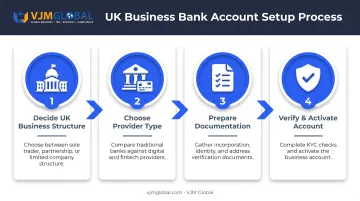
Step 1: Decide Your UK Business Structure
Your first decision shapes everything else: do you need a bank account for your existing UAE company, or are you incorporating a new UK limited company?
- Trading with a UAE entity: Some providers accept an overseas-registered business, but eligibility varies by bank
- Incorporating in the UK: Most providers prefer this route because it creates a Companies House-verified, identifiable structure
Most UK providers won't onboard an applicant without clearly identified beneficial owners attached to an incorporated entity.
A UK private limited company needs just one director aged 16 or over, and that director doesn't have to live in the UK. The company must have a genuine UK registered office (a PO Box alone won't qualify).
Since November 2025, Companies House also requires identity verification for every new director and person with significant control before incorporation completes.
Firms offering UK entity formation support, including VJM Global, can handle the Companies House filing, memorandum and articles of association, company registration number, and Corporation Tax/HMRC registration. UAE founders need these in place before a bank will review an application.
Step 2: Choose the Right Provider Type
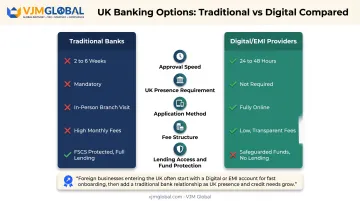
This is where most of the friction happens. Traditional high-street banks (Barclays, HSBC, Lloyds, NatWest) typically expect a UK-resident applicant or a UK trading address. Electronic money institutions (EMIs) and fintech providers, by contrast, allow fully remote applications from Dubai, Abu Dhabi, or anywhere else.
Your choice affects:
- Approval speed - days versus weeks
- Fee structure - subscription tiers versus pay-as-you-go
- Multi-currency capability - whether you can hold AED, USD, and GBP in one account
- Protection type - EMI funds are safeguarded, not FSCS-covered; banks protect eligible deposits up to £120,000 per person per firm as of December 2025
Step 3: Prepare and Submit Documentation
Incomplete submissions are the single biggest cause of delay. Before starting any online application, gather:
- Proof of identity for every director and shareholder
- UAE business registration documents (trade licence, incorporation certificate)
- Proof of business activity - contracts, invoices, or a live company website
Some providers accept standard copies; others require certified or notarised versions, plus a live video KYC call for applicants outside the UK. Check the specific provider's checklist before you submit anything, since resubmitting after a rejection resets the clock.
Step 4: Complete Verification and Activate the Account
Once submitted, the provider runs compliance checks (KYC/AML) on every director and shareholder, and separately verifies the source of funds. This step tends to run longer for UAE-registered entities simply because reviewers are less familiar with the documentation format.
- Wise Business states verification typically completes within two working days for standard applications
- HSBC's small business account cites an average of three business days, though this applies to its UK-tax-resident product
- Traditional banks generally run several weeks for non-resident structures
Once approved, you'll get a sort code and account number (or IBAN for some EMIs), and you can process your first GBP transaction almost immediately.
Documents & Eligibility Requirements for UAE Applicants
Most delays trace back to one thing: mismatched or incomplete paperwork. Getting your documents organised before you apply shortens approval time.
Company Documents You'll Need
- UAE Trade Licence or Certificate of Incorporation
- Memorandum and Articles of Association showing ownership structure
- Proof of business activity: signed contracts, recent invoices, or a functioning company website
Individual Documents for Directors and Shareholders
- Passport copies for every director and shareholder
- Emirates ID
- Recent proof of residential address (utility bill or bank statement, usually within three months)
- Source-of-wealth profile for each signatory (helps clear enhanced due diligence upfront)
Extra Requirements Some UK Providers Add for Non-Residents
Certain traditional banks ask for a UK-based director, a registered office address, or a minimum turnover threshold before they'll proceed. These aren't universal rules, but they show up often enough to plan around.
A formation partner like VJM Global can prepare the UK registered office and entity paperwork as part of standard incorporation. That removes a common sticking point for UAE founders who apply without an existing UK presence.
Choosing the Right Account: Traditional UK Banks vs Digital/Fintech Providers
Traditional UK Banks
Barclays, HSBC, Lloyds, and NatWest offer credibility, lending access, and physical branch support. The trade-off is slower onboarding.
Pros:
- Established reputation
- Access to business lending
- In-person branch support
Cons:
- Often require a UK-resident applicant or UK trading address
- Heavier documentation for non-residents
- Approval can take several weeks
Lloyds, for instance, asks applicants to wait four days after Companies House registration before applying, and its checklist explicitly covers source of funds, expected income, and overseas counterparty exposure.
Digital Banks and EMI/Fintech Providers
Wise Business, Airwallex, and Revolut Business built their onboarding specifically for remote, cross-border applicants.
Pros:
- Fully online applications
- Faster approval
- Multi-currency accounts
- No UK presence required
Cons:
- No lending products
- Funds are safeguarded rather than FSCS-covered
Cost snapshot for UAE applicants:
| Provider | Monthly Fee | FX Markup | Notes for UAE Applicants |
|---|---|---|---|
| Wise Business | Free (Essential); £50 one-time (Advanced) | From around 0.24% | Cannot receive transfers funded directly from an AED account, but can send AED out |
| Airwallex UK | £0-£49 depending on tier | 0.5% (major currencies), 1% (others) | Fee waiver often tied to a £10,000 monthly deposit or balance |
| Revolut Business | £10-£90+ depending on tier | 0.6% outside a £15,000 weekday allowance | UAE residency eligibility for company applicants varies by registration country, so confirm directly before applying |
Pricing details shift periodically, so always verify current figures on the provider's site before committing.
Which Option Fits a UAE-Based Business Best
Most UAE entrepreneurs are better off starting with a digital/EMI account. It's faster, doesn't require a UK presence, and gets you trading in GBP almost immediately.
Once your UK trading volume grows, or you need lending or a physical UK footprint, apply to a traditional bank alongside your existing digital account—not instead of it.
Common Mistakes & Key Factors That Affect Approval
A handful of recurring issues cause most UK account rejections for UAE-based businesses:
- ID or address proof in the wrong format (uncertified copies, or documents outside the provider’s date window) often triggers automatic rejection
- Providers with little AED-to-GBP or UAE-entity experience create transfer friction and slower onboarding
- Vague activity descriptions, especially in higher-risk areas such as crypto-adjacent trading or high-value goods, extend compliance review with any provider
Those mistakes map to the three factors that drive approval: document format, provider fit for UAE entities and AED flows, and a clear business-activity narrative. Spell out revenue sources and what the business does before you submit—not after a follow-up request.
Timelines and What to Do If Your Application Is Delayed or Rejected
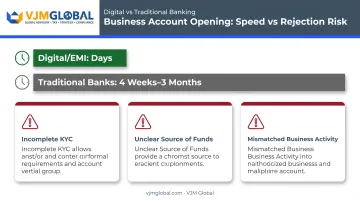
Set your expectations correctly from the start. Digital/EMI providers typically approve applications within days. Traditional UK banks can take considerably longer for non-resident applicants.
The UK government's own overseas business guidance puts the realistic range at four weeks to three months for setting up a UK bank account from abroad.
Common rejection reasons include:
- Incomplete KYC: missing ID, address proof, or ownership documentation
- Unclear source of funds: vague or unsupported explanations of where business income originates
- Mismatched business activity: the declared activity doesn't match invoices, contracts, or the company website
If your application is delayed past the stated timeline, contact the provider with your reference number and ask which documents are still under review. A short chase often surfaces a missing item you can fix quickly.
If you're rejected, don't just resubmit the same file. Identify exactly which requirement wasn't met, fix that specific gap, and reapply with a complete package.
Businesses facing repeated rejections often benefit from having a cross-border advisory firm like VJM Global review their documentation and confirm the UK entity structure meets provider expectations before they try again. It's a smaller upfront step that avoids weeks of back-and-forth later.
Frequently Asked Questions
Which UK business bank account is best for non-UK residents?
Digital/EMI providers like Wise or Airwallex suit UAE residents who need fast, fully online setup. Traditional banks suit those who need lending or an established UK presence.
Can a UAE company open a UK bank account without visiting in person?
Most digital/EMI providers allow entirely remote applications with video KYC. Some traditional banks may still require in-person verification at least once.
How long does it take to open a UK business bank account from the UAE?
Digital providers usually approve within a few business days. Traditional UK banks can take several weeks, sometimes longer, depending on compliance checks.
Do I need a UK company to open a UK business bank account from the UAE?
Some providers accept overseas (UAE) incorporated entities, while others require UK registration. Confirm this with your chosen provider before applying.
What is the minimum deposit required for a UK business account?
Many digital providers set no minimum balance. Some traditional banks apply minimum deposit or balance thresholds, so check the specific product terms.
Is Wise or Airwallex better for a UAE-based business?
Wise is typically stronger on low-fee international transfers. Airwallex offers broader multi-currency accounts and card features. Pick based on your transaction volume and the currencies you handle most.