Here's where many founders trip up: they treat "opening a branch office" as interchangeable with "incorporating a new US company." It isn't. Choosing the wrong path can leave your Dubai or Abu Dhabi parent company fully exposed to US liabilities it never intended to take on.
This article breaks down what a US branch actually is, the step-by-step registration process, the documents you'll need, realistic costs and timelines, and the tax traps that catch UAE businesses off guard.
Key Takeaways
- A US branch registers your existing UAE entity to do business in a state; it does not create a new company.
- Branches carry unlimited liability for the UAE parent, unlike a subsidiary structure.
- The federal Branch Profits Tax is 30% on repatriated earnings, with no US-UAE treaty relief available.
- Expect 4-8 weeks for registration; longer if documents need Arabic translation.
- Pick your state based on where you'll actually operate, not the cheapest filing fee.
What Is a US Branch Office, and How Is It Different From Opening a New Company?
A US branch isn't a new company at all. It's your existing UAE corporation registering to legally transact business in a US state under its own name, a process called foreign qualification. Delaware's own guidance describes it plainly: the filing recognizes an already-existing foreign corporation and doesn't create a new domestic one.
That distinction has teeth. Because the branch and the UAE parent are legally the same entity, the parent carries full, unlimited liability for whatever the branch does in the US, including debts, lawsuits, and contract disputes. There's no corporate veil separating the two, unlike a subsidiary, which stands as its own legal person.
Why State-by-State Registration Matters
US branch registration is never a one-time, nationwide event. You must foreign-qualify separately in every state where your business creates "nexus," meaning a "doing business" connection that triggers that state's authority-to-transact rules. Common nexus triggers include:
- Maintaining a physical office or warehouse
- Employing staff based in that state
- Holding frequent in-person client meetings there
- Storing inventory or keeping equipment in that state
Expand into three states, and you'll likely be filing three separate qualification packages, each with its own fee, its own agent requirement, and its own renewal calendar.
Branch Office vs. Subsidiary (New US Entity): Which Should a UAE Company Choose?
This is the decision most UAE founders get wrong before they even start the paperwork. A branch and a subsidiary look similar on the surface, but they diverge sharply on liability, tax exposure, and how US banks and investors perceive you.
| Factor | US Branch | US Subsidiary (LLC/C-Corp) |
|---|---|---|
| Legal identity | Same entity as the UAE parent | Separate US legal entity |
| Liability | Parent bears full, unlimited liability | Parent's exposure generally limited to its investment |
| Federal tax | 21% on effectively connected income, plus 30% Branch Profits Tax on repatriated earnings | Standard 21% corporate rate (C-Corp) or pass-through treatment (LLC); no branch profits tax |
| Investor appeal | Unfamiliar structure to most US investors | Familiar structure, far easier for raising US capital |
| Banking and credibility | Can invite extra scrutiny as a foreign-entity extension | Typically smoother through standard US bank onboarding |
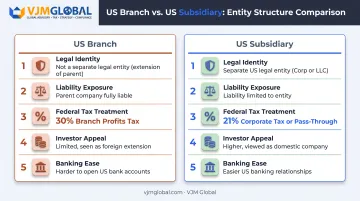
The IRS Form 1120-F instructions confirm the branch profits tax rate at 30% of the dividend-equivalent amount under Section 884, applied on top of the 21% federal rate on the branch's own taxable income. That's a meaningful tax stack to weigh against a subsidiary's simpler treatment.
When each structure makes sense:
- Subsidiary: Best for e-commerce, tech, or any plan that targets US investors. You get liability protection and a structure VCs and angels already know.
- Branch: Narrower fit—extending an existing contract, fulfilling a government tender, or bringing an established brand into the US without outside funding.
Step-by-Step Process to Open a Branch Office in the USA from the UAE
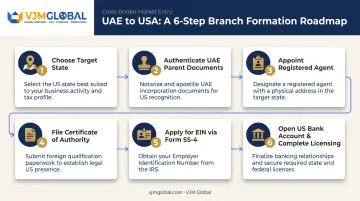
Steps 1-3: Structure, Documents, and Your Registered Agent
- Decide on the target state. Weigh nexus rules and ongoing tax treatment before you file anywhere:
| State | Initial filing fee | Ongoing obligation |
|---|---|---|
| Delaware | $245 | Annual report by June 30 ($250 fee); 8.7% corporate income tax on Delaware-apportioned income |
| Texas | $750 | Franchise tax report and Public Information Report due May 15 |
| New York | $225 | Article 9-A franchise tax return, plus a $9 biennial statement |
Authenticate your UAE parent company documents. Every state will want to see proof your company legitimately exists back home. That means pulling together:
- UAE trade license
- Memorandum and Articles of Association (MOA/AOA)
- Certificate of Incorporation
- Board resolution approving the US branch
- Passport copies of directors and authorized signatories
These documents then pass through an authentication chain before US authorities accept them: notarization in the UAE, attestation by the Ministry of Foreign Affairs and International Cooperation (MOFAIC), and authentication by the relevant US Embassy or Consulate.
The UAE is not a party to the Hague Apostille Convention, so a simple apostille will not substitute for this chain. Any Arabic-language original also needs a certified English translation.
- Appoint a Registered Agent in your chosen state. This is non-negotiable, regardless of whether you form a branch or subsidiary, and it applies to every state you register in. VJM Global helps UAE clients appoint a registered agent so state correspondence reaches the right place on time.
Steps 4-6: Filing, EIN, and Opening for Business
File your Certificate or Application of Authority with the state's Secretary of State, submitting your authenticated parent documents alongside a UAE Certificate of Good Standing.
Apply for an EIN using IRS Form SS-4. This step trips up more UAE founders than any other. Non-resident applicants without a US Social Security Number can't use the IRS online application.
According to the IRS instructions for Form SS-4, apply by phone at 267-941-1099, by fax, or by mail:
- Fax: typically about 4 business days
- Mail: roughly 4 weeks
- No SSN or ITIN for the responsible party: enter "foreign" on line 7b
VJM Global's New York office works with UAE clients on this filing, which often shortens IRS back-and-forth.
- Open a US business bank account and complete whatever state or local tax registration and licensing your specific activity requires.
Cost and Timeline to Open a US Branch from the UAE
Budget for these line items in your first year:
| Cost item | Typical cost / timing |
|---|---|
| State filing fee | $225 (NY) to $750 (TX) |
| Registered agent (annual) | $249 to $436 |
| EIN processing | Free; 4 business days by fax, up to 4 weeks by mail |
| UAE MOFAIC attestation | Digital: ~2 hours; courier: 1–3 business days |
| Certified translation | Varies by language pair and page count—get a quote upfront |
Timeline runs roughly 4–8 weeks for a fully operational branch:
- 1–3 weeks for document attestation in the UAE
- 2–6 weeks for state filing and EIN processing, run largely in parallel
- Extra time when Arabic documents need certified translation and multi-layer attestation
That last step is the bottleneck most UAE-based founders miss. Many assume the process moves as fast as UAE branch registration—and the calendar slips when it doesn’t.
Tax and Compliance Obligations for a UAE Branch Operating in the USA
A US branch is taxed on its US-source income at 21% federal on effectively connected income, calculated through Form 1120-F. On top of that sits the 30% Branch Profits Tax on earnings the branch doesn't reinvest in the US business, per IRS Form 1120-F.
There is no comprehensive income tax treaty between the US and the UAE. US Treasury and IRS treaty lists both confirm this. That means no automatic cut to the Branch Profits Tax rate—and real exposure to double taxation between US branch profits and UAE Corporate Tax (9% above AED 375,000).
Ongoing compliance doesn't stop at the tax return. Expect to manage:
- Annual state filings and reports (Delaware, Texas, and New York each run their own calendar)
- IRS Form 5472 for foreign-owned reporting corporations — $25,000 failure-to-file penalty, with another $25,000 if still open 90 days after IRS notice
- State-level sales tax and nexus obligations tied to your specific activities
Because the branch is legally one entity with the UAE parent, some US filings may require disclosing aspects of the parent's global financials, unlike a subsidiary, which files on its own.
Dual-jurisdiction rules like these are where a cross-border accounting team matters. VJM Global's US-trained CPAs and Chartered Accountants handle UAE Corporate Tax and VAT alongside US federal and state obligations, including nexus reviews, transfer pricing documentation, and W-8/W-9 and 1042-S withholding, so nothing slips between the two systems.
Common Mistakes UAE Businesses Make When Opening a US Branch
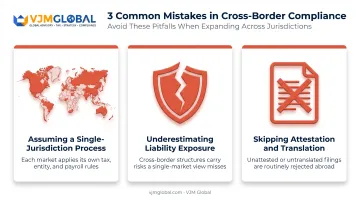
UAE companies often stall US branch setup on the same avoidable errors. Three show up most often:
- Assuming a single-jurisdiction process. Unlike more centralized UAE registration, every US state sets its own foreign qualification fees, forms, and renewals.
- Underestimating liability exposure. A true branch puts the full UAE parent on the hook for US claims, which hits asset-heavy or contract-heavy businesses hardest.
- Skipping attestation and translation. Missing notarization, MOFAIC and US Embassy authentication, or certified translation is the fastest path to a rejected state filing and weeks lost.
Frequently Asked Questions
Can a UAE company open a branch office in the USA without forming a new company?
Yes. Foreign qualification lets your existing UAE entity register to do business in a US state without incorporating a new domestic company. That's different from forming a subsidiary, which does create a separate US legal entity.
What is the difference between a US branch and a US subsidiary for a UAE company?
A branch is legally the same entity as the UAE parent, so you face unlimited liability and branch profits tax. A subsidiary is a separate US entity with liability protection, standard corporate tax treatment, and no branch profits tax.
Does a UAE company need a US visa or physical presence to open a branch office?
No. A Registered Agent and a registered US address satisfy the legal requirement in every state. A professional service provider can fulfill this role, so founders don't need to relocate or hold a US visa just to register.
How long does it take to register a branch office in the USA from UAE?
Plan for roughly 4-8 weeks total. That covers 1-3 weeks for UAE document attestation and 2-6 weeks for state filing and EIN processing, running largely in parallel.
Is there a tax treaty between the USA and UAE to avoid double taxation?
No. There is no comprehensive US-UAE income tax treaty currently in force. That means no automatic treaty relief on the 30% Branch Profits Tax, and double taxation risk on income reported in both the US and the UAE.
What US state is best for a UAE company to register its branch?
There's no single "best" state; it depends on where your business will actually operate or create nexus. Delaware and New York are commonly chosen for their business-friendly legal frameworks, but registering where you have no real presence wastes money.