Introduction
Singapore businesses face mounting pressure: accounting talent is expensive, in-house hiring is increasingly competitive, and compliance requirements from ACRA, IRAS, and CPF boards have grown steadily heavier. According to an ISCA survey from October 2025, 65% of Singapore businesses cite rising manpower costs as their top challenge—a persistent concern that's pushing finance leaders to explore smarter alternatives.
India has emerged as a preferred destination for accounting outsourcing globally, and Singapore businesses are well-placed to benefit. The geographic proximity, strong cultural and trade ties, and a manageable 2.5-hour time zone difference create ideal conditions for effective day-to-day collaboration — without the communication gaps that plague more distant offshore arrangements.
Key Takeaways
- Outsourcing to India can reduce accounting costs by up to 50% compared to hiring locally in Singapore
- India produces over 30,000 new Chartered Accountants annually, many trained in IFRS and international standards
- The Singapore–India time zone gap is 2.5 hours, enabling same-day collaboration and real-time query resolution
- Core services suitable for outsourcing: bookkeeping, payroll, GST filing prep, management reporting, tax computation support
- Choose a partner with proven international client experience, clear SLAs, and strong data security protocols
Why Singapore Businesses Are Turning to India for Accounting Support
The Talent and Cost Crunch in Singapore
Singapore's accounting market is tight. According to MOM's June 2024 wage survey, the median monthly salary for an accountant is SGD 5,498, while accounting managers command SGD 9,500. When you add employer CPF contributions (17% for employees 55 and below), benefits, office space, and training budgets, the fully-loaded annual cost of one in-house accountant exceeds SGD 77,000—and that's before bonuses.
Competition from MNCs and financial services firms drives salaries even higher. Many SMEs struggle to attract and retain qualified talent, especially for routine bookkeeping, payroll, and compliance tasks that don't require director-level oversight.
India and Singapore: A Natural Fit
India is Singapore's largest FDI source, with cumulative inflows of USD 186.82 billion from April 2000 to September 2025. Approximately 9,000 Indian companies are registered in Singapore, many using it as a holding company jurisdiction for regional operations.
That commercial depth translates directly into accounting expertise. Indian professionals working on Singapore-linked engagements are typically familiar with Singapore corporate structures, IFRS standards, and ACRA filing requirements — because many Indian firms already service Singapore subsidiaries or hold Singapore-registered clients. English is the working language on both sides, and business communication norms align closely enough that handoffs rarely need translation, literal or otherwise.
Time Zone Proximity: A Strategic Advantage
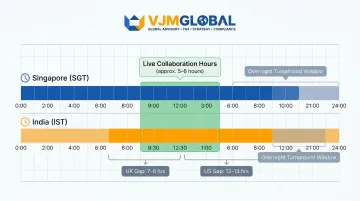
Singapore (SGT) is just 2.5 hours ahead of India (IST). This creates a working rhythm that other outsourcing destinations can't match:
- 5–6 hours of daily overlap — versus a 7–8 hour gap with the UK and 12–13 hours with the US
- Overnight turnaround — work submitted at 6 PM SGT is ready for review by 10 AM the next morning
- Live collaboration — urgent queries and scheduled calls fit comfortably into both teams' working hours without anyone joining at midnight
Key Benefits of Outsourcing Accounting to India for Singapore Businesses
Cost Efficiency Beyond Labor Arbitrage
The savings go beyond hourly rates. When you outsource to India, you eliminate:
- Employer CPF contributions (17% for most employees, rising to 17.5% for some age brackets from January 2026)
- Recruitment and onboarding costs
- Office space and equipment
- Accounting software licenses for each in-house user
- Training and professional development budgets
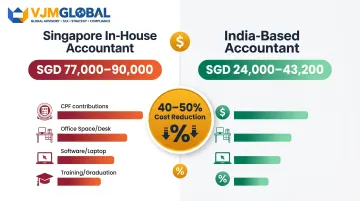
While a median accountant in Singapore costs approximately SGD 77,000-90,000 annually (fully-loaded), an equivalent India-based staff accountant costs USD 18,000-32,000 (approximately SGD 24,000-43,000) on a fully-loaded basis, according to industry cost benchmarks. That represents a potential 40-50% reduction in accounting function costs.
Deloitte's Global Outsourcing Survey 2024 found that 80% of executives plan to maintain or increase outsourcing investment, with cost reduction and skilled talent access ranking as top drivers.
Access to a Deep, Qualified Talent Pool
India produces approximately 900,000-1,000,000 commerce graduates annually. In 2024 alone, 31,946 new Chartered Accountants qualified through the Institute of Chartered Accountants of India (ICAI)—the world's second-largest accounting body with over 425,000 members.
Many Indian accounting professionals pursue international certifications:
- ACCA (Association of Chartered Certified Accountants) has over 252,500 members globally, with India representing a significant market
- Growing numbers hold CPA (Certified Public Accountant) credentials
- Many are trained in IFRS and GAAP through Big 4 experience
For Singapore businesses, this translates directly: you can hire offshore accountants already fluent in the standards your auditors and investors expect.
Scalability Without the Hiring Cycle
Need extra support during year-end close, GST filing deadlines, or audit preparation? Indian outsourcing firms allow you to scale up capacity immediately, then scale back down once the crunch passes. No recruitment lag, no probation periods, no redundancy costs.
For a Singapore SME preparing for an audit, this means engaging additional offshore capacity for a defined period rather than hiring a temporary accountant for three months and absorbing full onboarding and CPF costs.
Focus on Core Business Functions
When routine accounting tasks are handled offshore, Singapore-based finance staff and business owners can redirect their time toward strategic priorities: investor reporting, expansion planning, client relationships, and business development.
One Singapore e-commerce business outsourcing its bookkeeping and payroll to India freed its CFO to focus on fundraising preparation and financial modeling for international expansion. Those are the activities that move the needle — not month-end reconciliations.
Around-the-Clock Workflow
The 2.5-hour time zone overlap enables continuous workflow. A typical cycle looks like this:
- End of Singapore workday — month-end close data submitted to the India team
- Overnight processing — Indian accountants reconcile, categorize, and prepare reports
- Singapore morning — reviewers receive completed reports ready for sign-off
During tight deadlines, whether ACRA filing windows or audit preparation, this workflow continuity can compress project timelines by 30-40% compared to purely local processing.
What Accounting Services Can Singapore Businesses Outsource to India?
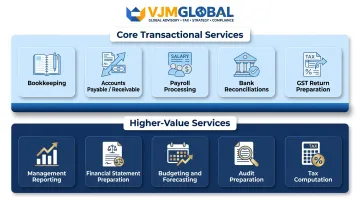
Core Transactional and Compliance Services
These high-volume, repetitive tasks are well-suited for offshore delivery:
- Bookkeeping and general ledger maintenance — daily transaction recording, journal entries, and reconciliation
- Accounts payable and receivable — invoice processing, supplier payments, billing, collections, and aging analysis
- Payroll processing — salary calculations, CPF contributions, leave tracking, and payslip generation (note: CPF submission responsibility stays with the Singapore employer)
- Bank reconciliations — monthly reconciliation of bank statements against general ledger cash accounts
- GST return preparation — compiling transaction data and preparing GST F5 returns; final IRAS submission must be overseen locally, as legal responsibility remains with the Singapore business
Higher-Value Services
Experienced India-based teams can also take on more analytical work:
- Management reporting — monthly management accounts, variance analysis, budget vs. actual comparisons, and KPI dashboards
- Financial statement preparation — P&L, balance sheets, and cash flow statements aligned with ACRA filing requirements
- Budgeting and forecasting — annual budgets, rolling forecasts, and scenario modeling
- Audit preparation — supporting documentation, reconciliation schedules, and audit workpapers
- Corporate tax computation — tax provisions, deferred tax analysis, and workpaper preparation to support (not replace) final IRAS submissions
What Typically Stays In-House or Local
- Final regulatory filings with ACRA (annual returns, financial statements submission)
- Director-level sign-offs and approvals
- Statutory audits (must be conducted by a Singapore-registered auditor)
- Tax advisory requiring local legal interpretation (e.g., complex restructuring, M&A tax implications)
These boundaries matter. Outsourcing handles the operational workload — the India-based team processes, prepares, and reconciles. Your Singapore-based team retains oversight, sign-off authority, and direct accountability to ACRA and IRAS.
Understanding the Cost: What Singapore Businesses Can Expect to Pay
Realistic Cost Ranges
Bookkeeping Services
USD 1,500-2,700 per month (approximately SGD 2,000-3,600) for a dedicated staff accountant handling day-to-day transactions, reconciliations, and ledger maintenance.
Payroll Processing
USD 500-1,200 per month (approximately SGD 675-1,600) depending on employee count and complexity (e.g., variable bonuses, multiple leave types).
Financial Reporting and Management Accounts
USD 2,000-3,500 per month (approximately SGD 2,700-4,700) for monthly management accounts, variance analysis, and executive dashboards.
These figures are directional based on industry benchmarks; actual costs vary based on scope, complexity, and provider.
Comparing Against Local Hiring Costs
Local Singapore Accountant (Median)
- Monthly base salary: SGD 5,498
- Employer CPF (17%): SGD 935
- Fully-loaded monthly cost: SGD 6,433
- Annual cost (excluding bonuses): SGD 77,196
India-Based Staff Accountant
- Fully-loaded monthly cost: USD 1,500-2,700 (SGD 2,000-3,600)
- Annual cost: SGD 24,000-43,200
Potential annual savings: SGD 34,000-53,000 (44-69%)
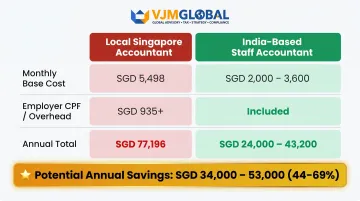
This does not include additional local overhead like office space, software, and training—making the true savings even higher.
Pricing Models
Hourly Billing
Suitable for ad-hoc projects, one-off financial statement prep, or audit support. Typical rates: USD 20-40 per hour (SGD 27-54).
Monthly Retainer
Best for ongoing bookkeeping, payroll, and management reporting. Provides cost predictability and dedicated resource allocation.
Per-Project Pricing
Ideal for defined deliverables like year-end close, tax computation, or audit preparation.
Quality Should Anchor the Cost Conversation
Understanding pricing models is only half the picture. The right provider also needs to understand Singapore's regulatory environment.
The cheapest provider is rarely the best choice. Firms lacking familiarity with Singapore-specific requirements—ACRA filing formats, XBRL tagging, IRAS GST rules, CPF compliance—may produce work requiring significant local rework, wiping out the cost savings and introducing compliance gaps.
When evaluating providers, ask specifically about their Singapore client portfolio, familiarity with IRAS filing cycles, and how they handle XBRL tagging. A firm that can answer these questions confidently is worth the premium over a generalist with no Singapore exposure.
Key Risks to Watch Out For—and How to Mitigate Them
Outsourcing accounting across borders introduces real exposure — in data security, compliance accuracy, communication breakdowns, and internal oversight. Here's how each risk plays out and what to do about it.
Data Security and Confidentiality
Singapore's Personal Data Protection Act (PDPA) applies even when data is processed overseas. Section 26 of the PDPA requires that any organisation transferring personal data outside Singapore must ensure a standard of protection comparable to the PDPA.
Permitted transfer mechanisms include:
- Contractual data processing agreements binding the recipient to PDPA-comparable protections
- Individual consent (after disclosure of protection standards)
- Transfers necessary for contract performance
The Singapore business retains compliance responsibility even after data leaves Singapore. In a 2017 PDPC case, Toll Logistics received warnings for transferring employee data to an Ireland-based HR vendor without ensuring comparable protection.
Mitigation steps:
- Verify your India partner holds ISO 27001 certification (the international standard for information security management)
- Include PDPA-compliant data processing clauses in your service contract
- Confirm that access to sensitive financial data is controlled, logged, and auditable
Quality and Compliance Gaps
An Indian firm unfamiliar with Singapore-specific requirements can produce work that looks correct but fails local compliance checks—requiring costly rework and risking late filings.
Common gaps include:
- ACRA filing format errors or incomplete XBRL tagging
- IRAS GST return miscalculations due to unfamiliarity with output tax vs. input tax rules
- CPF contribution errors (for example, incorrect wage ceilings or age-based rate application)
To reduce this risk:
- Provide detailed SOPs (Standard Operating Procedures) for each outsourced process
- Run a structured pilot engagement (2-3 months) with one process before full rollout
- Assign an internal reviewer to validate outputs before regulatory submission
Communication and Oversight Risks
Vague scope, informal review processes, and unclear ownership of deliverables are the most common causes of outsourcing failure. Accounting is no exception.
Mitigation steps:
- Set documented SLAs covering turnaround times, deliverable formats, and quality standards
- Assign an internal point of contact responsible for coordinating with the offshore team
- Schedule regular review calls (weekly or bi-weekly) to address issues proactively
Over-Dependence Without Internal Control
Outsourcing does not transfer accountability. Singapore directors remain legally responsible for the accuracy of financial statements filed with ACRA and tax returns submitted to IRAS.
Before each submission:
- Ensure a senior in-house reviewer (CFO, finance manager, or external advisor) validates all outsourced outputs
- Maintain internal visibility into key financial data and assumptions
- Treat the outsourced team as an extension of your finance function, not a replacement for oversight
How to Choose the Right India-Based Accounting Partner
Key Evaluation Criteria
Demonstrated International Client Experience
Look for firms serving clients in USA, UK, Australia, or other advanced markets—not just domestic Indian businesses. International clients demand higher standards of documentation, communication, and compliance rigor.
Familiarity with Singapore Regulatory Requirements
Ask: "Have you prepared ACRA XBRL filings before? How do you handle IRAS GST compliance?" If the answer is vague, expect a steep learning curve—on your dime.
Verifiable Data Security Certifications
ISO 27001 is the gold standard. Ask for a copy of the current certificate and confirm scope covers financial data processing.
Transparent SLA Commitments
Request sample SLAs covering turnaround times, deliverable quality standards, error correction protocols, and escalation procedures. Generic promises are red flags.
Proven Track Record
Ask for client references, case studies, or testimonials from businesses similar to yours in size and industry.
Start with a Structured Pilot
Rather than outsourcing your full accounting function immediately, begin with one well-defined process—for example, monthly bookkeeping or payroll processing.
Pilot engagement steps:
- Define scope, deliverables, and success criteria clearly
- Run the pilot for 2-3 months
- Evaluate performance against SLAs: accuracy, timeliness, communication quality
- Identify process improvements before scaling to additional functions
This reduces risk while building trust and process alignment between teams.
Consider a Partner Like VJM Global
The right partner will have already solved the problems Singapore businesses typically face—cross-border compliance rigor, holding company structures, and precision in regulatory filings. VJM Global has built that track record across three decades of international client work.
Key credentials worth noting:
- 30+ years of experience in tax, audit, and cross-border advisory
- 100+ professionals trained in IFRS, GAAP, and international compliance standards
- 95% client retention rate across USA, UK, and Australian engagements
- EAI International member — a globally recognised network of independent accounting and tax firms
- Hands-on experience with cross-border tax implications, FDI structures, and multi-jurisdiction reporting

That combination of scale, retention, and international exposure means Singapore businesses aren't starting from scratch with a firm learning your requirements on the job.
Frequently Asked Questions
How much does it cost to outsource accounting to India?
Typical costs range from SGD 2,000–3,600 per month for bookkeeping, SGD 675–1,600 for payroll, and SGD 2,700–4,700 for management reporting—representing 40–60% savings compared to hiring locally in Singapore.
Is outsourcing accounting to India worth it?
Yes, provided you choose a qualified partner and maintain internal oversight. For most Singapore SMEs, the cost savings, scalability, and access to skilled talent make it a practical, well-tested choice.
How do Singapore businesses get started with outsourcing accounting to India?
Most businesses follow three steps to get started:
- Identify which processes to outsource first — bookkeeping, payroll, or reporting
- Shortlist India-based firms with proven international client experience
- Run a 2–3 month pilot, then formalize SLAs and communication protocols before full rollout
What accounting services can Singapore businesses outsource to India?
Core services include bookkeeping, payroll processing, GST filing preparation, management reporting, financial statement preparation, and audit support. Final regulatory submissions to ACRA and IRAS should remain under local oversight.
How is data security handled when outsourcing accounting to India?
Verify that your partner holds ISO 27001 certification, ensure your service contract includes PDPA-compliant data processing clauses, and confirm that access to sensitive financial data is controlled, logged, and auditable. The Singapore business retains legal responsibility for data protection even after data is transferred to the outsourcing partner.