Introduction
Singapore business owners face mounting pressure: tax manager salaries reaching SGD 125,000–168,000 annually, tight IRAS filing deadlines, and 72% of finance employers reporting difficulty finding qualified tax professionals. Salary increases alone aren't closing that gap — which is why more Singapore businesses are turning to India for tax preparation support.
India offers a deep pool of qualified Chartered Accountants at significantly lower cost, with working hours that overlap with Singapore's business day. This guide covers:
- Why India is a practical fit for Singapore tax outsourcing
- Which tax tasks you can delegate safely
- How the end-to-end process works
- What IRAS compliance factors you must account for
Key Takeaways
- India offers 40-50% cost savings versus Singapore local rates for tax preparation work
- Access 400,000+ Chartered Accountants trained in international tax frameworks
- Key outsourced tasks include CIT preparation, GST returns, ECI filings, and transfer pricing documentation
- India Standard Time runs just 2.5 hours behind Singapore, making same-day collaboration straightforward
- Final review, IRAS correspondence, and all official filings must stay with a Singapore-registered tax agent or internal team
- Set up PDPA-compliant data processing agreements, NDAs, and defined review workflows before going live
What Is Tax Preparation Outsourcing to India?
Tax preparation outsourcing is the practice of engaging an India-based accounting team to compile tax returns, prepare supporting workpapers, and handle back-office compliance tasks on behalf of a Singapore business or its accounting firm.
This is not a replacement for a Singapore tax consultant. Outsourcing is a production and delivery model for routine compliance work—not high-judgment advisory or IRAS representation. The India team handles the preparation layer; Singapore-side professionals retain responsibility for final review, client communication, and submission.
Why India is a natural fit for Singapore businesses
Several structural factors make India a practical destination for Singapore tax outsourcing:
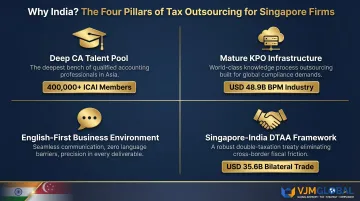
- Deep CA talent pool: India has over 400,000 ICAI members and 850,000+ students pursuing CA qualifications — many with hands-on experience in IFRS, transfer pricing, and cross-border tax relevant to Singapore MNCs.
- Mature KPO infrastructure: Indian firms routinely work inside clients' accounting systems (Xero, QuickBooks, SAP) with established data security protocols. India's BPM segment generates USD 48.9 billion in annual revenue.
- English-first business environment: English is the standard language for professional and business communication across Indian accounting firms, reducing coordination friction.
- Established bilateral framework: Singapore and India share a Double Taxation Avoidance Agreement (DTAA) and bilateral trade exceeding USD 35.6 billion, giving cross-border financial collaboration a clear legal and commercial footing.
Why Singapore Businesses Are Choosing India for Tax Outsourcing
Cost pressure: Quantifying the savings
Tax managers in Singapore earn SGD 125,000–168,000 annually at the 25th–75th percentile, with Tax Directors reaching SGD 209,000–336,000. These are base salaries—total employer costs (CPF, bonuses, recruitment fees, office overhead) push effective costs significantly higher.
India-based accounting hourly rates range from approximately USD 9.50 to USD 27.50 depending on seniority. Reuters reports typical cost savings of 40-50% for companies outsourcing to India, based on NASSCOM data.
For a mid-market Singapore firm processing 50 CIT returns annually, the cost differential between maintaining a full-time local tax manager versus engaging an India-based CA firm for preparation work is substantial.
The 2.5-hour time zone advantage
India Standard Time (UTC+5:30) is only 2.5 hours behind Singapore Time (UTC+8). An Indian team working 9:00 AM–6:00 PM IST overlaps with Singapore's 11:30 AM–8:30 PM SGT window, enabling approximately 6.5 hours of concurrent working time.
Time zone comparison for Singapore businesses:
| Outsourcing Destination | UTC Offset | Gap from SGT | Same-Day Overlap |
|---|---|---|---|
| India (IST) | UTC+5:30 | 2.5 hours | ~6.5 hours |
| United Kingdom (GMT) | UTC+0 | 8 hours | Minimal |
| United States (EST) | UTC-5 | 13 hours | Near-zero |
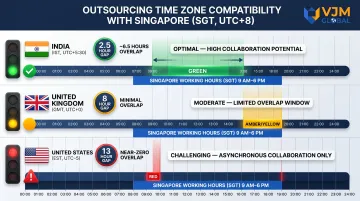
This near-alignment means a Singapore CFO can send queries at 9:00 AM SGT and receive responses by 11:30 AM the same day. US-based providers operate asynchronously, where turnaround inherently spans overnight cycles.
India's talent depth and infrastructure
India produces approximately 300,000 new CA qualifications annually, creating a continuously refreshed talent pipeline. Many Indian CAs working in outsourcing firms develop familiarity with multiple jurisdictions' tax frameworks, including IFRS-based reporting and OECD-aligned transfer pricing benchmarking.
Reputable India-based firms — including VJM Global, which prepares transfer pricing documentation aligned with OECD principles and IRAS Transfer Pricing Guidelines — typically offer:
- Secure data protocols and cloud-based workflow tools
- Experience working within clients' existing accounting systems
- FAR analysis and arm's length benchmarking studies
- Multi-jurisdiction compliance capabilities built over decades of serving US, UK, and Australian clients
Singapore-India bilateral ties support cross-border collaboration
This operational maturity is reinforced by a strong bilateral framework. Singapore and India maintain a comprehensive Avoidance of Double Taxation Agreement, with the updated protocol entering force on 1 October 2019. Combined with deep commercial ties, this makes India a familiar and well-regulated partner for Singapore-headquartered businesses.
What Singapore Tax Work Can Be Outsourced to India
Most of the preparation and documentation work across Singapore's core tax obligations can be handled offshore. The Singapore-side team retains review authority and filing responsibility throughout.
Corporate Income Tax (CIT) Preparation
Indian CA teams can compile income schedules, reconcile accounting profit to taxable income, compute tax payable, and prepare workpapers ready for Singapore-side review. The reviewer verifies the computation and submits via myTax Portal with Corppass authorization.
- Form C-S for businesses with revenue ≤ SGD 5 million
- Form C for all others
- Filing deadline: 30 November annually
- Directors remain legally responsible for timely and accurate filing, even when a tax agent is engaged
GST return preparation
Quarterly GST computation, output/input tax reconciliation, and exception flagging can be handled offshore. The Singapore team retains responsibility for final review and e-filing.
GST filing deadlines by quarter:
- Jan–Mar period: 30 April
- Apr–Jun period: 31 July
- Jul–Sep period: 31 October
- Oct–Dec period: 31 January
- Nil returns are required even when there is no business activity
Estimated Chargeable Income (ECI)
ECI computation and supporting documentation can be prepared offshore based on management accounts, with filings due within three months of financial year-end. Waivers apply if annual revenue ≤ SGD 5 million and ECI is nil.
Transfer pricing documentation
For Singapore businesses with related-party transactions, Indian CA firms with international tax experience can prepare contemporaneous TP documentation and benchmarking analyses under IRAS Transfer Pricing Guidelines.
Mandatory requirements from YA 2019 onwards:
- Applies when gross revenue exceeds SGD 10 million
- Documentation must be completed by the Income Tax Return filing deadline
- Must be produced within 30 days upon IRAS request
- Retained for at least 5 years
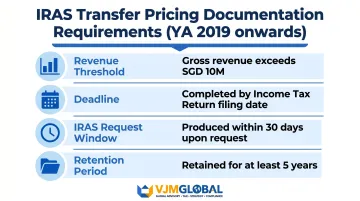
VJM Global's team prepares OECD-aligned benchmarking studies and FAR (Functions, Assets, Risks) analyses that meet IRAS documentation standards.
Payroll-related tax forms
Preparation of IR8A, IR8E, and IR21 forms for employees (including foreign workers) can be handled as part of an integrated payroll and tax back-office arrangement.
IR8A deadline: 1 March each year (for all employees: full-time, part-time, non-resident, directors, pensioners)
IR21 requirement: Tax clearance when foreign/SPR employee ceases employment, goes on overseas posting, or leaves Singapore for 3+ months
What must stay onshore
Certain responsibilities cannot be delegated offshore and must remain with a Singapore-registered tax agent or the business's qualified in-house team:
- IRAS correspondence and audit responses
- Tax advisory on structuring decisions
- Client-facing communications
- Actual submission of returns through myTax Portal with Corppass authorization
How Tax Preparation Outsourcing to India Works — Step by Step
The engagement functions as an extension of your Singapore firm's internal tax production process. The India team handles preparation and workpapers; all review, judgment, and filing authority stays with your Singapore side.
Step 1: Scoping and Onboarding
Define the scope of work: which tax types, which entities, complexity levels. Execute an NDA and a data processing agreement that satisfies Singapore's PDPA requirements for third-party data processors.
Configure secure access to shared workspaces or your accounting system. VJM Global provides access to secure document portals or works directly within your existing accounting platform — whichever fits your workflow.
Typical onboarding duration: Varies by complexity, but initial setup generally completes within 1-2 weeks once all agreements are signed.
Step 2: Document Sharing and Preparation
You provide source documents via a secure portal:
- Trial balance
- Prior tax returns
- Payroll data
- Invoices for GST
The India-based CA team prepares draft returns, workpapers, and open-item lists using agreed templates and your firm's naming conventions.
Step 3: Internal Quality Review and Open Items
The India team conducts a preparer-checker review before returning work. Any unresolved queries are documented in a shared tracker — not scattered across email threads.
VJM Global assigns separate preparation and review teams, so your Singapore reviewer receives clean, organized work rather than chasing open items across inboxes.
Step 4: Singapore-Side Final Review and Filing
Your Singapore tax agent or in-house reviewer takes the completed return across the finish line. This includes:
- Reviewing the draft return and supporting workpapers
- Applying professional judgment on complex tax positions
- Resolving any remaining open items
- Submitting the return to IRAS via mytax.iras.gov.sg
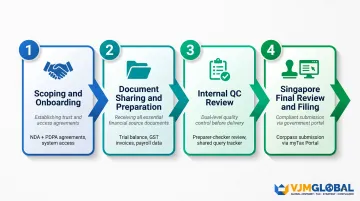
Filing requires Corppass authorization. Authorize your tax agent as an "Approver" under the "Corporate Tax (Filing and Application)" digital service before submission.
Key Considerations Before You Outsource
PDPA compliance: Protecting personal data
Singapore's Personal Data Protection Act requires businesses to ensure that any overseas third party handling personal data of Singapore residents processes it with appropriate safeguards.
Section 26(1) of the PDPA mandates that overseas recipients must be bound by legally enforceable obligations providing protection comparable to the PDPA.
Acceptable mechanisms:
- Contractual clauses requiring the recipient to provide comparable protection
- Law in the recipient's country providing comparable protection
- Binding Corporate Rules for intra-group transfers
Minimum contractual requirements for Data Intermediaries (typical outsourcing scenario):
- Data protection obligations
- Data retention limits
Before engaging an India-based provider, confirm they have signed a Data Processing Agreement (DPA), maintain documented data security controls, and hold relevant certifications such as ISO 27001.
Choosing the right India-based partner
Not all Indian accounting firms have international tax exposure. Look specifically for:
Key credential indicators:
- ICAI membership (qualified Chartered Accountants)
- ISO 27001 certification for information security
- SOC 2 Type II reports
- Experience serving Singapore, Australian, UK, or US clients
- Transparent pricing models
- Evidence of working within international accounting software environments

VJM Global has served 500+ American, UK, and Australian businesses across 15+ industries, with a team of qualified CAs and CPAs trained in international standards including IFRS. For Singapore businesses, that cross-border experience translates directly — the compliance mindset, documentation discipline, and familiarity with common accounting platforms carry over regardless of jurisdiction.
When outsourcing may not be the right fit
Outsourcing adds friction rather than efficiency if:
- Your internal processes are disorganized (no clean trial balance, inconsistent records)
- You have highly complex bespoke tax positions requiring constant IRAS engagement
- You need frequent real-time advisory rather than production support
Stabilize your internal workflows first. The best outcomes come when the India team operates as a structured extension of your workflow — with defined inputs, clear handoffs, and regular review points.
When you are ready, these foundations make the difference:
Success factors:
- Clear SOPs (standard operating procedures)
- Defined turnaround expectations
- Feedback loop after each batch of work
Frequently Asked Questions
How much does it cost to outsource tax preparation to India?
Costs vary by service type and complexity. India-based firms typically charge per return, per hour, or on a monthly retainer basis. Singapore businesses typically see 40-50% savings versus local rates. For a scoped quote based on entity count and filing types, contact the provider directly.
How much do tax consultants in India charge for tax preparation?
Hourly rates at Indian CA firms typically range from USD 9.50 to USD 27.50, depending on firm size and the seniority of the professional assigned. Fixed per-return and monthly retainer structures are also common for recurring compliance work.
Is outsourcing tax preparation to India illegal?
No. Outsourcing tax preparation work to India is legal for Singapore businesses. You must ensure PDPA compliance when sharing personal data offshore, and the final filing with IRAS must be made by or under the supervision of an authorized tax agent or the company itself via myTax Portal with Corppass authorization.
Is outsourcing tax preparation to India a good idea?
Yes, for most Singapore businesses with organized records and repeatable compliance tasks. The 2.5-hour time-zone gap and 40-50% cost savings make it practical — provided you have clear workflows and a partner with proven Singapore-jurisdiction experience.
How do I outsource tax preparation from Singapore to India?
A practical starting sequence:
- Identify which tasks to outsource — CIT, GST, ECI, or TP documentation
- Vet an India-based CA firm with Singapore-relevant credentials and international experience
- Execute an NDA and PDPA-compliant data processing agreement
- Run a defined pilot scope (such as 5–10 returns) before moving to full production
Are US CPAs in demand in India for outsourced tax work?
India's outsourcing firms often staff professionals with US CPA, EA, or CA qualifications for US-focused clients. For Singapore businesses, the relevant qualification is an Indian CA with international tax exposure. Many Indian CA firms have separate practice groups for different jurisdictions, including Singapore-linked work.