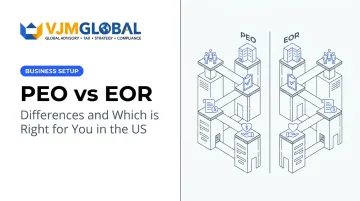
Choosing the wrong model can expose you to employment law violations, trigger unexpected entity registration requirements, or leave you paying for infrastructure you don't need.
This article breaks down exactly what each model does, where they differ, and how to decide which one fits your situation.
Key Takeaways
- An EOR acts as the sole legal employer — no local entity needed — making it the go-to for international or new-market hiring
- A PEO operates as a co-employer alongside your existing registered entity, keeping you as the legal employer of record
- Whether you have a registered entity in the hire location is the single most important deciding factor
- PEOs typically require a minimum of 5–10 employees; EORs can onboard a single hire
- Both models can run in parallel within the same company for different markets or workforce segments
PEO vs. EOR: Quick Comparison
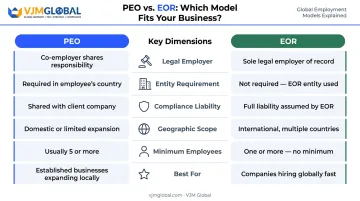
The table below maps both models across six key dimensions — use it to spot which one fits your situation before reading further.
| Dimension | PEO | EOR |
|---|---|---|
| Legal Employer | Client company (co-employment) | EOR provider |
| Entity Requirement | Client must have a registered entity | No entity required |
| Compliance Liability | Shared between PEO and client | EOR assumes full liability |
| Geographic Scope | Primarily domestic (US) | Global / cross-border |
| Minimum Employees | Typically 5–10 | As few as one |
| Best For | Domestic scaling with existing entities | New markets, international hiring |
What Is a PEO?
A Professional Employer Organization enters a co-employment relationship with your business to manage HR functions — payroll processing, tax filings, benefits administration, workers' compensation, and compliance guidance, while you remain the legal employer.
Your employees work for you. You direct their day-to-day activities and set their compensation; the PEO handles the administrative employment infrastructure behind the scenes. The IRS recognizes Certified PEOs as the employer for purposes of remitting wages and taxes under their own EIN — but legal employer status stays with the client.
Core PEO Services
- Payroll processing and tax withholding/filing
- Group health, dental, vision, and 401(k) benefits administration
- Workers' compensation coverage
- Onboarding and HR administration
- Employment compliance guidance
The Benefits Pooling Advantage
PEOs aggregate employees across hundreds of client companies, which lets them negotiate group insurance rates that small businesses couldn't access independently.
NAPEO's research found average annual health-benefit savings of $654 per full-time employee, representing 37% of total PEO cost savings. Roughly 63% of new PEO clients report lower health benefit costs after switching.
Who PEOs Work Best For
PEOs suit US-based small to mid-sized businesses (typically 5–50+ employees) that:
- Already have a registered legal entity in each state where they're hiring
- Want to offload HR administration without losing employer control
- Are looking for cost-effective group benefits access
PEO Pricing
Two common structures:
- Flat fee: $500–$1,500 per employee per year (Rippling, 2026), with published vendor rates starting around $99–$125 per employee per month
- Percentage of payroll: typically 3%–8% of total payroll, with some vendors reaching 12% for broader service packages
Pricing varies by company size, industry, and location — get quotes from at least two or three providers before committing.
What Is an EOR?
An Employer of Record is a third-party organization that legally employs workers on your behalf. The EOR signs employment contracts, runs payroll in local currency, administers statutory benefits, files taxes, and assumes full compliance responsibility — in whatever jurisdiction the worker is located.
This is the key legal distinction: unlike a PEO, the EOR is the sole legal employer in the eyes of the law. You manage the employee's day-to-day work and deliverables. The EOR owns all legal obligations attached to that employment relationship.
The Entity Advantage
Setting up a foreign legal entity independently can cost $15,000–$20,000 upfront, with annual maintenance running around $40,000, and the process can take 4 to 12 months, sometimes longer, before reaching full operational status. An EOR eliminates that entirely by using its own established entities in the countries where it operates.
Core EOR Services
- Compliant employment contracts in local format
- Payroll in local currency with statutory deductions
- Country-specific benefits and statutory contributions
- Tax withholding and filings
- Visa and work permit support (where applicable)
- Onboarding, offboarding, and risk mitigation
Who EORs Work Best For
EORs suit companies that:
- Want to hire in a country or US state where no entity exists yet
- Need to onboard one or a few employees quickly
- Are testing a new market before committing to entity setup
- Want to eliminate compliance liability entirely
EOR also works as a bridge: many companies hire through an EOR while their own entity is being established, then shift to direct payroll or a PEO once they're fully operational in that market.
EOR Pricing
EOR fees tend to run higher per employee than PEO fees, reflecting the full liability transfer:
- Flat monthly rates: approximately $300–$1,000 per employee per month
- Major providers like Remote ($699/month) and Deel ($599/month) publish US EOR rates in this range
For a team of three employees, EOR fees over 12 months ($25,000–$36,000) typically cost less than a single entity setup — making it the financially sound choice until headcount justifies a permanent structure.
PEO vs. EOR: Key Differences That Matter
Legal Employer and Liability
This is the foundational difference. A PEO operates as a co-employer: you retain legal employer status and share compliance exposure. If an employment law violation occurs, you bear legal risk alongside the PEO.
An EOR takes on sole legal employer status. Your compliance liability is sharply reduced because the EOR holds all obligations under local labor law.
Entity Requirements in Practice
If you want to hire in a new US state or a foreign country where you have no registered entity, only an EOR can facilitate that hire immediately. A PEO requires the entity to already exist — there's no workaround.
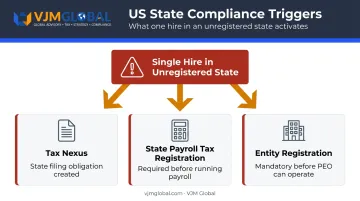
This matters more than most businesses initially realize. A single hire in an unregistered state can trigger:
- Tax nexus — creating a filing obligation in that state
- State payroll tax registration — required before running payroll
- Entity registration — mandatory before any PEO can operate there
Benefits and Insurance Structure
| Factor | PEO | EOR |
|---|---|---|
| Benefits type | Pooled US group plans (health, dental, 401k) | Country/state-specific statutory benefits |
| Insurance coverage | Often an add-on cost | Typically included in service fee |
| Best value for | Domestic US teams | International or multi-jurisdiction teams |
When EOR Becomes More Expensive Than an Entity
EOR makes financial sense for small headcounts in new locations. As your team in a single location grows, the math shifts. Most providers and legal advisors put the crossover threshold at 5–15 employees in a single location — at that point, the cumulative EOR fees often exceed the annualized cost of maintaining a local entity and running direct payroll. The exact threshold varies by country and provider.
Which One Is Right for Your Business?
Run through three diagnostic questions:
1. Do you already have a legal entity in the hire location?
- Yes → PEO is a viable option
- No → EOR is the practical choice
2. Are you hiring domestically in the US, or expanding internationally?
- Domestic US with existing state entities → PEO
- Cross-border, multi-country, or new US state without entity → EOR
3. How much compliance liability are you willing to retain?
- Want to offload all legal employer risk → EOR
- Comfortable with shared responsibility and have HR infrastructure → PEO
Situational Decision Guide
Choose PEO if:
- Your workforce is US-based and you have existing state entities
- You want access to better group benefits rates through employee pooling
- You prefer to retain legal employer status and direct HR control
- Your headcount is above the typical 5–10 employee minimum
Choose EOR if:
- You're entering a new country or US state without a registered entity
- You need to hire quickly — one employee or a handful
- You want full compliance liability off your plate
- You're testing a market before committing to entity setup costs
A Note for US Companies Expanding to India
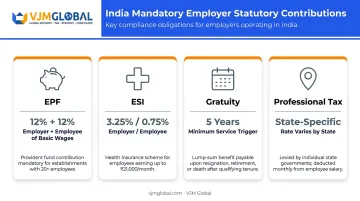
For US businesses establishing operations in India, the PEO vs. EOR question applies directly to the Indian regulatory environment, which is more complex than domestic US hiring. Mandatory statutory contributions include:
- EPF (Employees' Provident Fund): 12% of basic wages — both employer and employee
- ESI (Employees' State Insurance): 3.25% employer / 0.75% employee for eligible workers
- Gratuity: Statutory obligation once employees cross 5 years of service
- Professional Tax: Varies by state
An EOR handles all of these during early-stage entry. As headcount grows and a company establishes its own Private Limited Company or Wholly Owned Subsidiary, bringing payroll and compliance in-house under a dedicated partner becomes the more cost-efficient path.
VJM Global's India business setup and compliance services support US companies through this progression — from entity establishment (typically 15–30 working days from DSC to Certificate of Incorporation) through post-incorporation registrations for GST, EPFO, ESIC, and ongoing payroll compliance.
Conclusion
The right choice between PEO and EOR comes down to one core fact: whether a legal entity exists in the hire location. Beyond that, your headcount scale and how much compliance responsibility you're willing to manage determine which model fits.
US companies focused on domestic growth with established state entities are well-suited to a PEO — it delivers cost-effective HR support and access to pooled benefits. Companies entering new markets internationally, or new US states without entities, are better served by an EOR, which provides speed, flexibility, and full compliance coverage.
The two models aren't mutually exclusive. Many companies run a PEO for their domestic US workforce and an EOR for their international teams simultaneously — and transition from EOR to owned entity as headcounts grow.
Frequently Asked Questions
Can a foreign company use a PEO in the US without a US legal entity?
No. A PEO requires the client company to have a registered legal entity in the US — and in each state where employees are hired. Without a US entity, the company must use an EOR, which can legally employ US-based workers on its own behalf without any entity requirement on the client's side.
Is EOR more expensive than PEO in the US?
EOR fees appear higher per employee, but they avoid entity setup costs ($15,000–$20,000+) and annual maintenance (~$40,000) that PEO assumes you've already handled. For small headcounts or new market entry, EOR is often more cost-effective. Both models use similar fee structures — flat PEPM or a percentage of payroll.
Can a US company use both a PEO and an EOR at the same time?
Yes, and many do. A PEO handles the domestic US workforce where entities are established, while an EOR covers international employees in countries where no legal entity exists. Both can operate in parallel within the same HR and payroll ecosystem.
What are the minimum employee requirements for PEO vs. EOR in the US?
PEOs typically require a minimum of 5–10 employees, making them unsuitable for single hires or very small teams. EORs have no meaningful minimum — most providers can onboard a single employee — making them the preferred choice for gradual or test-market expansion.
How does legal liability differ between PEO and EOR?
With a PEO, liability is shared — the client remains the legal employer and carries exposure if employment laws are violated. With an EOR, the provider assumes full legal employer status and takes on all compliance liability, which means significantly less legal risk for the client company.
When should a business transition from EOR to its own legal entity?
The transition makes financial sense when cumulative EOR fees exceed the cost of maintaining a local entity — generally at 5–15 employees, though the exact threshold varies by country, entity type, and provider pricing. Beyond that point, direct payroll or a PEO arrangement typically costs less.