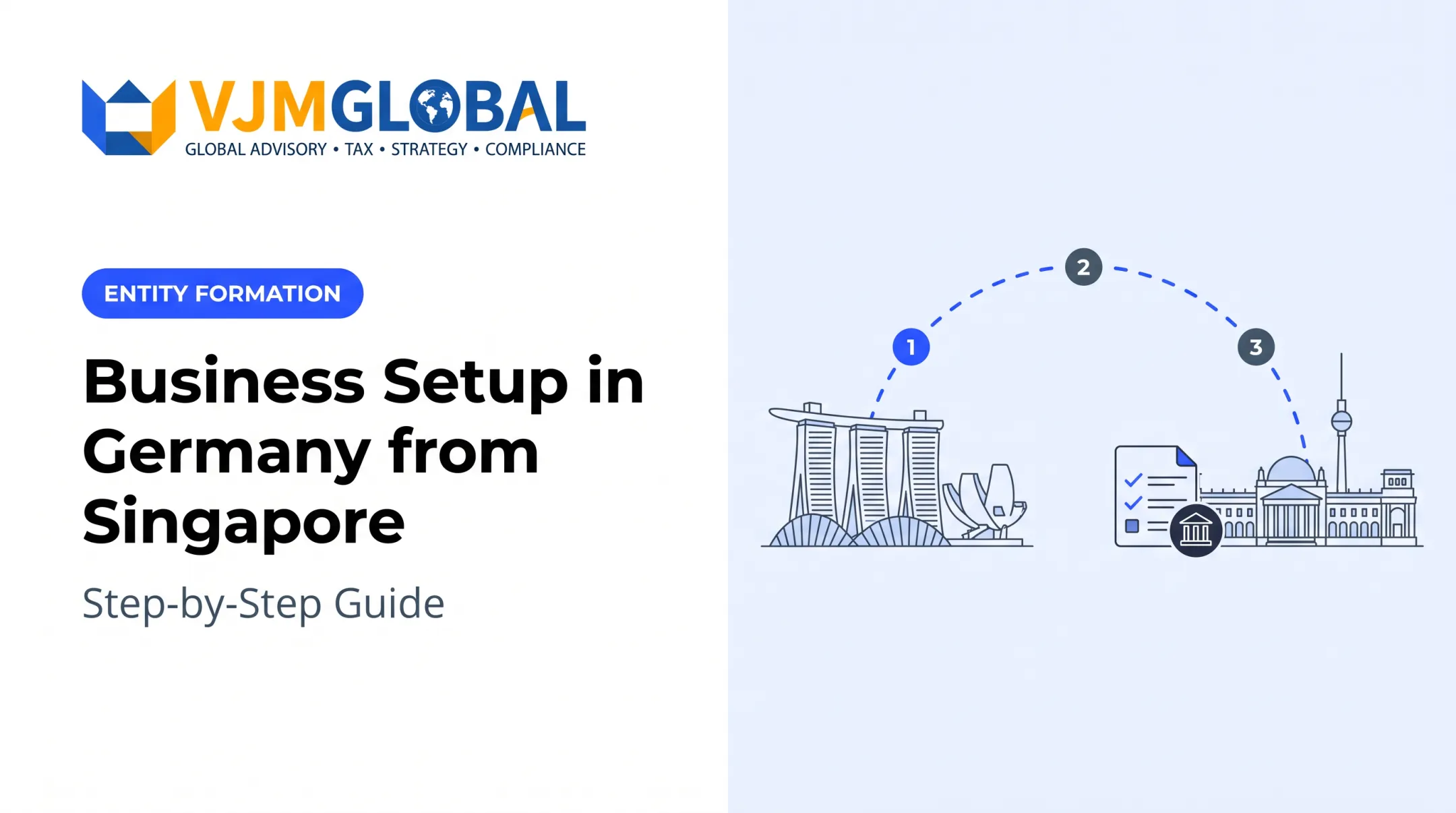
The common question we hear: can a Singapore entrepreneur actually incorporate a German GmbH without relocating? And what's the real difference between a GmbH, a UG, and an AG when it comes to liability and capital?
This guide walks through eligibility, entity choice, the registration process, realistic costs, and how VJM Global supports founders managing this from Singapore.
Key Takeaways
- Singapore founders can register a German GmbH remotely if notarisation and Commercial Register filing are handled correctly
- GmbH minimum share capital is EUR 25,000, with EUR 12,500 due before registration
- Incorporation does not grant residency or work rights — relocation requires a separate visa
- Annual financial statements, tax filings, and VAT compliance are mandatory after incorporation
- A formation partner helps coordinate notarisation, banking, and compliance without costly delays
Can Singapore Entrepreneurs Legally Register a GmbH in Germany?
Yes. German company law places no nationality restriction on shareholders or directors. GTAI's official investment guidance confirms that the nationality and residence of shareholders and managing directors are irrelevant to forming a GmbH, though the company still needs a German business address and a local representative.
The core legal steps are set out clearly:
- Notarisation of the Articles of Association under Section 2 of the GmbHG
- Commercial Register filing under Section 12 HGB, submitted electronically in certified form
- Tax registration under Section 138 AO, filed within one month of starting business activity
Singapore's regulatory framework doesn't create obstacles either. There's no barrier under Singapore law to sending capital abroad for share capital deposit, which simplifies the funding side.
Why Germany Appeals to Singapore-Based Founders
Three things pull Singapore entrepreneurs toward Germany specifically:
- EU market access: one German entity gives you a foothold across all 27 EU member states
- Competitive tax structure: corporate income tax at 15%, plus a ~0.8% solidarity surcharge (about 15.8% combined) and local trade tax
- Established trade ties: strong Singapore–Germany bilateral links and aligned transparency and governance standards
Trade tax varies by municipality, since it uses a nationwide 3.5% base multiplied by a local rate. Choosing where to register your registered office isn't just administrative; it affects your effective tax rate. See GTAI's corporate taxation guide for how the pieces stack.
Choosing the Right Structure: GmbH vs UG vs AG
Not every private limited structure suits a foreign founder equally. Here's how the three main options compare.
| Entity | Minimum Capital | Liability | Compliance Level |
|---|---|---|---|
| GmbH | EUR 25,000 (EUR 12,500 upfront) | Limited to company assets | Moderate |
| UG (haftungsbeschränkt) | EUR 1 | Limited to company assets | Moderate, plus mandatory reserve rules |
| AG | EUR 50,000 | Limited to company assets | High (supervisory board required) |

GmbH is the standard choice for most SMEs and foreign founders. It signals credibility to German banks, suppliers, and partners, and the compliance burden is real but manageable with the right support.
UG works as a low-capital "mini-GmbH." You can start with just EUR 1, but Section 5a of the GmbHG requires you to retain 25% of annual profit each year until reserves hit EUR 25,000. At that point, the UG can convert into a full GmbH.
AG requires EUR 50,000 in capital and a supervisory board of at least three members under Section 95 of the AktG. This structure suits larger ventures raising public capital, not typically a fit for early-stage Singapore founders.
A quick note on alternatives: sole proprietorships and certain partnership structures are generally unsuitable for non-resident founders, since they often carry registration and licensing constraints tied to local presence.
Step-by-Step Process to Register a GmbH in Germany from Singapore
Here's how the process typically unfolds:
Select your structure and registered office. Your Amtsgericht (local court) jurisdiction matters because municipal trade tax rates differ by city. Some locations are meaningfully cheaper than others.
Reserve a compliant company name. Under Section 18 HGB, your name must clearly identify the business and be distinguishable in the Commercial Register. Check availability early to avoid delays.
Appoint a managing director and prepare notarised Articles of Association. No German citizenship is required for the director role. The articles must be notarised under Section 2 of the GmbHG, with all shareholders' signatures.
Apostille your Singapore-issued corporate documents. Both Singapore and Germany are parties to the Hague Apostille Convention, so this route is available for qualifying documents. That said, translation and notary-specific checks still apply depending on document type. Apostille alone doesn't remove every formality.
Deposit share capital and complete registration. At least EUR 12,500 must be verifiably paid into a German bank account before the notary files with the Commercial Register. Once registered, you'll receive a tax number and VAT ID (USt-IdNr) from the local Finanzamt.
Processing times vary by court and case complexity. Some register courts report straightforward filings completing within a week, but this isn't a guaranteed benchmark.

Build in buffer time for notarisation and document authentication, especially when coordinating across time zones.
Costs, Requirements, and Ongoing Compliance
Initial Setup Costs
Budget for these components:
- Share capital: EUR 25,000 total, EUR 12,500 payable upfront
- Notarisation fees: typically a few hundred euros, depending on capital structure
- Commercial Register filing: court and register fees generally in the low hundreds of euros
- Trade office registration (Gewerbeanmeldung): municipality-specific fee
A recent chamber-of-commerce fee table put a standard EUR 25,000 cash formation's court, register, and notary costs at roughly EUR 730 in total. That figure excludes professional advisory fees for cross-border structuring, which vary with how much coordination your Singapore entity requires.
Recurring Compliance Obligations
After incorporation, your GmbH must meet these ongoing obligations:
- Annual financial statements prepared under HGB standards and filed electronically to the Bundesanzeiger, generally within a year of the balance-sheet date
- Corporate income tax and trade tax filings, with corporate tax returns typically due seven months after year-end
- VAT returns (Umsatzsteuervoranmeldung), filed monthly or quarterly; standard rate is 19%
- IHK (Chamber of Commerce) membership, which is compulsory for registered businesses, with fees set locally

Important clarification: incorporating a GmbH does not grant residency or work rights in Germany. Founders planning to relocate need a separate visa pathway, such as a self-employment permit or the EU Blue Card, depending on circumstances. Immigration and company formation are entirely separate processes.
Common Challenges and How VJM Global Supports Singapore Entrepreneurs
Founders running this process from Singapore tend to hit the same friction points repeatedly:
- Language barriers in notarisation. If you're not proficient in German, the notarial record must note this, and either the notary translates the document or an interpreter is brought in, adding steps and cost.
- Bank KYC requirements. Some banks run identity checks remotely; others expect in-person verification. That is bank practice, not a GmbH legal requirement, so clarify it early.
- Time zone coordination. German notaries, tax offices, and banks run on Central European Time, a wide gap from Singapore that slows back-and-forth during setup.
- German bookkeeping standards. Missed German-language disclosure deadlines or annual account windows can trigger late-filing penalties and, in some cases, personal liability for the managing director.
This is where a coordinated formation partner helps clear the friction above. VJM Global brings 30+ years of cross-border business setup, tax, and compliance advisory across markets, including Germany and Singapore.
Our team handles document preparation, registered office arrangements, and ongoing financial compliance so founders are not managing German bureaucracy alone from another time zone. We cover accounting, tax, and entity formation in over 16 markets, so the same team on your German GmbH can also coordinate Singapore-side compliance.
Frequently Asked Questions
How much does it cost to open a GmbH in Germany?
A GmbH requires EUR 25,000 minimum share capital (EUR 12,500 upfront), plus notarisation and registration fees typically totalling several hundred euros. Professional advisory costs for cross-border structuring vary depending on complexity.
Can I register a GmbH in Germany from Singapore without visiting in person?
Notarisation and Commercial Register filing can often be completed remotely with proper document preparation. However, some banks require in-person identity verification when opening the formation account.
Does forming a company in Germany grant me a visa or residency?
No. Incorporation and immigration are entirely separate processes. Founders planning to relocate need to apply for a distinct residence permit, such as a self-employment visa or EU Blue Card.
What is the difference between a GmbH and a UG?
A UG is a low-capital variant of the GmbH, starting from just EUR 1 instead of EUR 25,000. It requires mandatory profit retention (25% annually) until reserves reach standard GmbH capital levels.
Do I need a local director or partner in Germany to incorporate?
No German citizenship is required for the managing director role. That said, director residency can affect banking onboarding and immigration matters if relocation is planned later.
What ongoing compliance is required after incorporating a GmbH?
You'll need annual financial statements filed to the Bundesanzeiger, corporate and trade tax filings, and VAT returns where applicable. IHK membership and its associated fees are also compulsory.