Incorporation looks straightforward on paper. In practice, the German process involves notaries, minimum share capital and Commercial Register filings that differ substantially from the UK's Companies House model. There's no online same-day registration here.
This guide walks through the entity type, step-by-step process, requirements, costs, common pitfalls and alternatives worth considering before you commit.
TL;DR
- A GmbH is Germany’s private limited company (like a UK Ltd), with €25,000 minimum capital (€12,500 paid up before filing)
- Core steps: UK certificate of existence, German notary, bank account, then Commercial Register filing
- Full incorporation typically takes several weeks to a few months, depending on notary and bank scheduling
- Much of the process can run remotely; notary and banking steps still need careful sequencing
- Get preparatory documents right first time to avoid costly delays
How to Set Up a GmbH in Germany from the UK
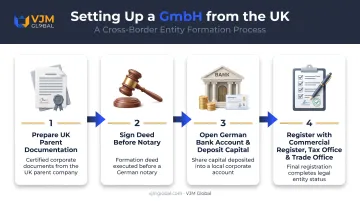
Step 1: Prepare the UK Parent Company and Documentation
Start with a board meeting of the UK company to formally approve creating the German subsidiary and authorise a representative to act on its behalf.
You'll then need a certificate of existence and representation from a UK notary, confirming your company's status and who has authority to sign.
According to German government trade body GTAI, nationality and residence of shareholders and directors are irrelevant to forming a GmbH—but the company still needs a German business address and local representative.
Before the notary appointment, decide on:
- The registered office ("Sitz") location in Germany
- The founding shareholder(s)
- Initial director(s) and their authority
Step 2: Sign the Deed of Incorporation Before a Notary
German law requires notarial certification of the articles of association. This isn't optional and it isn't something a UK solicitor can substitute for.
Arrange the notary appointment early. Some UK-based notaries have German departments that can coordinate the process, though the actual certification must meet German notarial standards. The Bundesnotarkammer has introduced a video-based formation system for eligible cases, but many cross-border formations still require physical attendance.
The deed must accurately set out:
- Company name and registered seat
- Share capital amount and structure
- Director details and authority
Critical point: liability remains unlimited during the "GmbH i.G." (under incorporation) stage. Anyone acting on the company's behalf before Commercial Register entry can be personally, jointly and severally liable.
Step 3: Open a German Bank Account and Deposit Share Capital
Present the certified deed to a German bank to open a company account. You'll need to deposit the minimum share capital of €25,000, with at least €12,500 paid in cash before you can register.
This paid-in capital is equity, not a government fee—the remaining balance stays owed to the company. Once deposited, the bank issues a confirmation letter of paid-in capital, which is required for your Commercial Register application.
Step 4: Register with the Commercial Register, Tax Office, and Trade Office
The notary transmits the registration application (Anmeldung) electronically to the local register court, along with director declarations and shareholder lists.
An IHK Konstanz benchmark shows the register court can process a defect-free application in 5-8 working days once received. That figure is only the court-stage window, not your total project timeline.
After entry, you'll need to:
- Notify the Transparency Register of ultimate beneficial owners without delay
- Register with the Gewerbeamt (trade office) before beginning business activity
- Complete tax office registration to receive a tax number and, where applicable, a VAT ID
When Should a UK Company Set Up a GmbH in Germany?
A GmbH suits UK businesses seeking a permanent, credible EU presence: trading, contracting or hiring staff locally under a legally distinct entity.
Common scenarios where a GmbH makes sense:
- E-commerce sellers needing an EU VAT and logistics presence
- SaaS or consulting firms with ongoing German client relationships requiring local contracting
- Manufacturers needing an EU-based subsidiary for regulatory or supply-chain reasons
A full GmbH can be overkill for short-term market testing. If you're not sure Germany will be a long-term market, alternatives like a branch structure or an Employer of Record arrangement may serve better without the capital commitment.
Permanence is the deciding factor. Only commit to a GmbH when scale in the German market clearly justifies the cost and ongoing admin.
What You Need Before Setting Up a GmbH in Germany
Missing documentation is the most common cause of delay in cross-border incorporations. Sort these out before booking any notary appointment.
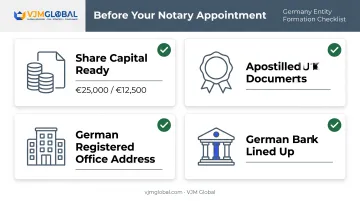
Have these workstreams moving in parallel:
- Share capital ready to fund (€25,000 minimum; €12,500 available to pay in when the German account opens)
- Apostilled UK corporate documents, plus any translations the notary will require
- A German registered office address for the articles and commercial register filing
- A German business bank lined up so the account can open as soon as the deed is ready
Corporate and Capital Requirements
Confirm your UK company has sufficient liquid assets to cover the €25,000 minimum share capital, with €12,500 ready to transfer once the German bank account is open.
Documentation and Certification
You'll typically need a certificate of existence and representation from a UK notary. The UK remains party to the 1961 Hague Apostille Convention, so relevant UK public documents can still be authenticated via a Hague apostille through the UK Legalisation Office. Brexit did not remove this route. Only the UK Legalisation Office issues apostilles for British documents.
Ask the German notary to confirm exactly which documents and translations they will accept before you order authentication. Requirements vary by case.
Banking and Local Presence Readiness
Secure a registered office address in Germany before the notary appointment; it belongs in the deed and register filing. The German business bank account is opened after notarisation, because the bank needs the deed of incorporation to open the account and accept the capital deposit. Line up the bank in parallel so account opening is not the step that stalls registration.
Key Factors That Affect Your GmbH Setup Timeline and Cost
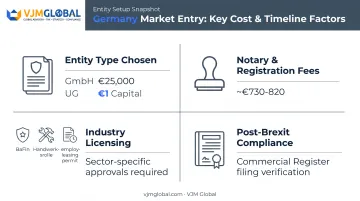
How long setup takes and what you pay depends on four things: the entity you choose, notary and register fees, any sector licences, and how you handle post-Brexit compliance.
Entity Type Chosen (GmbH vs UG)
A UG (haftungsbeschränkt) needs only €1 share capital, but it carries less weight with German banks, clients and suppliers than a full GmbH. That credibility gap matters most when you bid for larger contracts, and it can slow bank onboarding even after registration.
Notary and Registration Fees
According to IHK Koblenz's fee tables, a standard cash GmbH costs around €730, rising to around €820 with an in-kind contribution. These fees scale with share capital and shareholder count, and sit on top of the mandatory capital itself.
Industry-Specific Licensing (Gewerbeerlaubnis)
Financial services, construction and recruitment need extra trade licences before you can legally trade. A fully registered GmbH still cannot operate in those sectors without the right permit: BaFin authorisation for financial services, Handwerksrolle entry for construction trades, or an employee-leasing permit for staffing. Licence lead times often sit on the critical path after the Commercial Register entry.
Post-Brexit Cross-Border Compliance
Brexit added trade friction but did not change ownership rules. UK companies and individuals can still own and direct a GmbH freely. You still need the Commercial Register entry confirmed before you start operating, because liability protection only begins once that entry is live.
Common Mistakes UK Companies Make When Setting Up a GmbH
These recurring errors cause the most delay and risk:
- Trading before registration is complete: exposes directors to personal, unlimited liability during the "GmbH i.G." stage
- Underestimating notarisation and translation timelines: apostilles and certified translations take longer than most first-time founders expect
- Skipping the licensing check: failing to confirm whether the intended business activity needs a special trade licence before incorporation
- Overlooking ongoing compliance: Transparency Register updates, VAT registration and annual filings with the Bundesanzeiger don't stop once you're registered
Alternatives to Setting Up a New GmbH from the UK
A brand-new GmbH isn't always the most efficient route into Germany. Weigh these structural alternatives and support options before you commit.
Cross-Border Merger into an Existing German GmbH
When it's better: Preserves existing contracts and business relationships without renegotiation.
Key trade-offs: More expensive and time-consuming, with dual-country registration under the EU Mobility Directive. This suits acquisitions, not fresh market entry.
Establishing a German Holding Company
When it's better: Suitable for groups planning long-term German operations with the UK entity as parent above a German subsidiary.
Key trade-offs: Requires careful sequencing and specialist tax advice to avoid contractual and participation-exemption issues.
Outsourcing Formation and Compliance to a Cross-Border Specialist
When it's better: Useful when your UK team lacks in-house knowledge of German notarial and tax procedures.
A firm like VJM Global can coordinate the full setup stack:
- Entity formation for GmbH, UG, AG, GmbH & Co. KG or branch structures
- Finanzamt tax registration and VAT ID applications
- Ongoing compliance filings aligned with the UK parent's obligations
Key trade-offs: Adds professional fees on top of statutory notary and registration costs, but cuts the risk of procedural errors that cause delays.
Conclusion
Setting up a GmbH in Germany from the UK works best when share capital, documentation and notary steps are sequenced properly in advance. Most delays and liability risks stem from starting operations before Commercial Register registration is finalised, rather than from the incorporation process itself.
Balancing cost, credibility and long-term market commitment determines whether a GmbH, a leaner UG, or an alternative structure like a branch is the right fit. Once that choice is clear, finish registration before you start trading.
Frequently Asked Questions
Is a GmbH the same as an LLC?
A GmbH is Germany's equivalent of a UK Ltd or US LLC, offering limited liability to shareholders. However, it has distinct capital and notarisation requirements that don't apply to UK or US entities.
How much share capital is required to set up a GmbH?
The minimum is €25,000, with at least €12,500 paid in cash before you can file for registration. The remaining balance stays owed to the company as unpaid capital.
Can a UK company own a GmbH without a German resident director?
Yes. Directors and shareholders don't need to reside in Germany or hold German nationality. The registered office, however, must be a genuine German business address.
How long does it take to set up a GmbH from the UK?
The process typically takes several weeks to a few months, depending on notary and bank scheduling. Court registration itself can be quick (around 5-8 working days) once a complete application is submitted.
What happens if I start trading before the GmbH is registered?
Liability remains unlimited during the "GmbH i.G." stage. Anyone acting on the company's behalf can be held personally, jointly and severally liable until Commercial Register registration is complete.
Do I need a UK notary before seeing a German notary?
Yes, typically. A certificate of existence and representation from a UK notary confirms your company's status and signatory authority, which the German notary will need before proceeding with incorporation.