Since leaving the EU, UK citizens are now treated as third-country nationals in Germany. That affects everything: your right to work, the permits you need, and how long the whole process takes. This guide walks through what's actually required — visa status, legal structure, registration steps, and ongoing compliance — so you can plan with realistic expectations rather than discover the blockers mid-process.
Key Takeaways
- Visa-free entry covers up to 90 days in any 180-day period; a residence permit is required to act as managing director
- The GmbH (€25,000 share capital) and UG (from €1) are the two most common legal structures for UK founders
- A detailed business plan with 3-year financial projections is a formal immigration requirement
- Expect 3–6 months minimum from start to full operational readiness, including permit approval
- Remote company formation is possible via notarised power of attorney, but adds weeks to the timeline
Why Start a Business in Germany from the UK?
Germany's economic scale alone makes it worth considering. IMF data puts Germany's GDP at USD 5.45 trillion for 2026, and a German entity restores EU single market access — something UK businesses lost after Brexit and have been actively working to recover.
Germany Trade & Invest (GTAI) recorded 137 UK investment projects in Germany in 2024, with British investors ranking third among all foreign investors over the five years since Brexit. That level of sustained activity signals a well-worn path — and an established playbook for UK founders to follow.
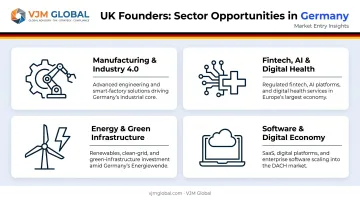
Sector opportunities worth noting:
- Manufacturing and Industry 4.0: Germany's industrial base remains the EU's largest, with strong demand for advanced automation and engineering
- Fintech, AI, and digital health: GTAI specifically highlights UK activity in these sectors post-Brexit
- Energy and green infrastructure: significant government investment in grids, hydrogen, and smart cities continues to create entry points
- Software and digital economy: sustained demand across the German ICT sector with no sign of slowing
The incentives extend beyond market access, too. Germany's Forschungszulage R&D tax credit covers 25% of eligible R&D costs — rising to 35% for SMEs — making it one of the more generous R&D schemes available to UK-origin businesses in the EU.
On the talent side, German employment reached a record high above 46.1 million in 2024, giving incoming businesses access to one of Europe's deepest skilled labour pools.
What UK Entrepreneurs Must Know Before Starting
Your Status Has Changed
UK citizens are no longer EU nationals. In Germany, that means third-country national status for business purposes. The practical effect:
- Visa-free entry for up to 90 days in any 180-day period still applies — you can travel to Germany, attend meetings, and conduct preliminary research without a visa
- Working or operating a business during that time requires a residence permit, which you must apply for from within Germany
The Shareholder vs. Managing Director Distinction
This catches many UK founders off guard. Here's how it works:
| Role | Residence Permit Required? |
|---|---|
| Shareholder (non-active) | No |
| Managing Director (active management) | Yes |
According to GTAI, GmbH incorporation itself has no nationality or residence requirements — but non-EU entrepreneurs who manage a German company on-site may need a self-employment residence permit. If you plan to run the business yourself, you need that permit before you start operations.
Self-Employment Residence Permit Criteria
The Aufenthaltserlaubnis zur selbständigen Tätigkeit — Germany's self-employment residence permit — is assessed against these criteria:
- Economic interest or regional demand
- Positive effect on the broader economy
- Secured financing — own capital or a confirmed loan
- Entrepreneurial experience and capital investment
- Projected employment or training impact
- Contribution to innovation or research
Local chambers of commerce are consulted as part of this process. If you're over 45, you may also need to demonstrate adequate pension provision.
Language and Documents
Most German government forms, the ELSTER tax portal, and official correspondence are in German. The ELSTER portal does have English information pages for business founders, but the BZSt's VAT ID application is German-only.
Documents submitted for immigration purposes require translation by a sworn translator. Depending on the document type, notarisation and apostille through the FCDO may also be required — budget time for this step, as it adds weeks to your preparation.
Timeline Reality
The German Embassy in London states that self-employed entrepreneur visa processing takes several months, potentially up to a year depending on project complexity. Build that into your planning from day one.
Choosing the Right Business Structure in Germany
The right structure depends on your capital, liability tolerance, and whether the business is a commercial trade or a professional service.
The Main Options
Three structures suit most UK founders entering Germany. Here's how they compare at a glance:
| Structure | Liability | Min. Capital | Best For |
|---|---|---|---|
| Freiberufler | Unlimited | None | Doctors, lawyers, architects qualifying as liberal professions |
| Einzelunternehmen | Unlimited | None | Very early-stage or low-risk sole traders |
| Branch / Rep Office | Parent bears liability | None | Established UK firms testing the market |
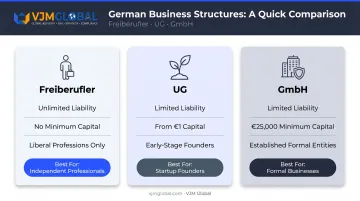
For most founders seeking formal limited liability, the choice comes down to UG or GmbH.
UG (Unternehmergesellschaft)
The UG is the lower-barrier route to limited liability. It can be established with as little as €1 in share capital. German law does require 25% of annual profits to be held in a statutory reserve until accumulated capital reaches €25,000, at which point the entity can convert to a GmbH.
This makes the UG practical for founders who want to move quickly without committing significant capital upfront — though the profit-retention rule is worth factoring into early cash flow planning.
GmbH (Gesellschaft mit beschränkter Haftung)
The GmbH is the most common choice for UK founders setting up formally in Germany. Key facts:
- Minimum €25,000 share capital; €12,500 must be paid at registration
- Requires notarisation and double-entry bookkeeping
- Provides limited liability
- Can be founded by a single person — no requirement for a German national director
- The managing director must hold appropriate immigration status
How to Start a Business in Germany from the UK — Step by Step
The most common mistake UK founders make is beginning company formation before sorting immigration status and the business plan. That sequence leads to delays and rework. Here's the right order.
Step 1 – Clarify Your Immigration Pathway
Two routes exist:
D-Visa (national visa for self-employment) — applied for through the German Embassy in London before travelling. Allows economic activity from the first day of validity. The self-employment residence permit is valid for a maximum of 3 years. The visa fee is cited as €75 by GTAI and €90 by Make it in Germany; confirm the current figure with the German Embassy directly.
In-country application — enter visa-free, then apply for a residence permit within the 90-day window. Business activities cannot begin until the permit is approved.
Also decide at this stage: will you act as managing director, or appoint a local MD? Appointing a German-resident MD significantly reduces your personal immigration requirements as a non-active shareholder.
Step 2 – Prepare Your Business Plan
The business plan is a formal immigration document. Authorities and chambers of commerce evaluate it for economic viability and regional demand. A compliant plan must cover:
- Market analysis
- 3-year financial projections (P&L and liquidity plan)
- Marketing and sales strategy
- Capital structure
- Projected number of jobs created
Vague projections are a leading cause of visa delays or rejections. Use concrete numbers. If you don't have German market expertise, engage a local business consultant or tax advisor to validate the plan before submission.
Step 3 – Choose and Register Your Legal Entity
Registration follows this sequence:
- Secure a registered German business address — virtual offices are permitted, but must be properly compliant
- Sole proprietorships and Freiberufler: register at the local Gewerbeamt (trade office) — fees vary by municipality (Munich charges €50–€60; Hamburg charges around €25 for certain cases)
- GmbH or UG: requires a notary appointment to authenticate the articles of association; attend in person or use a notarised power of attorney
- Commercial register entry (Handelsregister): Hamburg official sources indicate fees around €240–€300 for GmbH cases; the official BMWK start-up portal cites notary costs of approximately €830 including VAT for the formation deed and commercial register application
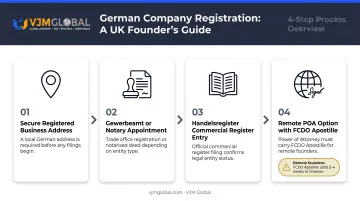
UK founders forming remotely must have their power of attorney notarised in the UK and accompanied by an apostille via the FCDO. This adds several weeks to the timeline. Weigh that delay against the option of travelling to Germany to sign in person.
Step 4 – Open a Business Bank Account
A German business bank account is required before the company can operate. Banks follow strict KYC rules. Typical documents required:
- Gewerbeschein (trade licence)
- Tax identification number
- ID documents
- Proof of business address
Non-residents may face delays or be required to complete video identification. Some digital banks are more accommodating for international founders than traditional German banks. Check current options and their specific requirements for UK applicants, as these change frequently.
Step 5 – Register for Tax and VAT
After business registration, notify the Finanzamt (tax office) within one month by completing the Fragebogen zur steuerlichen Erfassung (tax registration questionnaire). This can be submitted electronically via ELSTER. The tax office issues a Steuernummer (tax number), which is required for all invoicing.
For intra-EU trade, apply for a VAT ID (USt-IdNr.) — the BZSt online application is German-language only. Under current UStG thresholds, the small business exemption applies if previous-year turnover was below €25,000 and current-year turnover is projected below €100,000. GmbH entities must maintain double-entry bookkeeping and file annual financial statements.
Step 6 – Set Up Ongoing Compliance
Key recurring obligations:
- Health insurance (Krankenversicherung): mandatory for all German residents; self-employed founders must arrange this independently
- Bookkeeping and records: all transactions, receipts, invoices, and bank statements must be maintained for tax authority review
- Business liability insurance: required in most industries; check sector-specific requirements
- Annual filings: GmbH entities must file annual financial statements and tax returns
Most UK founders engage a German Steuerberater (tax advisor) for bookkeeping and compliance. Tax errors in Germany carry penalties and interest that compound quickly — getting this right from the start is cheaper than correcting it later. UK businesses that also have India-side operations can work with VJM Global, which has served 250+ UK businesses and specialises in cross-border accounting, Indian tax compliance, and back-office support for companies operating across multiple markets.
Key Costs and Timelines to Budget For
Setup Costs
| Item | Indicative Cost |
|---|---|
| Gewerbeamt registration (sole trader) | €25–€60 (varies by municipality) |
| Handelsregister entry (GmbH) | ~€240–€300 |
| Notary fees (GmbH formation) | ~€830 incl. VAT (BMWK example) |
| GmbH share capital (minimum paid at registration) | €12,500 |
| D-Visa fee | €75–€90 (confirm with German Embassy) |
| Legal/consulting fees | Variable — confirm with advisors |
Note: The widely cited "€1,000–€3,000 total setup budget" for a GmbH (excluding share capital) is not officially confirmed by German government sources — treat it as a rough working figure and obtain actual quotes from advisors.
Timeline Expectations
| Stage | Typical Duration |
|---|---|
| D-Visa processing | Several months to up to a year |
| Sole proprietorship / Freiberufler registration | Days to weeks |
| GmbH/UG notarisation and commercial register entry | 2–4 weeks once documents are ready |
| Full operational readiness (including visa/permit) | 3–6 months minimum |
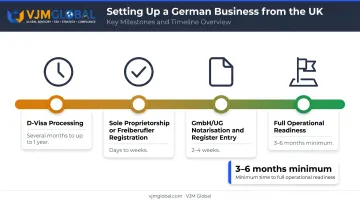
These timelines directly affect your funding runway. Build them into your business plan from day one — a permit delay at month five becomes a cash flow crisis, not just a scheduling setback.
Recurring Monthly Costs
Ongoing operational costs vary by business type, but four categories need line items in your cashflow projections from the start:
- Accounting & tax (Steuerberater) — obtain quotes early; fees depend on turnover and complexity
- Business banking — German banks often charge monthly account fees
- Business insurance — liability and professional coverage requirements vary by sector
- Compliance filings — VAT returns, annual accounts, and trade tax declarations
No official benchmark exists for these costs combined. Get Steuerberater quotes before finalising your budget.
Conclusion
Starting a business in Germany from the UK is entirely achievable, but it requires more preparation than most founders expect. Post-Brexit status changes, the self-employment residence permit process, and multi-step registration bureaucracy are all manageable. Starting early and getting the sequence right is what keeps them that way.
Founders who establish quickly share three things in common:
- A credible business plan that satisfies Ausländerbehörde requirements
- The right legal structure matched to their specific situation
- Qualified advisors covering immigration, tax, and accounting from the start
Build in a realistic time buffer — Germany's registration timelines are fixed, and rushing the preparation stage is where most delays originate.
Frequently Asked Questions
Can a UK citizen open a business in Germany?
Yes. UK citizens can enter Germany visa-free for up to 90 days in any 180-day period. To act as managing director or engage in economic activity, a residence permit is required. Shareholders who are not actively managing the company do not need one.
How much money is required to start a business in Germany?
A sole proprietorship requires only the Gewerbeamt registration fee (approximately €25–€60). A UG can be formed with €1 in share capital. A GmbH requires €12,500 paid upfront against the €25,000 minimum share capital, plus notary and registration fees — typically several hundred euros in official costs alone.
What is the 183-day rule in Germany?
German tax residency under the Abgabenordnung is determined by having a dwelling or habitual abode in Germany — a stay exceeding six months is generally treated as more than temporary. The 183-day threshold appears in the UK-Germany Double Taxation Convention for specific income-allocation contexts, not as a standalone residency test. UK founders splitting time between both countries should seek specialist tax advice.
Do I need to speak German to start a business in Germany?
German proficiency is not formally required for GmbH incorporation, but most official forms, portals, and correspondence — including the BZSt's VAT ID application — are in German only. Professional translators are typically needed for document submissions. B1 language requirements apply to settlement permits, not standard company registration.
How long does it take to register a company in Germany from the UK?
A sole proprietorship can be registered within days once required documents are prepared. A GmbH or UG typically takes several weeks for notarisation and commercial register entry. The full process — including visa or residence permit approval — means founders should plan for 3–6 months for complete operational readiness.
Can I run a German company remotely from the UK?
Shareholders can participate remotely without a residence permit. A managing director, however, must hold an appropriate German residence permit. Remote formation via notarised power of attorney is possible but adds weeks to the timeline. For ongoing day-to-day management, authorities expect the MD to have the legal right to operate in Germany.