But the process still raises real questions. Many founders struggle with unfamiliar UK company law, cross-border tax exposure, and uncertainty about registering remotely without a UK address or visit.
This guide walks through eligibility, the step-by-step registration process, required documents, costs, and the tax rules that matter most for German residents. We'll also look at how a cross-border formation specialist like VJM Global can reduce the friction involved.
Key Takeaways
- German residents can own and direct a UK Ltd with no residency requirement and no minimum share capital
- Registration can be completed fully online, usually within 24 hours via Companies House
- Post-incorporation duties—Confirmation Statement, Corporation Tax, and VAT—are mandatory from day one
- The UK-Germany Double Taxation Agreement can prevent double tax, but "place of effective management" rules still decide where you are taxed
- Expert filing support cuts errors in documents, identity checks, and UK bank onboarding
What is a UK Private Limited Company (Ltd)?
A "Private Limited Company," written as Ltd, is a business structure where shareholder liability is limited to the value of their shares. If the company fails, personal assets stay protected. This is different from a public company (PLC), which can offer shares to the general public and faces stricter regulatory requirements.
Main Characteristics
- Separate legal personality — the company can own assets, sign contracts, and be sued independently of its owners
- Limited liability — shareholders only risk what they've invested in shares
- Minimum one director and one shareholder — these can be the same person
- No UK residency requirement for directors or shareholders
Who Controls It
- Directors run day-to-day operations: signing contracts, managing finances, and filing statutory documents
- Shareholders own the company through shares and vote on major decisions, such as appointing or removing directors
In many small UK Ltds, particularly those formed by solo German founders, the director and the sole shareholder are the same person.
Types of UK Private Limited Companies
| Structure | Best For |
|---|---|
| Ltd (by shares) | Standard trading businesses — used by most founders |
| Company Limited by Guarantee | Non-profits and community organisations |
For most German entrepreneurs entering UK markets, the Ltd by shares is the correct choice.
Step-by-Step: How to Register a UK Ltd from Germany
1. Choose Your Business Structure
Stick with the standard Ltd by shares unless you have a specific reason for an LLP or PLC. It's simpler to administer and universally recognised by UK banks, suppliers, and investors.
2. Check Your Company Name
Your chosen name must be unique on the Companies House register and shouldn't infringe existing trademarks. Before filing:
- Search the Companies House register for exact and similar matches
- Check the UKIPO trademark database separately
- Avoid restricted words (like "Royal" or "Bank") without prior approval
3. Secure a UK Registered Office Address
Here's a rule that trips up many German founders: a German address cannot be used as your registered office. Companies House requires a physical UK address in the same UK country where you're registering. Most non-resident founders use a virtual office or registered agent service for this.
4. Appoint a Director and Shareholder
You need at least one director aged 16 or over — no UK residency required. Since 18 November 2025, identity verification has been a legal requirement for directors and Persons with Significant Control (PSCs). A German passport holder can typically complete this through the Companies House online verification route if using a biometric passport.
An Authorised Corporate Service Provider (ACSP), such as an accountant or solicitor registered with Companies House, can also verify your identity on your behalf.
5. File Your Incorporation Documents
You'll submit Form IN01 along with your Memorandum and Articles of Association. This covers:
- Proposed company name and SIC code
- Registered office details
- Director and shareholder information
- Share capital structure
- Statement of compliance
Current fees (as of 2026):
| Route | Fee | Processing Time |
|---|---|---|
| Online incorporation | £100 | Usually within 24 hours |
| Software incorporation | £100 | Same-day option at £156 |
| Paper (IN01 by post) | £124 | 8–10 days |
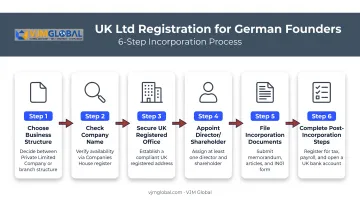
6. Complete Post-Incorporation Steps
Once incorporated, you'll need to:
- Open a UK business bank account (non-resident directors sometimes face extra scrutiny here)
- Register with HMRC for Corporation Tax within three months of trading
- Register for VAT if turnover exceeds the threshold
- Set up PAYE if you plan to hire staff
Documents Required for German Founders
German founders should prepare the following before starting the process:
- A certified passport or national ID — a biometric passport works with the Companies House online verification route
- Proof of German address, such as a recent utility bill or bank statement
- Incorporation documents — completed Form IN01, plus the Memorandum and Articles of Association
Some documents may need a certified English translation, depending on the format and issuing authority. A Companies House-approved ACSP can guide you through identity verification if you'd rather not manage the process alone.

Tax and Compliance Considerations for German Residents
This is where things get genuinely complex, and where many founders make costly assumptions.
The UK-Germany Double Taxation Agreement
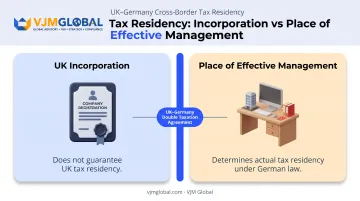
The 2010 UK-Germany Double Taxation Convention prevents you from being taxed twice on the same income. Under Article 4, where a company is technically resident in both countries, it's deemed resident only where its "place of effective management" sits.
Here's the catch: incorporating in the UK doesn't automatically make you a UK tax resident for German purposes. If the real decision-making, the actual management, happens from your desk in Munich or Berlin, German tax law can still claim you.
Germany's Corporate Income Tax Act treats a company as fully taxable in Germany if its management (Geschäftsleitung) or registered seat is located there. The German Fiscal Code defines Geschäftsleitung as the centre of top management — not just where the certificate of incorporation was filed.
In plain terms: registering the Ltd in London doesn't erase Germany's tax interest if you're still running the show from home.
Ongoing UK Compliance Obligations
Once your Ltd is live, several filing obligations kick in automatically:
- Annual Confirmation Statement — file each year; complete director identity verification first
- Statutory accounts — filed within 9 months of your accounting reference period end
- Corporation Tax returns (CT600) — filed with HMRC annually
- VAT registration — mandatory once taxable turnover exceeds £90,000 in a 12-month period
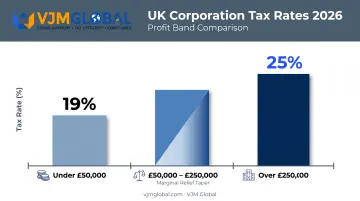
Corporation Tax rates for 2026 remain:
| Profit Band | Rate |
|---|---|
| Under £50,000 | 19% (small profits rate) |
| £50,000–£250,000 | Marginal relief applies |
| Over £250,000 | 25% (main rate) |
Missing any of these deadlines can result in penalties or, in extreme cases, the company being struck off the register.
Why Work with a Cross-Border Formation Specialist
Navigating UK incorporation while simultaneously managing German tax residency questions requires expertise in two regulatory systems at once. Get the UK side right but ignore the German side, and you risk an unpleasant tax surprise. Get lost in German rules and you might delay the entire registration.
VJM Global handles entity formation, accounting, and multi-jurisdiction tax compliance across 100+ countries, including the UK and Germany. Each engagement follows that market’s own regulators and statutes—Companies House filings for the UK company, and Geschäftsleitung and related German tax points where they affect the founder.
The firm brings 30+ years of experience, 250+ UK businesses served, and a team of Chartered Accountants and compliance specialists. Support goes past the registration certificate to the ongoing calendar:
- Confirmation Statements
- Corporation Tax filing
- VAT registration
- Annual accounts
That keeps UK filings on track while you stay focused on the business—and on how the German side interacts with the new company.
Frequently Asked Questions
Do all UK businesses have to be registered?
Any business trading as a limited company must register with Companies House. Sole traders face lighter, but still mandatory, HMRC registration requirements instead.
Can I move my UK limited company to a different country?
Direct redomiciliation isn't currently available under UK law. Founders typically use cross-border mergers or holding company structures, both of which carry significant legal and tax complexity.
What are the main characteristics of a UK private limited company?
A UK private limited company has limited liability, a legal identity separate from its owners, and a flexible ownership structure. Directors and shareholders can be the same person or different people.
Who controls a UK private limited company?
Directors manage daily operations and decision-making. Shareholders own the company through shares and vote on major matters, such as appointing directors.
What are the different types of UK private limited companies?
The most common form is a private company limited by shares, used for standard trading businesses. A company limited by guarantee suits non-profits. PLC status is separate and applies when you plan to offer shares to the public.
What does "Pvt Ltd" mean?
It denotes a private limited company, a structure where shareholder liability is limited to their share value and ownership stays private rather than traded publicly.