Today, if you want frictionless EU market access, you need a local footprint. That usually means incorporating an EU entity, and it means navigating non-resident director rules, country-specific VAT registration, and 27 different sets of company law.
This guide breaks down what it actually costs, which countries make sense for different business goals, and the step-by-step process for getting it done, including where you can register without ever booking a flight.
Key Takeaways
- Costs vary enormously: from €50 for an Irish electronic filing to €25,000 in share capital for a German GmbH
- Ireland requires an EEA-resident director, unless you post a €25,000 bond or secure an exemption
- Estonia offers the fastest remote route, with online company registration in 1-2 days after e-Residency approval
- No universal "best" country exists: the right choice depends on your trading, tax planning, or manufacturing goals
- VAT obligations depend on your transactions, not just where you incorporate
Why UK Businesses Are Expanding Into Europe Post-Brexit
Before Brexit, a UK company could sell into France, Germany, or Poland without setting up anything local. That single-market access disappeared in January 2021, replaced by customs checks, tariffs on certain goods, and VAT complications at every border.
Incorporating a local EU entity restores much of that lost simplicity:
- Customs-free trade within the EU once goods clear the border once
- Simplified VAT through EU-based registration rather than juggling import VAT on every shipment
- Local bank accounts that European clients and suppliers trust more readily than a UK account
- Access to talent pools in cities like Dublin, Amsterdam, or Tallinn without relocating staff
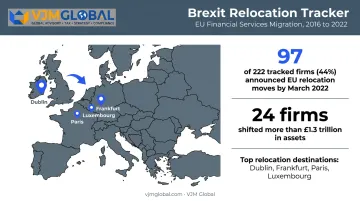
EY's tracking of 222 large UK financial-services firms found that 44% (97 firms) had announced plans to move operations or staff to the EU by March 2022, with 24 firms shifting more than £1.3 trillion in assets. EY's Financial Services Brexit Tracker shows Dublin, Luxembourg, Frankfurt, and Paris as the biggest beneficiaries.
That's the financial-services picture specifically, but the underlying logic applies to any UK business trading with EU customers. The friction didn't exist five years ago, and a local entity is how most companies are choosing to remove it.
Key Factors UK Businesses Must Evaluate Before Incorporating in Europe
Not every EU country works the same way for a UK-owned company. Before you pick a jurisdiction, weigh these five factors, since getting the structure wrong at the outset often costs more to fix later than to plan for upfront.
Director Residency Rules
Some EU countries, Ireland being the clearest example, require at least one director to be EEA-resident. A UK-only board can't simply appoint a UK director and file the paperwork.
Ireland offers two statutory workarounds:
- Post a €25,000 bond (Section 137), valid for at least two years
- Obtain a Section 140 certificate proving a real and continuous economic link with Ireland
Note: appointing a commercial "nominee director" isn't a separate legal exemption. That person becomes a genuine director with full statutory duties, not a rubber stamp.
Cost to Register a Company in Europe
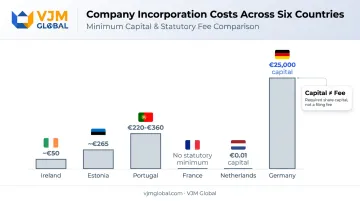
This is one of the most-searched questions for a reason: costs swing wildly by country.
| Country | Registration fee | Notes |
|---|---|---|
| Ireland | ~€50 (electronic A1) | Plus EEA-director requirement |
| Estonia | ~€265 (online OÜ) | Requires e-Residency first (~€150) |
| Portugal | €220-€360 | Online or in-person counter route |
| Germany | €25,000 minimum capital | Not a fee — it's required share capital |
| France | No statutory minimum | Articles of association set the capital |
| Netherlands | €0.01 starting capital | Notary fees run €500-€1,500 separately |
The headline fee often isn't the real cost. Germany's €25,000 requirement is share capital your business retains, not money paid to the state, but it still needs to be available before registration completes.
Corporate Tax Rate Differences
Tax rate is often the deciding factor for holding companies or trading entities. Current 2026 rates:
- Hungary: 9% — the lowest in the EU
- Ireland: 12.5% on trading income (25% on non-trading income)
- Cyprus: 15% — raised from 12.5% as of 1 January 2026
- UK: 25% main rate (19% for profits under £50,000)
Large groups with revenue above €750 million face Ireland's Pillar Two minimum effective rate of 15%, regardless of the headline 12.5% figure.
Minimum Share Capital Requirements
Beyond the registration fees above, share capital rules vary just as widely:
- France (SARL): No statutory minimum — the articles decide
- Netherlands (BV): €0.01
- Portugal (Lda.): Freely fixed, minimum €1 per quota
- Germany (GmbH): €25,000 total, with €12,500 typically paid up before registration completes
Remote vs In-Person Registration
These capital rules matter less if you can't register remotely in the first place. Contrary to what many guides claim, Germany and the Netherlands aren't strictly "in-person only" anymore — both now permit online notarisation with qualified electronic signatures. Portugal offers both a counter service (Empresa na Hora) and a fully online route (Empresa Online). Estonia remains the most straightforward digital process, provided you already hold e-Residency credentials.
VAT Registration
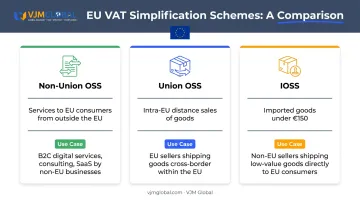
Getting the company registered, whether remotely or in person, is only half the picture. Here's a common misconception: incorporating in an EU country doesn't automatically trigger VAT obligations there. VAT depends on what you sell, to whom, and where your stock sits.
- Non-Union OSS covers services sold to EU consumers from outside the EU
- Union OSS covers intra-EU distance sales of goods
- IOSS simplifies declarations for imported goods under €150
You may still need separate national VAT registration depending on your supply chain, so map your transactions before assuming OSS solves everything. Given how these director, tax, and VAT rules interact differently in each jurisdiction, most UK businesses find it worthwhile to have a cross-border advisory team validate the structure before filing, rather than after.
Best European Countries for UK Businesses to Incorporate
There's no universal "best" answer here. It depends entirely on what you're trying to achieve — trading efficiently, optimising tax, running everything remotely, or building manufacturing capacity.
Ireland
Ireland remains the default choice for UK businesses, and for good reason:
- English-speaking, removing translation headaches for contracts and filings
- Common law system, similar enough to UK law that legal advice translates more easily
- 12.5% trading tax rate, among the lowest in Western Europe
The trade-off is the EEA-resident director requirement, which adds a compliance step UK-only boards need to plan around.
Estonia
Estonia built its entire company registration system around remote founders. Through e-Residency, you can:
- Apply for digital residency (3-8 weeks processing, ~€150)
- Register your OÜ (private limited company) online in as little as 1-2 days once approved
- Manage the entire company digitally without ever visiting Estonia
This suits UK founders who want an EU entity purely for banking, invoicing, or holding purposes without relocating.
Netherlands & Germany
Both countries appeal to UK businesses building manufacturing or logistics operations closer to EU customers.
- Netherlands (BV): Starting capital of just €0.01, flexible governance, strong logistics infrastructure around Rotterdam
- Germany (GmbH): €25,000 capital requirement, but access to Europe's largest consumer market and manufacturing base
Germany demands more upfront capital. Netherlands offers more flexibility for smaller operations testing the market first.
Country Comparison at a Glance
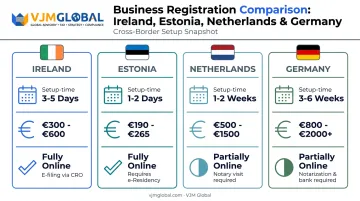
Here's how the four options stack up side by side:
| Country | Registration cost | Setup time | Fully online? |
|---|---|---|---|
| Ireland | ~€50 | ~10 working days | Yes, with EEA-director rule |
| Estonia | ~€265 (+€150 e-Residency) | 1-2 days post-approval | Yes |
| Netherlands | €0.01 capital + notary fees | Days to weeks | Yes (online notarisation available) |
| Germany | €25,000 capital + notary fees | 2-4 weeks | Partial (notarisation often in-person) |
Step-by-Step Process to Incorporate a Company in Europe as a UK Business
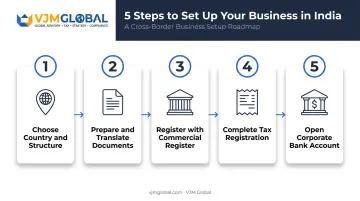
Choose your target country and legal structure. Decide whether you need a trading subsidiary, a holding company, or simply a branch of your UK entity. This decision shapes everything downstream.
Prepare and translate incorporation documents. You'll need articles of association, director and shareholder details, and proof of a registered address in the target country. Many jurisdictions require certified translations.
Register with the local commercial register. Estonia, Ireland, and France support full online registration. Germany, Portugal, and the Netherlands require notarisation, though online notary appointments are increasingly available.
Complete tax registration. Spain's CIRCE system, for example, bundles VAT/tax ID registration with incorporation through a single electronic form, cutting out separate applications. Other countries require this as a distinct step.
Open a corporate EU bank account. This is often the most underestimated step. Some banks still require directors to appear in person for identity verification, even when incorporation itself was entirely remote.
Managing five steps across unfamiliar legal systems, in a language you may not read fluently, is where most UK founders get stuck. Missing a translated document or a notary deadline in one country can delay the entire structure, particularly when tax registration and banking depend on incorporation being finalised first.
Cross-border compliance advisors such as VJM Global, which has supported 250+ UK businesses with international tax and regulatory filings, can help you sequence these steps correctly and flag jurisdiction-specific requirements before they become costly delays.
Legal Structures Available: Do European Countries Allow LLCs?
Yes. Nearly every EU country offers a private limited liability structure functionally similar to a UK Ltd, just under a different name:
- France: SARL
- Germany: GmbH
- Netherlands: BV
- Portugal: Lda.
- Estonia: OÜ
Private Limited vs Public Limited vs Sole Proprietorship
For most UK SMEs entering Europe, the private limited liability structure is the obvious choice:
- Private limited: Caps personal liability at your investment amount
- Sole proprietorship: Leaves personal assets exposed to business debts
- Public limited: Carries heavier governance and disclosure rules, better suited to larger, publicly-traded operations
Most first-time entrants choose private limited for this balance of protection and simplicity.
The European Company (SE) Option
For UK businesses already operating across two or more EU countries, the Societas Europaea (SE) offers one unified legal framework instead of managing separate national entities. It requires:
- Minimum subscribed capital of €120,000
- A genuine cross-border EU element (a UK company alone doesn't qualify)
- Registered office and head office in the same EU country
This structure suits established multi-country groups, not first-time entrants.
Managing Compliance and Accounting After Incorporation
Incorporation is the easy part. What follows is where most UK businesses underestimate the workload.
Every EU jurisdiction imposes ongoing obligations:
- Annual accounts filed in the local format and often the local language
- Tax filings, with deadlines and thresholds that differ country by country
- Social security registration for any local employees
Miss a filing deadline in Germany, and penalties escalate quickly. Get VAT treatment wrong in Portugal, and you're looking at retroactive assessments plus interest. Running this across two or three countries simultaneously, without local expertise, becomes an administrative burden that pulls focus away from actually growing the business.
This is precisely why many UK businesses outsource multi-country bookkeeping and compliance rather than building an in-house international finance function from scratch. A local accountant in each jurisdiction, or a firm experienced in cross-border EU compliance, can manage the calendar of filings so founders stay focused on trading, not tax deadlines.
Frequently Asked Questions
How much does it cost to register a company in Europe?
Costs range from around €50 in Ireland to €220-€360 in Portugal or Estonia for basic registration fees. Factor in minimum capital requirements too — Germany's GmbH alone requires €25,000 in share capital before registration.
What's the best country in Europe to incorporate a company?
It depends on your goal. Ireland suits trading and tax efficiency, Estonia suits remote management via e-Residency, and Netherlands or Germany suit manufacturing and logistics access.
Do countries in Europe allow LLCs?
Yes. Nearly every EU country has a private limited liability equivalent, such as the SARL in France, GmbH in Germany, or BV in the Netherlands. Names and specific rules vary by jurisdiction.
Can a UK citizen open a company in Europe after Brexit?
Yes, UK citizens can still incorporate in the EU as non-EU foreigners. Some countries, including Ireland, require an EEA-resident director or an authorised local agent to satisfy residency rules.
Do I need to visit Europe in person to register a company?
Not always. Estonia, Ireland, and France support fully remote registration. Germany and the Netherlands require notarisation, though online notary appointments are increasingly available, and Portugal offers both online and in-person routes.
What's the difference between a branch, subsidiary, and a new company in Europe?
A branch extends your UK parent company's liability directly. A subsidiary is a separate legal entity that limits liability to itself. Setting up a new company gives you a fully independent local entity with no legal ties to your UK business — a decision worth discussing with a cross-border advisory team, as the right structure affects tax treatment and compliance obligations.