But incorporating from Vancouver, Toronto, or Calgary while dealing with a regulator you've never heard of (SSM, Malaysia's Companies Commission) isn't simple. Canadian founders run into unfamiliar foreign ownership rules, residency requirements for directors, and compliance steps that don't map neatly onto anything in the CBCA.
This guide walks through the structure, requirements, incorporation process, costs, and post-incorporation obligations for setting up a Sdn Bhd (private limited company) in Malaysia as a Canadian founder.
Key Takeaways
- A Sdn Bhd allows up to 100% foreign ownership in most non-restricted sectors
- You don't need to relocate, but you must appoint at least one Malaysia-resident director
- Registration runs through SSM's MyCoID portal; timelines vary by case, not a fixed 7-10 days
- Company secretary, tax registration, and bank account setup are mandatory, not optional add-ons
What Is a Private Limited Company (Sdn Bhd) in Malaysia?
Sdn Bhd stands for "Sendirian Berhad," Malaysia's private limited company structure under the Companies Act 2016. It's a distinct legal entity from its shareholders, regulated by the Suruhanjaya Syarikat Malaysia (SSM).
Key features include:
- Limited liability — shareholders only risk their unpaid share capital
- Perpetual succession — the company survives changes in ownership or management
- 1-50 shareholders — a hard cap that keeps the structure private, not publicly traded
- Name suffix — company names must end in "Sendirian Berhad" or "Sdn. Bhd."
Ownership Rules and the Canadian Comparison
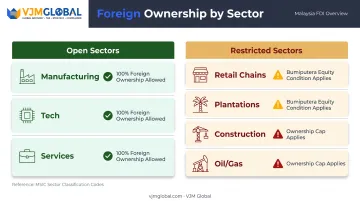
According to MIDA, the Malaysian Investment Development Authority, the Companies Act 2016 imposes no blanket foreign-equity limit, and 100% foreign ownership is allowed in manufacturing and many other activities. Sector-specific licences can still impose ownership conditions.
For Canadian founders, limited liability will feel familiar—much like a corporation under the CBCA or a provincial equivalent. The structures are not interchangeable: a Sdn Bhd does not inherit Canadian tax treatment, and Canadian founders get no automatic permanent-establishment relief.
Watch for restricted sectors. Retail chains, plantations, certain construction work, and oil and gas contracting can carry Bumiputera equity conditions or foreign-ownership caps. Always confirm your specific business activity (MSIC code) with the relevant regulator before assuming 100% ownership is available.
Requirements for Canadians to Register a Sdn Bhd
Before filing anything, Canadian founders need to line up a few pieces that don't exist in a typical Canadian incorporation.
Directors and Shareholders
- Resident director: At least one director must ordinarily reside in Malaysia (principal place of residence there). A Canadian founder cannot be sole director unless they meet that test
- Shareholders: Minimum one shareholder — a Canadian individual or a corporate entity is fine
- Director eligibility: Natural persons, 18 or older, with no active bankruptcy or disqualifying convictions
Company Secretary and Registered Office
You must appoint a licensed company secretary within 30 days of incorporation. This person must be a Malaysian citizen or permanent resident, ordinarily resident in Malaysia, and either SSM-licensed or a member of a prescribed professional body.
Your registered office also needs to be a real, physical Malaysian address, open and accessible during business hours. A P.O. box alone won't satisfy SSM's requirement for unit, floor, building, and postcode details. Virtual office or nominee-address services are what most non-resident founders use to meet this rule.
Capital and Documents
SSM's official incorporation guidance requires at least one issued share but sets no specific RM minimum for incorporation itself. RM1 is a common practical starting figure used by many companies, not a statutory floor.
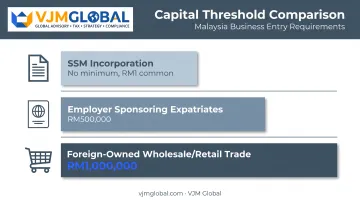
Don't confuse this with other capital thresholds that apply later:
| Purpose | Capital Threshold |
|---|---|
| SSM incorporation | No stated minimum (RM1 commonly used) |
| Employer sponsoring expatriates (100% foreign-owned) | RM500,000 |
| Foreign-owned wholesale/retail/trade (WRT) activity | RM1,000,000 |
The expatriate and WRT thresholds come from Malaysia's Expatriate Services Division and related foreign-ownership policy. They matter if you later plan to sponsor your own Employment Pass or run WRT activity.
Documents you'll need to prepare:
- Passport copies for all directors and shareholders
- Proposed company name (and backup options)
- Description of intended business activity
- Signed declarations of compliance
Step-by-Step Incorporation Process from Canada
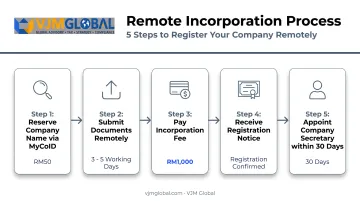
Follow this sequence if you are incorporating from Canada and working through a Malaysian company secretary.
Reserve your company name through MyCoID. Reservation costs RM50 and holds the name for 30 days, extendable in 30-day increments up to 180 days.
Submit incorporation documents remotely. A Malaysian corporate service provider or company secretary can file the Section 14 particulars for you, so you never need to use MyCoID yourself.
Pay the incorporation fee. The standard fee for a company limited by shares is RM1,000, payable online. You do not need to visit Malaysia in person.
Receive your registration notice. SSM issues a notice of registration automatically. A certified digital certificate is available on request for roughly RM20–30.
Appoint your company secretary within 30 days and move into bank, tax, and employer registrations.
A note on timing: Be cautious of fixed "7–10 working day" promises. SSM does not publish a guaranteed processing window. Timing depends on name-search results, document completeness, and any sector-specific licences.
Also build in courier or notarization time for Canadian-issued documents, and the roughly 12–13 hour time difference when you schedule calls with your Malaysian secretary or bank.
Post-Incorporation Compliance Steps
Incorporation starts the compliance clock. Several obligations apply right away.
Bank Account and Tax Registration
Opening a corporate account can often start remotely, but each bank sets its own bar.
Common requirements include:
- Certified constitutional documents, director/signatory ID, and a board resolution (e.g., Maybank)
- Similar packs at CIMB, which may also ask foreign nationals for evidence of a Malaysian employment pass
- In-person attendance by signatories at some banks
You'll also need to:
- Register your Tax Identification Number (TIN) with LHDN through the MyTax e-Daftar portal
- Assess whether SST (Sales and Service Tax) registration applies — thresholds vary by activity, ranging from RM500,000 for many service categories to RM1.5 million for food and beverage services
If You're Hiring Staff
Hiring Malaysian employees triggers additional registrations:
- EPF (retirement fund) registration within seven days of becoming liable
- SOCSO (social security) registration within 30 days using Forms 1 and 2
Ongoing Statutory Obligations
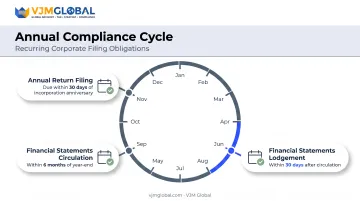
- Annual return filing within 30 days of your incorporation anniversary
- Financial statements circulated within six months of year-end, lodged within 30 days after
- No AGM required for private companies solely under the Companies Act (unlike public companies)
Managing this from Canada without local support is where most founders stall.
VJM Global helps Canadian founders coordinate post-incorporation filings, bookkeeping, and payroll compliance across borders, working with a local Malaysian company secretary where the process requires one.
Costs of Setting Up a Sdn Bhd from Canada
SSM's published fees give you a reliable floor for government charges:
| Item | Fee (RM) |
|---|---|
| Name reservation (30 days) | 50 |
| Incorporation (company limited by shares) | 1,000 |
| Annual return filing | 150 |
| Financial statement lodgement (non-audited) | 20 |
These are official SSM figures, but they don't cover most of what a Canadian founder will actually pay. Company secretary fees, registered address fees, and accounting support are market-priced, not government-set. Expect these to vary with service scope rather than a fixed schedule.
Additional costs for non-resident founders typically include:
- Courier and notarization of Canadian-issued documents
- Remote banking setup or KYC verification fees
- Professional incorporation service fees for MyCoID filing
Because SSM doesn't regulate these service prices, get a written quote before you commit.
Frequently Asked Questions
What does it mean to have a private limited company?
A private limited company is a separate legal entity from its owners, meaning shareholders' liability is limited to their unpaid share capital. It also has perpetual succession, so it continues to exist regardless of changes in ownership.
How can I check if a company is registered in Malaysia?
Suruhanjaya Syarikat Malaysia (SSM) offers portals such as SSM e-Info and MYDATA-SSM for company searches. You can verify registration status and view basic profile details, including directors and shareholders.
Can you give me an example of a private limited company in Malaysia?
Most small and mid-sized Malaysian businesses across retail, trading, tech, and services operate as Sdn Bhd entities. It's the default structure for anyone running a for-profit business beyond a sole proprietorship.
Can a Canadian be the sole director and shareholder of a Malaysian Sdn Bhd?
A Canadian can be the sole shareholder, but not the sole director unless they meet Malaysia's residency test. Most non-resident founders satisfy the resident-director requirement through a nominee director service.
Do I need to travel to Malaysia to incorporate my company?
Most incorporation steps, including name reservation and document filing, can be handled remotely through a local service provider. Some banks, though, require in-person attendance from signatories to open a corporate account.
How is a Malaysian Sdn Bhd taxed compared to a Canadian corporation?
Malaysia’s standard corporate tax rate is 24%, versus Canada’s 15% federal rate (plus provincial tax) or 9% for qualifying small businesses. Malaysia levies no withholding tax on dividends to overseas shareholders, but you still have Canadian tax obligations on that income.