Introduction
Malaysian entrepreneurs are increasingly looking east to Thailand. ASEAN's second-largest economy offers scale, connectivity, and one notable advantage over home turf: Thailand does not require a resident director, unlike Malaysia, which requires at least one under the Companies Act.
But setting up shop isn't as simple as filling out a form. Foreign ownership limits under the Foreign Business Act, Thai-language paperwork, and an unfamiliar regulatory system trip up plenty of DIY founders.
This guide walks through the structure options, the registration steps, realistic costs, and the compliance obligations that follow. We'll also flag where professional support—such as VJM Global's cross-border entity formation help—can remove friction from the process.
Key Takeaways
- A Private Limited Company is the practical default structure for Malaysian investors entering Thailand
- Foreign ownership is capped at 49% under the Foreign Business Act; BOI promotion or an FBL can lift it
- Standard registration takes 3–5 working days once complete; FBL approval can take months
- Tax registration, VAT, and ongoing filings need continuous attention after incorporation
- Cross-border specialists cut document errors and post-setup compliance gaps
Why Malaysian Businesses Are Choosing Thailand
Thailand is often ranked among Southeast Asia's largest economies—sometimes second, depending on exchange rates and GDP revisions. Treat that league-table spot as a snapshot, not a fixed fact.
Harder to dispute is formation activity on the ground: Thailand's Department of Business Development recorded 87,596 new company registrations in 2024, up 2.69% from the year before.
Malaysian interest is part of a broader regional flow. Thailand's Board of Investment logged 35 Malaysian investment applications worth THB 5.75 billion in 2025, against a total of 2,421 foreign applications worth over THB 1.36 trillion. These are promotion applications rather than confirmed inflows, but they signal active appetite.
Appetite alone does not explain the move. For Malaysian owners who want to stay based at home, director residency rules are just as practical a draw:
- Malaysia's Category 1 Employment Pass rules effectively require a locally resident director for certain company categories
- Thai company law generally does not require a director to be Thai or resident in Thailand
- Remote oversight from Kuala Lumpur or Penang is therefore far more workable
For SMEs weighing regional diversification, Thailand's market size plus that administrative flexibility is a real pull—provided the ownership rules are understood upfront.
Understanding Foreign Ownership Rules Before You Start
Before you reserve a company name, you need to know whether your business activity is even open to majority foreign ownership. This is where most first-time founders stumble.
The Foreign Business Act and Its Three Lists
The Foreign Business Act (FBA) governs foreign ownership of Thai companies. A Thai company becomes legally "foreign" once 50% or more of its capital is foreign-held, which is why 49% is the familiar ceiling for straightforward foreign ownership.
The FBA sorts restricted activities into three lists:
- List 1 — closed to foreigners entirely (media, land trading, and similar sensitive sectors)
- List 2 — security, cultural, and natural-resource activities requiring special ministerial approval
- List 3 — activities where Thais are considered "not yet ready to compete"; this is the common route for a Foreign Business Licence (FBL)
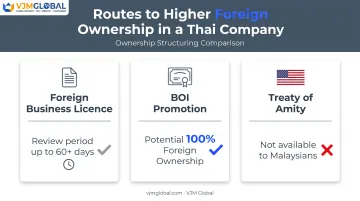
Three Routes to Higher Ownership
If your activity falls under List 2 or 3, you have options:
- Foreign Business Licence (FBL) — The Department of Business Development (DBD) and the Foreign Business Committee review your business plan, financials, and proof of benefit to Thailand. The statutory decision stage is up to 60 days, though gathering documents often stretches the full process to several months.
- Board of Investment (BOI) promotion — Eligible promoted List 2/3 projects may face no foreign-equity restriction at all, subject to the specific promotion certificate's conditions.
- Treaty of Amity — This preferential route is reserved for qualifying US citizens and companies. Malaysians cannot use it, so skip it entirely when planning your structure.
Structural Basics of a Private Limited Company
A Thai Private Limited Company needs at least two individual promoters/shareholders under current guidance, though older references cite three. Liability is limited to unpaid share value, similar to a Malaysian Sdn Bhd.
Before choosing a structure, assess:
- Does your intended activity sit on List 1, 2, or 3?
- Would a Thai-majority shareholding work for your business model?
- Is your activity a realistic candidate for BOI promotion?
Step-by-Step Process to Register a Private Limited Company in Thailand
Once you've settled the ownership question, registration itself is fairly linear.
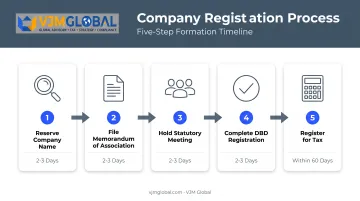
1. Reserve Your Company Name
Submit a preferred name plus two alternatives to the Department of Business Development (DBD). Approval typically takes 2-3 working days, and the reservation is valid for 30 days with no extension. The registered name is checked in Thai through DBD's Biz Regist system, not via informal English translation.
2. Draft and File the Memorandum of Association
The Memorandum of Association (MOA) sets out:
- Company name and head office province
- Business objectives
- Registered share capital and share value
- Promoter details and their subscriptions
All promoters sign the MOA and file it with DBD after the name is approved. That filing locks in your capital structure before the statutory meeting.
3. Hold the Statutory Meeting
At this meeting, promoters:
- Adopt the Articles of Association
- Appoint directors and an auditor
- Approve share allocation, with at least 25% of subscribed capital paid up
Complete this meeting inside the 30-day name-reservation window so you can move straight to incorporation filing.
4. Complete Registration at DBD
Since 1 July 2025, private company applications moved to electronic-only filing through DBD Biz Regist. Pay the registration fee and confirm authorised signatories and e-filing credentials. A company chop (seal) is common practice but not legally compulsory for an ordinary private limited company, unless your articles or a counterparty require one.
5. Register for Tax
Apply for a corporate Tax Identification Number within 60 days of incorporation (Form L.P.10.3). Register for VAT before starting business, or within 30 days of crossing THB 1.8 million in annual turnover.
A practical note for Malaysian founders: most DBD and Revenue Department forms are in Thai. Small translation errors delay approvals, so have a Thai-speaking adviser review filings before you submit.
Costs, Capital Requirements, and Visa Considerations
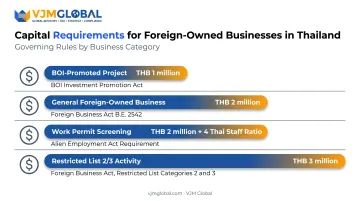
Capital requirements in Thailand aren't a single figure — they depend on what test you're answering.
| Test | Benchmark | Governs |
|---|---|---|
| General foreign-owned business | THB 2 million paid capital | FBA benchmark outside restricted lists |
| Restricted List 2/3 activity | THB 3 million per business | FBA/FBL minimum capital |
| Ordinary foreign work permit | Roughly THB 2 million registered capital + 4 Thai staff per foreign hire | Work permit screening |
| BOI-promoted project | Normally THB 1 million investment (excluding land/working capital) | BOI eligibility |
Visas and Work Permits
Capital alone does not let a Malaysian director or staff member work in Thailand. They generally need a Non-Immigrant B visa secured before entry, followed by a work permit. Incorporating the company doesn't itself authorise anyone to work; that remains a separate legal step.
Budgeting for Setup
Line items to plan for include:
- DBD registration and MOA filing fees
- Thai-language translation and e-signing costs
- FBL application fees, if your activity requires one
- Professional incorporation and advisory fees
- Registered office costs
- First-year accounting and audit setup
There's no single reliable "all-in" figure currently published for total setup costs, so request itemised quotes rather than anchoring to a rough estimate. Keep your paid-up capital (company funds) clearly separate from service fees in your budgeting.
Post-Incorporation Compliance and Tax Obligations
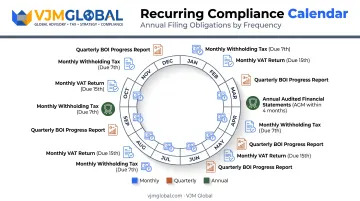
Incorporation is the easy part. What follows is a recurring compliance calendar.
Ongoing obligations include:
- Monthly VAT returns, generally due by the 15th of the following month
- Monthly withholding tax remittance, generally by the 7th of the following month
- Annual audited financial statements — AGM within four months of year-end; DBD filing within one month after approval
- Quarterly BOI progress reports for promoted companies (cadence moved from half-yearly to quarterly from April 2026)
Those filings sit alongside the main tax rates. Thailand's standard corporate income tax is 20% on net profits. VAT is 7% and becomes compulsory once turnover exceeds THB 1.8 million — reconfirm the rate before you file, as it is reviewed periodically.
Hiring adds another layer. Ordinary work-permit holders typically trigger a 4:1 Thai-to-foreign employee ratio. BOI-promoted companies get more flexibility, but it is not a blanket exemption: salary, skill, and workforce conditions under the promotion terms still apply.
How VJM Global Supports Malaysian Businesses Expanding into Thailand
Navigating a foreign regulator in a language you don't read fluently is where most incorporation timelines slip. Cross-border compliance specialists exist to close that gap.
VJM Global delivers entity formation, tax compliance, accounting, and payroll support across 100+ countries, with a team of 100+ CPAs, Chartered Accountants, and multi-jurisdiction compliance professionals. For a Malaysian founder entering Thailand for the first time, that experience translates into:
- Structuring guidance on whether a Thai-majority shareholding, FBL, or BOI route fits your activity
- Document preparation and coordination support to reduce back-and-forth with Thai regulators
- Ongoing bookkeeping, tax filing, and audit support services once the entity is live
- Payroll processing for staff once work permits are secured
Not ready to incorporate yet? VJM Global's Employer of Record service lets you hire staff in Thailand before committing to a full entity. It covers compliant local employment contracts, onboarding, payroll, statutory contributions, and offboarding, priced per employee per month.
For a Malaysian business wanting to test demand in Thailand before building a full local entity, EOR is a lower-risk first step.
Frequently Asked Questions
Can a foreigner own a company in Thailand?
Yes, up to 49% under the Foreign Business Act for most activities. Full ownership is possible through a Foreign Business Licence or BOI promotion, depending on your business activity.
What is a Private Limited Company in Thailand?
It's a separate legal entity with shareholder liability limited to unpaid share value. It's managed by directors and requires a minimum of two promoters/shareholders under current guidance.
How do you check if a company is legitimate in Thailand?
Search the DBD Data Warehouse for registered name, directors, shareholder details, and financial filings. You can also validate an English registration certificate through DBD's certificate checker by reference number.
What is the DBD in Thailand?
The Department of Business Development sits under the Ministry of Commerce and handles company registration, name reservations, and corporate record-keeping in Thailand.
How long does it take to register a company in Thailand?
Standard registration typically takes 3-5 working days once your application is complete. A Foreign Business Licence, by contrast, can take several months due to committee review.
What are the main tax considerations for a new company in Thailand?
Corporate income tax stands at 20%, and VAT is 7% once turnover exceeds THB 1.8 million. Rules vary by activity and structure, so get professional tax advice early.