Many founders get stuck comparing LLC, C-Corp, and Sdn Bhd as if they're interchangeable labels. They're not. Add in questions about visas, residency, and whether you even need to set foot in America, and the confusion compounds fast.
This guide breaks down the closest US equivalents, the exact registration steps, what documents you'll need as a Malaysian founder, and what compliance looks like once your entity exists.
Key Takeaways
- The US has no "private limited company"; LLCs and C-Corporations are the closest equivalents
- Malaysians can own 100% of a US LLC or C-Corp without a visa or US residency
- Delaware, Wyoming, and Nevada are the most common states for foreign-owned entity formation
- An EIN, registered agent, and US bank account are mandatory after incorporation
- Plan dual US–Malaysia tax and compliance obligations from day one
What Is the US Equivalent of a Private Limited Company?
There's no Sdn Bhd-style entity type in US law. Instead, businesses register as either a Limited Liability Company (LLC) or a C-Corporation. Neither is legally identical to a Malaysian private limited company, so it's better to compare their legal and tax attributes than to hunt for a matching label.
An LLC is a state-law structure whose owners are called "members." According to the IRS, most states allow LLC members to include individuals, corporations, other LLCs, and foreign entities, with no cap on the number of members.
That flexibility makes it a natural fit for a Malaysian founder operating solo or with a small partner group.
A C-Corporation is a separate corporate taxpayer. It files its own tax return (Form 1120), pays federal tax at a flat 21% rate, and any profit distributed to shareholders is taxed again as dividends, per IRS Publication 542. C-Corps suit founders planning to raise venture capital or issue stock, since VCs typically require this structure.
Quick clarification: "LLC" isn't exclusive to the US. Malaysia has its own LLP structure, and the UK has Ltd companies. These are similar in spirit but governed by entirely different rules and regulators.
For Malaysian founders running e-commerce stores, SaaS products, or consulting businesses internationally, the LLC usually wins on simplicity. Lower compliance burden, flexible tax treatment, and no requirement to issue stock make it the default choice unless outside investment is on the roadmap.
Which Entity Type Suits Malaysian Founders?
| Factor | LLC | C-Corp |
|---|---|---|
| Liability | Personal liability protection | Same corporate liability shield |
| Taxation | Pass-through by default (disregarded, partnership, or corporate election) | Separate 21% federal corporate tax; dividends taxed again |
| Ownership limits | No cap on members; foreign entities permitted | No general shareholder cap for C-Corps (unlike S-Corps) |
| Ideal use case | Freelancers, SaaS, e-commerce, consulting | Startups raising VC funding or planning to issue stock |
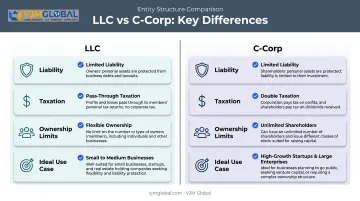
If you're unsure which structure fits, get professional advice before you file—entity choice is hard to unwind later.
Step-by-Step Process to Register a US Company from Malaysia
Registering a US entity from Kuala Lumpur or anywhere else in Malaysia is entirely doable online. Here's the sequence.
- Choose a US state. Delaware, Wyoming, and Nevada are the most common picks for non-residents, largely because they don't require you to operate a physical business there. Each has different fee structures and annual obligations, so check the current numbers before committing.
- Reserve your company name. Search the Secretary of State's business database for your chosen state and confirm the name isn't taken before filing anything else.
- Appoint a registered agent. Every state requires a registered agent with a physical address in that state. Since Malaysian founders won't have a local address, this step is non-negotiable — you'll need to hire one.
- File your formation documents. This means Articles of Organization for an LLC, or Articles of Incorporation for a C-Corp, filed directly with your chosen state.
- Obtain an EIN from the IRS. This is your business's tax ID. Malaysians without a US Social Security Number complete Form SS-4 by fax, mail, or phone. Enter "foreign" on the SSN/ITIN line, per the IRS SS-4 instructions.
- Draft your governance document. An Operating Agreement for an LLC, or Corporate Bylaws for a C-Corp, spells out ownership percentages and decision-making authority. Banks and fintechs will ask for this later, so don't skip it.
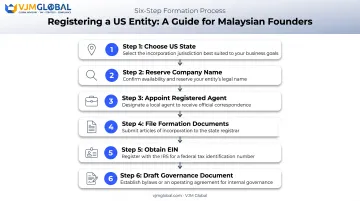
VJM Global handles this entity-formation sequence for founders of any nationality across LLCs, C-Corps, and branch registrations. State filing, EIN application, and registered agent appointment are coordinated as one engagement rather than six separate headaches.
Documents & Requirements for Malaysian Applicants
Here's what you'll typically need on hand:
- Passport copy for identity verification
- Proof of Malaysian address (utility bill or bank statement usually works)
- Proposed company name and a backup option
- Business activity description — what your company actually does
- Registered agent details for your chosen state
A few things trip people up here, so let's clear them:
No visa or Green Card required. Nothing in the state formation requirements or IRS EIN process asks about immigration status. Delaware registered-agent guidance confirms local physical presence is met through the agent, not the owner.
Owning a US company and being authorized to work physically in the US are separate matters.
No local resident director required. Unlike a Malaysian Sdn Bhd, which needs at least one director ordinarily resident in Malaysia, a US LLC or C-Corp can have a Malaysian founder as sole owner and sole director. There's no equivalent residency rule.
Opening a US Business Bank Account and Managing Compliance
This is where most Malaysian founders hit friction. Traditional US banks often want you to show up in person, which obviously isn't practical from Kuala Lumpur or Penang.
Fintech alternatives fill the gap:
- Mercury doesn't require US citizenship or residency, but does require a US-formed entity with existing or planned US operations
- Wise Business allows non-US citizens to open accounts for a registered US business, provided you have a US operating address
- Relay accepts US-registered businesses owned by non-residents who have a US operating presence
None of these guarantee approval just because your entity exists; each has its own verification process, and you'll typically need your EIN confirmation letter, formation documents, and governing documents (bylaws or operating agreement) ready.

Ongoing Compliance Obligations
After formation, keep these US obligations on the calendar:
- Annual state report filing: most states require this, with fees varying by jurisdiction
- Franchise tax: Delaware charges this annually regardless of income; other states use their own formulas
- Federal and state tax returns: even a dormant LLC usually needs to file something
- BOI reporting (Corporate Transparency Act): under FinCEN's March 2025 interim rule, US-created entities and their beneficial owners are exempt. Older guides often still say the opposite.
Running a US entity alongside a Malaysian business (or personal Malaysian tax residency) means two sets of rules apply simultaneously. VJM Global's cross-border team supports this dual-jurisdiction setup. That includes EIN acquisition, state-level compliance, and the tax-treaty and reporting questions that come with operating in both countries.
Estimated Costs and Timeline
Costs depend on the state, the entity type (LLC or C-Corp—the usual US stand-ins for a Malaysian private limited), and whether you use professional help. Figures below focus on LLCs, the path most foreign founders take; C-Corp state filing fees usually land in a similar range at formation.
Typical formation costs:
- Delaware LLC: $110 formation fee, plus a $300 annual franchise tax due each June 1, according to Delaware's official LLC formation form
- Wyoming LLC: $100 for Articles of Organization, plus an annual license tax that's the greater of $60 or a small percentage of Wyoming-based assets, per the Wyoming Secretary of State fee schedule
- Registered agent fees: typically $50–$300 per year, depending on the provider
- EIN: free from the IRS, though processing takes longer for foreign applicants without an SSN
- Professional service fees: vary by state and entity type; firms such as VJM Global quote from the state and structure you choose
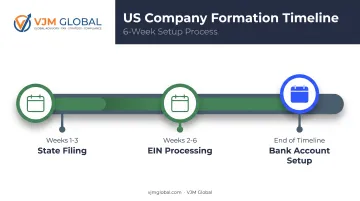
Realistic timeline:
1-3 weeks for the state filing itself, assuming no backlog
2-6 weeks end-to-end, once you factor in EIN processing (roughly 4 business days by fax, or 4-5 weeks by mail per IRS guidance) and bank account setup
Bank account: rarely same-week for non-US founders—between EIN processing and fintech checks, budget the full six weeks for a calm launch
Frequently Asked Questions
What is a private limited company in Malaysia?
A Sdn. Bhd. is Malaysia's private limited company structure: a company limited by shares, regulated by SSM under the Companies Act 2016. It requires at least one director ordinarily resident in Malaysia.
What is the equivalent of a private limited company in the USA?
There's no direct "Ltd" equivalent in US law. The closest structures are the LLC and the C-Corporation, each with different tax treatment and ownership rules.
Are LLCs only available in the USA?
LLCs originated in the US and remain a US state-law concept. Similar structures exist elsewhere, such as Malaysia's LLP, but they follow different rules and aren't legally interchangeable.
Can Malaysians work in the USA?
Owning and operating a US company remotely from Malaysia requires no visa at all. Physically working inside the United States, however, requires the appropriate US work visa. Ownership doesn't substitute for authorization.
Do I need to visit the USA to register my company?
No. The entire formation process, including state filing and EIN application, can be completed remotely online, by mail, or by fax.
How do I open a US bank account as a Malaysian founder?
Traditional banks often require in-person visits, so most non-resident founders use fintech platforms like Mercury, Wise, or Relay instead. Each requires your EIN, formation documents, and a US operating address for verification.