
Zimbabwe's Companies and Other Business Entities Act, 2019 gives foreign investors a workable path into the market. But the outcome of your registration depends heavily on three things: how well you prepare your documents, which entity type you choose, and whether you get the Indian-side FDI/RBI compliance right.
This article walks through the registration steps, the paperwork you'll need, realistic costs and timelines, mistakes to avoid, and alternative structures worth considering.
Key Takeaways
- Zimbabwe requires at least one resident director under the 2019 Act; a resident shareholder is optional
- Indian promoters must meet Zimbabwe incorporation rules and India’s FEMA/Overseas Investment reporting
- File with Zimbabwe’s Companies and Other Business Entities registry; Indian documents usually need notarisation
- Registrar fees are modest (about $40 for a Pvt Ltd); professional and compliance costs dominate
- Cross-border advisory cuts delays from documentation gaps and dual-reporting errors
How to Register a Private Limited Company in Zimbabwe from India
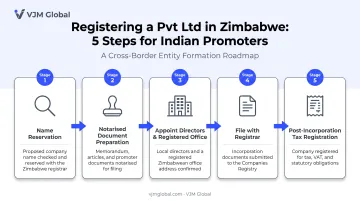
Step 1: Choose and Reserve the Company Name
Start by submitting a proposed company name to the Zimbabwe Registrar of Companies for approval. The name must be unique and not deceptively similar to an existing entity.
Indian promoters usually do this remotely through a local agent or registered office provider in Zimbabwe. According to CDH's Zimbabwe incorporation guide, the name search itself takes 3-6 working days, though full reservation can stretch to a month.
Step 2: Prepare and Notarise Incorporation Documents in India
You'll need to assemble:
- Passport copies of all directors and shareholders
- Proof of residential address
- Memorandum and Articles of Association details
- Signed shareholder and director declarations
Documents executed in India generally require notarisation before the Zimbabwean registry will accept them. Certified translations are also needed if any document isn't in English. Get this step wrong, and you'll be resubmitting paperwork weeks later.
Step 3: Appoint Directors, Shareholders and a Registered Office
Here's something many Indian promoters miss: Zimbabwe's Companies and Other Business Entities Act requires at least one director ordinarily resident in Zimbabwe. This is different from jurisdictions that allow fully non-resident boards, so plan for a resident director arrangement early.
You'll also need:
- A Zimbabwe postal address
- A physical registered office where legal notices can be served
- A local registered agent to handle statutory correspondence
Step 4: File Incorporation Application with the Registrar of Companies
Once your documents and appointments are in order, file with the Registrar:
- Memorandum and Articles of Association
- Incorporation statement
- Director details
- Prescribed fee
On approval, the Registrar assigns a registration number and issues a Certificate of Incorporation. That certificate is proof your company legally exists.
Step 5: Complete Post-Incorporation Tax and Regulatory Registrations
After incorporation, complete these registrations:
- Register with the Zimbabwe Revenue Authority (ZIMRA) for a Taxpayer Identification Number
- Register for VAT if turnover exceeds or is expected to exceed US$25,000
- Apply for PAYE registration within 14 days of hiring your first employee
- Open a local corporate bank account and remit share capital
- Report the outward remittance to the RBI under India's Overseas Investment rules
Skipping any of these creates compliance gaps that surface later, usually at the worst possible time.
Which Zimbabwean Entity Type Should Indian Investors Choose?
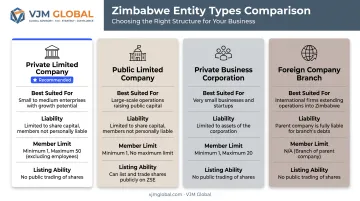
A Private Limited Company (Pvt Ltd) is not the only option. Zimbabwe’s Companies and Other Business Entities Act also allows these structures:
| Entity Type | Best Suited For |
|---|---|
| Private Limited Company (Pvt Ltd) | Ongoing operations, manufacturing, trading, mining — limited liability protection |
| Public Limited Company | Businesses planning to list shares on a stock exchange |
| Private Business Corporation (PBC) | Very small operations, up to 20 members, no directors required |
| Foreign Company (branch) | Existing foreign entities extending operations into Zimbabwe |
For most Indian companies planning manufacturing, mining or trading activity, Pvt Ltd remains the recommended structure. It offers unrestricted business activity and clean liability separation. A PBC suits only very small, member-run ventures. It is a poor fit for export plans or multiple stakeholders.
What Indian Promoters Need Before Starting Registration
Preparation on the Indian side prevents most of the delays that surface at the Zimbabwean registry.
Documentation Readiness
- Valid passports for all directors and shareholders
- Notarised address proof
- Board resolutions from corporate shareholders authorising the Zimbabwe entity formation
Regulatory and Compliance Readiness
- Confirmation of your applicable route under RBI's Overseas Investment (ODI) rules
- Clarity on ODI/FEMA reporting tied to your investment structure
- Sector-specific approvals if you're entering regulated industries like mining or pharmaceuticals
Local Support Readiness
Indian promoters often cannot be on the ground in Zimbabwe for every filing step. Line up local support before you file:
- A registered office address in Zimbabwe
- A workable resident-director or local nominee arrangement
VJM Global can help sort ODI classification and FEMA reporting on the India side while local counsel handles the Zimbabwean registration itself.
Costs, Timelines and Compliance Factors That Affect the Process
Registration Fees and Government Costs
As of August 2024, CDH's fee guide put statutory Registrar fees at:
- US$40 for a Private Limited Company
- US$20 for a PBC
- US$80 for a Public Limited Company
Professional fees sit on top of these and vary by firm and scope. Always confirm current tariffs before budgeting, since these figures date to 2024.
Processing Timeline
Name search takes 3-6 working days, with registration following within roughly two weeks after filing. The real bottleneck, though, is usually on the Indian side — notarisation and courier turnaround for documents often adds more delay than the Zimbabwean registry process itself.
Corporate Tax and Compliance Obligations
Once the company is registered, ongoing tax and filing rules drive the real cost of staying compliant. Zimbabwe's standard corporate tax rate is 25%, plus a 3% AIDS levy on tax chargeable, per ZIMRA's tax rate table.
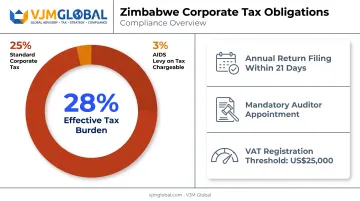
Key obligations include:
- File an annual return within 21 days of the incorporation anniversary
- Appoint an auditor unless a private-company exemption applies
- Budget for the 25% corporate tax rate plus the 3% AIDS levy
Currency and Capital Remittance Rules
Remitting share capital from India must go through the correct RBI outward-investment route. That filing is not a one-time step: Annual Performance Reports remain due for as long as the investment is held.
Common Mistakes Indian Investors Make When Registering in Zimbabwe
Most delays come from a few avoidable gaps on the Zimbabwe filing side and the India outbound-investment side. Watch for these:
- Submitting non-notarised or improperly executed documents, leading to registry rejection and lost weeks
- Missing the resident director requirement, then scrambling to find a suitable candidate mid-process
- Filing outbound investment incorrectly under RBI/FEMA, or missing Annual Performance Report deadlines
- Underestimating post-incorporation compliance, particularly ZIMRA tax registration, VAT thresholds, and annual returns
VJM Global handles FEMA reporting, ODI advisory, and cross-border compliance for Indian companies expanding abroad. That dual view helps keep Zimbabwe filings aligned with what must be reported back in India, so neither side misses a deadline.
Frequently Asked Questions
How much does it cost to register a private limited company in Zimbabwe?
Government Registrar fees are modest, around $40 for a Pvt Ltd, but you'll also pay for notarisation in India, courier costs, and local agent or professional fees. Get a current quote before budgeting, as fee schedules change.
Is there an Indian population in Zimbabwe?
Yes. According to the Ministry of External Affairs' overseas Indian population data, Zimbabwe hosts roughly 9,500 people of Indian origin. A long-established business community there can support networking for new investors.
Can an Indian company own 100% of a Zimbabwean Pvt Ltd?
Foreign ownership is broadly permitted under the Companies and Other Business Entities Act, though Zimbabwe requires at least one director to be ordinarily resident there. Sector-specific ownership limits should always be checked before finalising your structure.
Is a resident director required to incorporate in Zimbabwe?
Yes. Unlike some other African jurisdictions, Zimbabwe's Act requires all companies (except foreign companies) to appoint at least one director ordinarily resident in the country.
How long does it take to incorporate a company in Zimbabwe from India?
Registry processing typically takes a few weeks once documents are filed. Add extra time for notarisation and courier delivery from India, which is usually the bigger delay factor.
Do Indian investors need RBI approval to invest in a Zimbabwean company?
Outward investment must be reported through RBI's Overseas Investment framework, with the exact route depending on your investment value and structure. Annual Performance Reports are also required for as long as you hold the investment.