Here's the problem: most guides stop at incorporation. They skip the part where the Reserve Bank of India cares about what you just did.
This is a step-by-step, 2026-updated guide to registering and running a UK Private Limited Company from India, including the FEMA/RBI angle most guides conveniently leave out.
Key Takeaways
- UK Ltd allows 100% Indian ownership and directors with no UK residency requirement
- Online incorporation costs £100 and takes ~24 hours; banking and compliance raise first-year cost
- Buying UK shares can trigger FEMA/RBI Overseas Investment (ODI) filings for Indian investors
- Incorporation and business banking are separate; a Certificate of Incorporation does not open Stripe or Wise
What Is a UK Private Limited Company (and Why Indian Founders Choose It)?
A UK Ltd is a company limited by shares, registered with Companies House, with a legal identity separate from its owners. Shareholder liability is capped at unpaid share capital. Your personal assets remain protected.
The structural appeal for Indian founders is simple: a UK Ltd needs just one director and one shareholder, and that person can be the same individual. Compare that to an Indian Pvt Ltd, which requires two directors, at least one India-resident.
Common use cases we see:
- Solo consultants invoicing international clients who need a credible invoicing entity
- SaaS founders wanting UK or EU market trust signals
- E-commerce sellers running UK fulfilment or Amazon UK operations
- Established Indian companies setting up a UK subsidiary for market entry
What to Know Before You Register From India
Many founders assume incorporation solves banking, payments, and tax questions in one shot. It doesn't. Here's what actually needs separate attention:
- Registered office must be a genuine UK address in England & Wales, Scotland, or Northern Ireland. Your home address in India won't work
- Identity verification is mandatory for directors and Persons with Significant Control (PSCs) since 18 November 2025, via GOV.UK One Login or an Authorised Corporate Service Provider
- Bank and fintech approval (Wise, Revolut, Payoneer, HSBC) is a conditional process independent of incorporation
- Direct ownership vs. UK subsidiary of an existing Indian company changes your entire FEMA/RBI compliance path
- Managing the company entirely from India can pull it into Indian tax residence under Place of Effective Management rules
Get these wrong at the start, and you're fixing structural problems six months in — usually at a worse time.
Documents and Structural Decisions to Get Right
Lock in the paperwork and structure choices before you file with Companies House. Missing one item delays incorporation.
Documents to gather:
- Passport scan and Indian proof of address
- Director and shareholder details
- SIC code (your business activity classification)
- Statement of capital
- PSC (Person with Significant Control) declaration
Ltd vs LLP vs Branch Office
For almost all solo Indian founders, a private limited company (Ltd) is the right vehicle. It allows a single director and shareholder, unlike an LLP (which needs two members) or a branch office (which is not a separate legal entity).
Registered Office vs Director Service Address
These are different things, and mixing them up is a common miss:
- Registered office: the company's official UK address, publicly visible
- Director service address: where a director can be officially contacted, also public
Most non-resident founders use a professional UK address service for both. A service address protects your correspondence, but not your privacy entirely.
The UK maintains a public company register where the director's service address is visible; only the residential address stays private.
How to Register a UK Private Limited Company from India — Step by Step
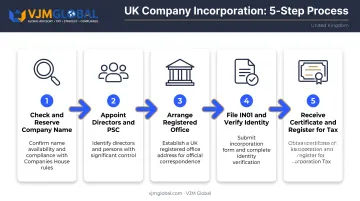
Incorporation breaks into five practical stages. The most common mistakes are ignoring identity verification timelines and using an invalid registered address.
1. Check and Reserve Your Company Name
Search the Companies House name checker and the UKIPO trademark database before you commit. The name must end in “Limited” or “Ltd” and cannot match an existing company or protected trademark.
2. Appoint Directors, Shareholders and Identify the PSC
You need at least one director. One person can hold both director and shareholder roles, and non-UK residents are eligible—important if your board sits in India. Anyone owning more than 25% must be declared a Person with Significant Control (PSC).
3. Arrange a UK Registered Office and Registered Email
Secure a compliant UK address through a formation agent; a PO box alone will not be accepted. You also need a registered email address that Companies House can use for official correspondence.
4. File Form IN01 and Complete Identity Verification
File incorporation documents online with Companies House and complete director/PSC identity verification before or shortly after filing. Standard online filings are often processed within 24 hours once verification is in order.
5. Receive Your Certificate of Incorporation and Register for Corporation Tax
Once approved, you receive a Certificate of Incorporation and company number. HMRC issues a Unique Taxpayer Reference (UTR) automatically. You must register for Corporation Tax within 3 months of starting to trade.
Costs, Tax and Ongoing Compliance
Here's the fee breakdown as it stands in 2026:
| Item | Cost |
|---|---|
| Online incorporation | £100 |
| Annual confirmation statement | £50 |
| Registered office/agent service | Varies by provider |
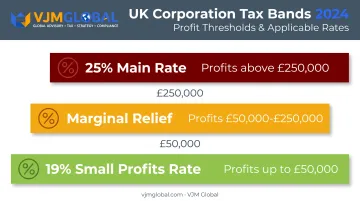
Beyond those filing fees, Corporation Tax is the main ongoing cost:
- 19% small profits rate for profits up to £50,000
- Marginal relief between £50,000 and £250,000
- 25% main rate above £250,000
Recurring filings you can't skip:
- Confirmation statement (annually)
- Annual accounts
- CT600 (Corporation Tax return)
- VAT return, if turnover exceeds £90,000
- PAYE, if you hire UK staff
Running a UK entity alongside Indian filings means two regulatory calendars, two deadline sets, and two penalty regimes if either side is missed.
VJM Global handles UK incorporation and compliance together with India-side FEMA and tax filings, so founders are not managing both calendars alone.
Tax Residency, FEMA and Banking: What Indian Founders Must Not Ignore
This is the section most incorporation guides skip entirely, and it's where the real risk sits.
POEM Can Make Your UK Company an Indian Taxpayer
Run your UK Ltd entirely from India — every decision, every meeting — and it can be treated as an Indian tax resident under Section 6(3) POEM rules. That means your company's global income becomes taxable in India, not just its UK-sourced income.
FEMA and the ODI Route
Acquiring shares in an unlisted UK company as an Indian resident typically falls under RBI's Overseas Investment (ODI) framework, regardless of shareholding percentage.
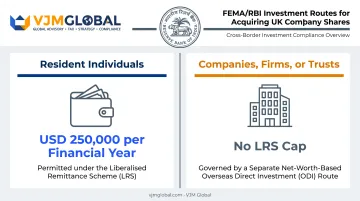
Who invests changes the remit route:
- Resident individuals: up to USD 250,000 per financial year under the Liberalised Remittance Scheme (LRS)
- Companies, firms, or trusts: separate net-worth-based ODI route (LRS does not apply)
DTAA Doesn't Remove Your Reporting Duty
The India-UK Double Taxation Avoidance Agreement lets you claim foreign tax credit for UK tax paid, avoiding double taxation. It does not, however, remove the need for correct classification and reporting on both sides.
Banking Is Its Own Approval Process
Your Certificate of Incorporation doesn't guarantee a Wise, Revolut, or HSBC account. Providers run independent KYC checks, and approval depends on their own risk criteria, not on Companies House paperwork.
POEM, ODI, DTAA reporting, and banking KYC stack on each other. Structures that look simple on the UK side often leave FEMA and tax gaps in India that only surface at audit. VJM Global works across UK company formation and Indian FEMA/tax compliance so those gaps are designed out before filing, not patched after.
Frequently Asked Questions
Is a US LLC the same as a UK Ltd?
No. A US LLC is typically a pass-through entity by default, while a UK Ltd is a separate taxable legal entity under the Companies Act 2006. Different legal systems, different tax treatment entirely.
Is there any difference between a private company and a private limited company?
"Private company" is a broad term. "Private limited company" specifically refers to a company limited by shares or guarantee, with shareholder liability capped.
What are 5 characteristics of a private limited company?
- Separate legal identity from its owners
- Limited liability for shareholders
- Restricted share transfer
- Minimum one director and one shareholder
- Mandatory Companies House registration and ongoing filings
Can you give an example of a private limited company?
A UK-based SaaS or consultancy business trading as "XYZ Ltd," registered with Companies House and owned by one or more shareholders.
Can an Indian resident be the sole director and shareholder of a UK company?
Yes. There is no UK residency requirement. FEMA/ODI compliance may still apply to the share acquisition itself.
Do I need to visit the UK to incorporate or open a business account?
No. Incorporation is fully online, and fintech providers like Wise or Revolut allow remote account opening, subject to their own eligibility checks.