
Both structures file through the same Companies House digital system, but a PLC comes with extra layers: a qualified company secretary, a £50,000 minimum share capital requirement, and India-side FEMA compliance before a single pound can be remitted. Get any of these wrong and you could delay trading or trigger penalties on both sides of the border.
This guide walks through whether a PLC is genuinely the right choice, the exact registration steps, FEMA/RBI requirements, realistic costs, and the mistakes Indian promoters make most often.
Key Takeaways
- A UK PLC requires 2 directors, a qualified company secretary, and £50,000 share capital (£12,500 paid up).
- Trading and borrowing are illegal until Companies House issues a separate Trading Certificate.
- Indian promoters must file Form FC with an Authorised Dealer bank before remitting funds under FEMA.
- Most Indian founders expanding to the UK only need a Ltd company: faster, cheaper, and far less compliance-heavy.
- First-year PLC costs reach several thousand pounds once secretary retainers and mandatory audit fees apply.
How to Register a UK Public Limited Company from India
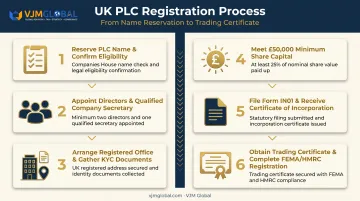
Step 1: Reserve Your PLC Name and Confirm Eligibility
Every PLC name must end in "Public Limited Company" or "PLC." Run the proposed name through the Companies House name availability checker to confirm it isn't identical, or "too like," an existing registered name.
Before going further, pressure-test the decision itself. PLC status brings mandatory audits, a qualified secretary, and public disclosure obligations that a Ltd company simply doesn't carry. If you're not planning a genuine public raise or listing, this is the moment to reconsider.
Step 2: Appoint Directors, Shareholders and a Qualified Company Secretary
A PLC needs at least 2 directors, with no UK residency requirement. This differs from a Ltd company, which only needs one.
You'll also need a company secretary who meets one of the qualification routes under Section 273 of the Companies Act 2006:
- Served as a public company secretary for at least 3 of the previous 5 years
- Holds membership of a listed professional body (ICAEW, ICAS, ACCA, ICSA, CIMA, CIPFA, or Chartered Accountants Ireland)
- Is a UK-qualified barrister, advocate, or solicitor
- Otherwise appears capable to the directors based on relevant experience
Two additional compliance steps apply at this stage:
- Complete GOV.UK One Login identity verification. This became mandatory from 18 November 2025 under the Economic Crime and Corporate Transparency Act rollout and accepts a biometric passport from any country, including India.
- Identify all Persons with Significant Control (PSCs) — anyone holding more than 25% of shares or voting rights must be recorded and separately identity-verified.
Step 3: Arrange a UK Registered Office and Gather KYC Documents
Your registered office must be a genuine physical address in England and Wales, Scotland, or Northern Ireland, capable of receiving and acknowledging post. A Royal Mail PO Box won't qualify. Many Indian promoters use a registered agent service for this rather than renting UK office space they don't need yet.
Alongside the address, you'll need to gather:
- Passport copies for all directors and PSCs
- Proof of current address (bank statement, utility bill, or similar)
- The correct SIC code describing your business activity
Step 4: Meet the £50,000 Minimum Share Capital Requirement
This is the single biggest structural difference from a Ltd company, which has no statutory minimum capital at all.
A PLC must allot at least £50,000 in nominal share capital. Under Section 586 of the Companies Act 2006, at least one-quarter of that nominal value, plus 100% of any share premium, must actually be paid up before allotment. In practice, that means:
- £50,000 nominal capital allotted
- £12,500 minimum paid up (25%)
- Any premium above nominal value paid in full
Without meeting this threshold, Companies House cannot issue your Trading Certificate later.
Step 5: File Form IN01 and Receive the Certificate of Incorporation
Submit your Memorandum and Articles of Association, statement of capital, and director/PSC details via compatible commercial software or paper Form IN01. The standard GOV.UK web incorporation service only covers private companies, not PLCs.
Standard digital incorporation typically processes within 24 hours once correctly filed, though complex applications can take longer. Same-day software filing is available if submitted before 3pm on a business day.
Step 6: Obtain the Trading Certificate and Complete FEMA/HMRC Registration
Incorporation isn't the finish line for a PLC. Under Section 761 of the Companies Act 2006, a newly formed PLC cannot legally trade or borrow until Companies House issues a Trading Certificate.
To get there:
- File Form FC with your Authorised Dealer bank in India before remitting any investment funds, satisfying FEMA (Overseas Investment) Rules, 2022 requirements
- File Form SH50, confirming allotted capital meets the £50,000 minimum and at least £12,500 is paid up
- Register for UK Corporation Tax with HMRC within 3 months of starting to trade
Only after the Trading Certificate arrives can the company legally allot shares, borrow, or commence business.
FEMA/RBI Compliance and Cost of Registering a UK PLC from India
Getting Money Out of India Legally
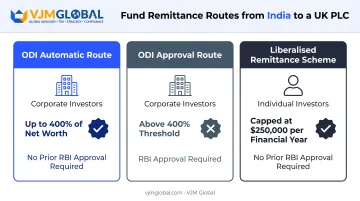
If your Indian company is funding the UK PLC, the ODI Automatic Route generally applies, allowing investment up to 400% of net worth (per the last audited balance sheet) without prior RBI approval. Anything beyond that needs the Approval Route.
If you're investing as an individual rather than through a corporate vehicle, a different cap applies. The Liberalised Remittance Scheme caps individual remittances at $250,000 per financial year.
The PLC's £50,000 minimum share capital alone can eat a large chunk of that limit, before you've paid for a secretary, registered office, or advisory fees. Most serious promoters find a corporate investment vehicle far more practical than remitting as an individual.
Two filings keep you compliant on an ongoing basis:
- Form FC, filed with your Authorised Dealer bank before remitting funds or undertaking financial commitment
- Annual Performance Report (APR), due by 31 December each year for as long as the overseas holding exists
What It Actually Costs
There's no single number for "the cost of a UK PLC," because several line items are quote-based. Here's the realistic breakdown:
| Cost Item | Estimated Range | Notes |
|---|---|---|
| Companies House incorporation | £100–£156 | Standard digital vs same-day software filing |
| Minimum paid-up capital | £12,500 | 25% of £50,000 allotted capital (statutory floor) |
| Registered office service | Varies by provider | Jurisdiction and mail-handling driven |
| Qualified company secretary retainer | Varies by provider | Depends on scope and transaction volume |
| Statutory audit (mandatory, no small-company exemption) | Varies by size/complexity | Required every year the company is active |
| Cross-border advisory (UK + FEMA coordination) | Varies by scope | Formation, tax, ODI/FEMA reporting |
The Companies House incorporation fee itself rose from £50 to £100 for standard digital filing, in line with wider fee and identity-verification changes at the registrar.
UK filing and India-side FEMA compliance run on separate tracks with separate deadlines, so both need to move together. Firms like VJM Global often run the Companies House filing and Form FC/APR compliance in parallel, rather than leaving promoters to juggle two regulators alone.
PLC vs Ltd vs LLP: Which UK Structure Do You Actually Need?
A PLC is rarely the right first move. Most Indian entrepreneurs entering the UK market are better served by one of the two more common structures below.
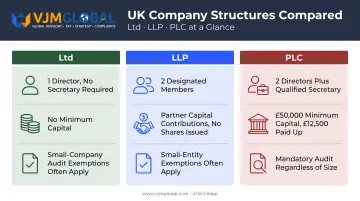
| Structure | Directors/Secretary | Capital | Audit |
|---|---|---|---|
| Ltd | 1 director, no secretary needed | No statutory minimum | Small-company exemptions often apply |
| LLP | 2 designated members | Partner contributions, no shares issued | Small-entity exemptions often apply |
| PLC | 2 directors + qualified secretary | £50,000 minimum, £12,500 paid up | Mandatory, regardless of size |
Private Limited Company (Ltd)
When it's better: Startups, SMEs, and service exporters who aren't planning a public listing. You need just one director, no company secretary, and no minimum capital to get started.
Key trade-offs: A Ltd company can't offer shares to the public, and it carries less institutional weight if you're chasing large-scale public fundraising down the line.
Limited Liability Partnership (LLP)
When it's better: Professional services or consulting setups where profits should flow directly to partners' personal tax returns rather than sitting inside a corporate tax wrapper.
Key trade-offs: An LLP can't issue shares at all, which rules it out for equity fundraising or institutional investment of any kind.
Public Limited Company (PLC)
When it's better: Only when you're genuinely planning an IPO on the London Stock Exchange, raising capital from the public, or operating in a sector (like certain regulated financial services) that specifically requires PLC status.
Key trade-offs: Mandatory audit regardless of size, £50,000 minimum capital, a required qualified secretary, and significantly heavier ongoing disclosure obligations.
Common Mistakes When Registering a UK PLC from India
These three mistakes create the costliest setbacks for Indian promoters registering a UK PLC:
- Defaulting to PLC without a genuine need. Choosing “public limited” for credibility alone locks you into years of audit fees and secretary retainers even if you never list.
- Trading before the Trading Certificate arrives. Incorporation and trading eligibility are separate milestones—starting business or borrowing before Companies House issues the certificate breaches Section 761 of the Companies Act 2006.
- Missing the FEMA filing window. Remitting investment funds before filing Form FC with your Authorised Dealer bank is a frequent slip. FEMA penalties can reach up to three times the amount involved where quantifiable, or up to ₹2,00,000 plus ₹5,000 per day for continuing violations.
Conclusion
A UK PLC is a much bigger commitment than a Ltd company. You need two directors instead of one, a qualified company secretary, £50,000 in share capital, and a separate Trading Certificate before you can trade. None of these apply to a standard Ltd formation.
For most Indian entrepreneurs expanding into the UK, a Ltd company remains the faster, cheaper, and entirely sufficient option. PLC status only justifies the extra cost and complexity when public capital raising or an LSE listing is genuinely on the roadmap.
Where that ambition is real, treating UK Companies House filings and India's FEMA/RBI obligations as two disconnected processes invites missed deadlines. Cross-border advisory support from VJM Global, spanning entity formation and FEMA compliance, keeps both sides moving in sync and reduces the risk of penalties.
Frequently Asked Questions
Can an Indian register a company in the UK?
Yes. Indian residents can register any UK company type, including a PLC, without visiting the UK. Before remitting investment funds, you must meet FEMA Overseas Direct Investment (ODI) rules and complete the required filing with an Authorised Dealer bank.
Should an Indian business register as a PLC or a Ltd company in the UK?
A Ltd company suits most Indian founders due to lower cost and lighter compliance. A PLC only makes sense if you plan to raise public capital or list on the London Stock Exchange.
Is an LLC available in the UK?
No. The LLC (Limited Liability Company) is a US structure with no equivalent under UK law. The closest UK options are the Ltd company and the LLP.
What are some examples of public limited companies in the UK?
Tesco PLC, BP PLC, Barclays PLC, and Marks & Spencer Group PLC are well-known examples. These are large listed entities, not the typical structure for new market entrants.
How much does it cost to register a UK PLC from India?
Costs include the Companies House filing fee (£100–£156), the £12,500 minimum paid-up capital, a company secretary retainer, and professional advisory fees. See the full cost breakdown above for details.
Does a UK PLC need a UK resident director?
No. Directors don't need to be UK residents. A qualified company secretary is mandatory, and every director must complete identity verification via GOV.UK One Login.