Most Indian founders entering Malaysia default to a Sdn Bhd, the private limited structure. But a growing number with plans to raise public capital or eventually list on Bursa Malaysia are asking a different question: does a Berhad (public limited company) make more sense?
This guide walks through what a Berhad involves, who it actually suits, and how an Indian entrepreneur can register one, including the India-specific compliance layer under RBI and FEMA that generic incorporation guides often skip.
Key Takeaways
- A Berhad fits public share issuance or a future Bursa Malaysia listing—not routine market entry
- Indian founders can own a Berhad remotely but must appoint two Malaysia-resident directors and a licensed secretary
- Indian investors must follow RBI FEMA Overseas Investment rules plus Malaysian SSM and LHDN requirements
- Incorporation grants no residency or work rights; apply for passes separately
- Full setup usually takes several weeks when handled remotely end to end
What Is a Public Limited Company (Berhad) in Malaysia?
A Berhad (Bhd) is a public limited company registered under Malaysia's Companies Act 2016. It's built for businesses that may eventually offer shares to the public or seek a listing on Bursa Malaysia.
That public-capital path is the key distinction from a Sdn Bhd, which stays privately held and can't raise capital from the public.
Here's what defines the structure:
- Shareholders: At least one member required, with no upper cap
- Directors: At least two directors ordinarily resident in Malaysia—stricter than the single resident director many Indian founders expect from Sdn Bhd rules
- Financial disclosure: Must lodge financial statements with the Companies Commission of Malaysia (SSM) within 30 days of its AGM
- Audit: No private-company audit exemption, regardless of size or revenue
That last point trips up a lot of founders. A small Sdn Bhd might qualify for audit exemption under SSM's phased thresholds. A Berhad never does, even if it's pre-revenue and has never touched a public market.
Berhad vs Sdn Bhd vs Other Structures
Choosing the right entry vehicle depends on how much disclosure and audit burden you're willing to carry from day one.
| Structure | Ownership & Directors | Disclosure/Audit | Best Fit for Indian Founders |
|---|---|---|---|
| Berhad | No shareholder cap; 2 resident directors required | Annual audit mandatory; statements filed within 30 days of AGM | Public capital raising or Bursa listing plans |
| Sdn Bhd | Max 50 shareholders; lighter private-company director rules | May qualify for audit exemption at qualifying thresholds | Standard market entry, most SMEs |
| Registered branch/foreign company | Extension of Indian parent | Annual return within 30 days of registration anniversary; statements within 30 days of AGM | Testing market with parent-company liability |
| Representative office | MIDA-approved, not incorporated | No trading, no contracts, research/coordination only | Feasibility studies before committing |
Most Indian SMEs enter Malaysia as a Sdn Bhd, then convert to a Berhad only when they need public capital or more than 50 shareholders. Starting with a Berhad "just in case" usually means paying audit and disclosure costs before you need them.
Why Indian Entrepreneurs Consider a Berhad Structure in Malaysia
A Berhad makes sense under specific conditions:
- Unlimited shareholders
- Plans for a public share offering
- A Bursa Malaysia listing on the horizon
It's not a default upgrade from Sdn Bhd, and treating it as one usually backfires on compliance costs.
Tax Positioning: Malaysia vs India
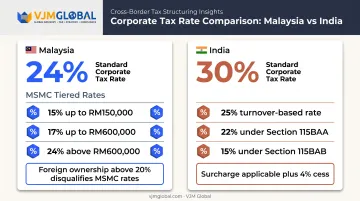
Malaysia's standard corporate tax rate is 24%. Resident small and medium companies (MSMC) get tiered relief:
- 15% on the first RM150,000 of chargeable income
- 17% on RM150,001 to RM600,000
- 24% above RM600,000
There's a catch specific to Indian investors. From year of assessment (YA) 2024, these preferential MSMC rates are disqualified once foreign ownership exceeds 20%, whether that ownership is direct or indirect. A wholly Indian-owned Berhad won't qualify for MSMC treatment and defaults straight to 24%.
Compare that to India's own regime for domestic companies (AY 2026-27):
- 25% for companies with FY2020-21 turnover up to ₹400 crore
- 30% for other ordinary domestic companies
- 22% under Section 115BAA (concessional regime)
- 15% on business income under Section 115BAB for qualifying new manufacturing companies
Add India's surcharge (7-12% depending on income) and 4% Health and Education Cess. Malaysia's flat 24% often still compares favourably for profits earned in the region.
The FEMA Compliance Layer
An Indian company setting up a Berhad doesn't just deal with Malaysian regulators. It must also comply with RBI's Overseas Investment rules under FEMA, which means:
- Filing Form FC with your Authorised Dealer (AD) bank before the initial investment or remittance
- Obtaining a Unique Identification Number (UIN) through the AD bank before funds move
- Filing an Annual Performance Report through the same AD bank
- Seeking prior RBI approval if financial commitment exceeds USD 1 billion in a single financial year
Miss the Form FC filing sequence and your remittance simply doesn't go through. This is the piece most generic incorporation providers gloss over.
DTAA and MIDA Incentives
The India-Malaysia Double Taxation Avoidance Agreement (effective in India from April 2013) prevents the same income being taxed twice. It applies a foreign-tax-credit method under Article 24.
MIDA also offers incentives worth exploring for manufacturing-linked Berhads:
- Pioneer Status: five-year partial exemption, tax applies to only 30% of statutory income
- Investment Tax Allowance: 60% allowance on qualifying capital expenditure within five years
The trade-off remains constant, though: higher compliance and disclosure obligations persist even if your capital-raising plans stall or the listing never happens.
Requirements and Step-by-Step Process to Register a Berhad Company in Malaysia from India
Requirements for Indian Applicants
Before filing anything, get these in order:
- Promoters/shareholders: At least one; Indian individuals or corporate entities both qualify
- Resident directors: At least two ordinarily resident in Malaysia—founders without a Malaysia contact typically appoint local professional directors
- Company secretary: A licensed Malaysian secretary must be appointed within 30 days of incorporation
- Documentation: Passport copies, proof of residential address, and director/shareholder declarations. India-origin documents typically require notarisation or apostille before SSM will accept them
The Registration Sequence
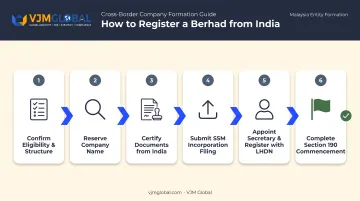
- Confirm eligibility and finalise structure - lock in your business activity and share structure before filing
- Reserve your company name via SSM's e-Search or MyCoID portal; reservation holds for up to 180 days
- Prepare and certify incorporation documents from India, including notarised passport and address proof
- Submit incorporation filing to SSM, including public-company status, member and director declarations
- Appoint the company secretary and register for tax with LHDN (tax file setup is often automatic if you filed via MyCoID)
- Complete public-company commencement filing under Section 190, plus any sector licences and bank account setup
Work this sequence as a Berhad process, not a Sdn Bhd checklist. Director counts, disclosure timing, and audit rules differ—treating them as interchangeable is the usual reason founders refile mid-process.
Costs, Banking, and Visa Considerations for Indian Founders
Incorporation and Recurring Costs
SSM's fee schedule is straightforward:
- RM1,000 flat incorporation fee for a company limited by shares
- RM50 per 30 days for name reservation, up to 180 days
- RM500 for the Section 190 commencement declaration
Beyond that, a Berhad carries recurring costs that apply regardless of revenue:
- Mandatory annual audit fees
- Company secretary retainer
Neither is optional, and neither scales down for a quiet year.
Banking Realities
Malaysian banks run strict KYC checks on non-individual accounts. Maybank and CIMB both require directors and authorised signatories to appear in person at a branch, with original corporate documents verified on-site. There's no fully remote path here yet.
For interim fund movement while a physical account gets activated, fintech platforms like Wise Business or Payoneer are commonly used as a bridge.
Incorporation Doesn't Equal Residency
This trips up nearly every first-time founder: incorporating a Berhad grants zero residency or work rights in Malaysia. If you plan to work or spend extended time there, you typically need an Employment Pass tied to your company (up to 60 months).
An Investor Pass generally does not apply if you are already a director of your own company. The Immigration Department usually directs those cases toward an Employment Pass instead.
How VJM Global Supports Indian Businesses Expanding into Malaysia
Coordinating a Berhad setup from India involves more moving parts than most founders expect:
- Notarised documents from India
- Resident director appointments and a licensed secretary
- LHDN tax registration aligned with SSM filing timelines
- RBI/FEMA Overseas Investment compliance in parallel
VJM Global brings 30+ years of tax, audit, and advisory experience across 100+ countries to this process. The firm coordinates Indian paperwork, Malaysian statutory appointments, and SSM timelines so filings stay on track.
Many Malaysian incorporation providers handle SSM filings well but have limited depth on Form FC, AD bank coordination, or annual performance reporting back to India. VJM Global covers both sides—Malaysian setup and Indian RBI/FEMA obligations—so founders are not left stitching two regimes together alone.

Not ready for a full Berhad and its audit obligations? VJM Global's Employer of Record capability across 100+ countries, including Malaysia, lets you hire local talent and test the market first, without incorporating.
Frequently Asked Questions
What is a public limited company in Malaysia?
A public limited company is a Berhad (Bhd) registered under the Companies Act 2016 that can issue shares to the public, with no maximum shareholder count. It carries mandatory financial disclosure and audit requirements regardless of size.
What are some public limited companies in Malaysia?
Well-known Bursa Malaysia-listed Berhad companies include Malayan Banking Berhad (banking), Maxis Berhad (telecommunications), SD Guthrie Berhad (plantation), and Tenaga Nasional Berhad (utilities).
Is Pte Ltd the same as Sdn Bhd?
Not quite. Pte Ltd is Singapore's private limited company designation under ACRA, while Sdn Bhd is Malaysia's equivalent under SSM. Both function similarly as private limited entities in their respective jurisdictions.
Can an Indian entrepreneur own 100% of a Berhad company in Malaysia?
Generally, yes. Indians can own up to 100% of most Malaysian companies, including manufacturing and many service sectors. Regulated activities may still impose sector-specific equity limits.
Do I need to travel to Malaysia to register a Berhad company from India?
Most incorporation filing can be completed remotely with notarised documents. The main exception is opening a corporate bank account, which typically requires directors to appear in person.
Does incorporating a Berhad in Malaysia give Indian founders residency or a work visa?
No. Incorporation alone grants no residency or work rights. Founders who plan to work in Malaysia need a separate Employment Pass or, in some cases, an Investor Pass.