Introduction
Dutch entrepreneurs keep putting Kenya on the shortlist for African expansion. Kenya's Business Registration Service (BRS) now runs almost entirely through the eCitizen portal, so a founder in Amsterdam or Rotterdam can register a company without booking a flight.
That said, remote incorporation isn't the same as simple incorporation. Many Dutch founders struggle with unfamiliar terminology, unclear document requirements, and the gap between "legally incorporated" and "actually operational" (bank account, tax registration, the works).
This guide walks through structure choice, eligibility, the step-by-step BRS process, realistic costs, and what happens after your certificate arrives.
Key Takeaways
- Dutch founders can register a Kenyan private limited company remotely through eCitizen/BRS
- A private limited company (Ltd) offers limited liability and stronger local credibility than a branch
- Government registration fees start at KSh 10,650, with certificates typically issued in 3-5 business days
- KRA PIN registration, tax setup, and bank account opening matter as much as the incorporation itself
- Bank KYC, not company law, is usually the real bottleneck for non-resident founders
Why Dutch Businesses Are Expanding into Kenya
Kenya is a regional base, not only a single-country market. The World Bank identifies it as the IFC's East Africa hub for finance, innovation, logistics, healthcare, and technology, which gives companies registered there a platform across the region.
In 2023, Kenya exported USD 706 million to the Netherlands, while Dutch exports to Kenya reached USD 377 million. The Netherlands ranks among Kenya's top three FDI contributors, and more than 150 Dutch companies already operate there across agriculture, water, logistics, and finance.
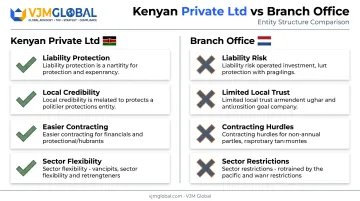
Why incorporate a Kenyan Ltd rather than run things through a branch?
- Liability protection — a Kenyan Ltd is a separate legal person; your Dutch parent company isn't directly exposed to Kenyan claims
- Local credibility — Kenyan clients, banks, and regulators tend to trust a locally registered entity over a foreign branch
- Easier local contracting — tenders, leases, and county permits often require a Kenyan-registered entity
- Sector flexibility — a Ltd can pivot into regulated activities more easily than a branch structure
BV in the Netherlands vs Private Limited Company in Kenya
What is a Private Limited Company (BV) in the Netherlands?
A BV (besloten vennootschap) is the Netherlands' standard private limited entity. It's a separate legal person with limited liability, and there's no traditional minimum start-up capital requirement beyond a nominal opening balance.
What is the main difference between a BV and an NV in the Netherlands?
A BV restricts share transfers and needs shareholder consent for changes; an NV (naamloze vennootschap) allows freely tradable shares but requires at least EUR 45,000 in minimum capital. Most small and mid-sized Dutch businesses choose the BV structure.
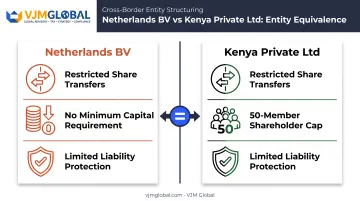
Mapping this onto Kenya: the Kenyan private company limited by shares is the closest structural match to a Dutch BV. They share the same core traits:
- Restricted share transfers (shareholder consent required)
- Capped membership (Kenya limits private companies to 50 members)
- Limited liability that keeps company debts separate from owners' personal assets
Kenya has no direct equivalent to a US-style LLC. If you've been comparing US entity types, set that frame aside. For founders with a European legal background, the Kenyan private Ltd is the functional match to the Dutch BV.
Eligibility and Requirements for Dutch Founders Setting Up in Kenya
Kenyan law does not require a resident director for a private company at incorporation. Foreign nationals, including Dutch citizens, can hold 100% of shares and directorships, with no obligation to bring in a local partner.
Documentation and Structural Basics
You'll generally need:
- Passport details for each director and shareholder
- Proposed officer and beneficial owner particulars, as required under the Companies Act
- Signed director consent (Form CR1) and the model memorandum (Form CR2)
- Director address notification (Form CR8)
- A registered Kenyan office address, mandatory regardless of where founders live
A private company can have between 1 and 50 members. At least one director must be a natural person aged 18 or older. Practitioners commonly reference a nominal share capital figure around KSh 100,000, but the Companies Act itself does not set a fixed statutory minimum for private companies. Confirm the figure required for your application at filing time.
The Registered Office Problem
Here's the catch for remote founders: you need a physical Kenyan address on file, and you can't use a P.O. box or a Dutch office. Most non-resident founders appoint a local professional service provider to hold the registered address, or use a registered agent who also handles correspondence and statutory filings. This is a standard arrangement, and it is how most foreign-owned Kenyan companies meet the requirement without relocating anyone.
Step-by-Step Process to Register a Private Limited Company in Kenya from the Netherlands
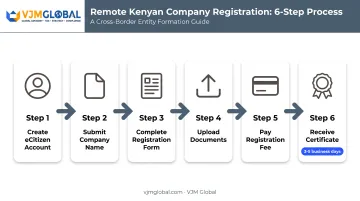
Create an eCitizen account. Register as a foreigner using your nationality and passport details, then gather your KYC documents in advance: passport copies, address evidence, and any signed consent forms.
Submit your company name with the full application. BRS has merged name reservation into the registration step itself, so you'll list three preferred names directly on the application rather than reserving one separately in advance.
Complete the online registration form. Enter director and shareholder details, share capital structure, registered office address, and your intended business activity.
Upload supporting documents. Include Forms CR1, CR2, and CR8, plus beneficial owner and officer particulars. Check the live BRS checklist for certification or translation needs; apostille is more clearly tied to foreign branches than to a fresh local subsidiary.
Pay the registration fee remotely. BRS accepts mobile money and card payments, so you can settle this from a Dutch bank account without a Kenyan intermediary.
Receive your digital Certificate of Incorporation. BRS benchmarks this at 3 to 5 business days, though incomplete foreign identity data or name objections can extend that window.
A practical note for Dutch founders: coordinating document legalisation, BRS filing, and the registered-office arrangement simultaneously from the Netherlands is where most delays creep in. Firms like VJM Global that operate across both Dutch and Kenyan regulatory systems can help sequence these steps correctly rather than discovering a missing document mid-filing.
Cost, Timeline and Post-Registration Compliance
What It Actually Costs
| Item | Cost | Notes |
|---|---|---|
| Private Ltd registration | KSh 10,650 | Official BRS fee, includes certificate |
| Stamp duty | Varies | Based on nominal capital |
| Professional/agent fees | Varies | Registered office, filing support, KYC prep |
Some published figures (such as a separate KSh 150 name-reservation fee) are outdated since name reservation is now bundled into registration. Always check the live BRS fee schedule before budgeting.
Realistic Timeline
- Incorporation itself: 3-5 business days once filed correctly
- KRA PIN and tax registration: typically adds another few days
- Bank account opening: the real variable, anywhere from days to several weeks depending on the bank's KYC process
- Total realistic window: 2-3 weeks for a founder who has documents ready in advance
Post-Registration Steps You Can't Skip
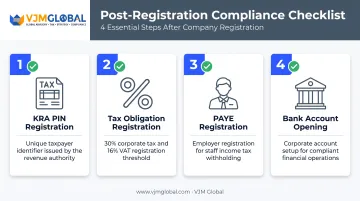
- KRA PIN registration via iTax, done through the "New PIN Registration" option
- Tax obligation registration: corporate income tax is 30% for resident companies. VAT (16%) applies once taxable supplies reach or are expected to reach KSh 5 million in a year
- PAYE registration if you'll have employees, with monthly filings due by the 9th of the following month
- Kenyan business bank account: start this conversation with a bank early, not after incorporation
Ongoing Compliance
Annual returns are due within 28 days of your incorporation anniversary, not after an 18-month grace period as some guides suggest. Beyond that, keep statutory registers updated and file financial statements within the applicable period after your accounting reference date.
Managing this without a Kenyan in-house team is where a cross-border compliance partner helps most. VJM Global's entity formation and compliance service supports foreign-owned companies with local KRA and BRS filings so founders aren't tracking two regulatory calendars alone.
Common Challenges Dutch Entrepreneurs Face When Setting Up Remotely
Remote Kenyan incorporation from the Netherlands usually stalls on three points.
Document certification uncertainty. There is no blanket apostille rule for every Dutch-issued document used in a fresh Kenyan incorporation. Certification requirements vary by document type, and getting this wrong causes real delays. Confirm requirements against your specific filing before submitting.
Bank account bottlenecks. This remains the hardest step. Kenyan banks typically request the certificate of incorporation, constitutional documents, CR12, company KRA PIN, passports, and address evidence.
Many still require at least one director to appear in person. Some banks offer remote verification; most do not. Timelines run from a few days to several weeks depending on the institution.
Time zone and coordination gaps. Nairobi runs two hours ahead of Amsterdam, which is manageable on paper. Coordinating BRS queries, local agents, and your own schedule across that gap still causes friction if nobody is tracking deadlines locally.
Frequently Asked Questions
How much does it cost to open a private limited company in Kenya?
Government registration fees start at KSh 10,650, covering the BRS filing and certificate. Add stamp duty and any professional or registered-office fees on top if you're filing remotely without local presence.
How do you register a private limited company in Kenya?
Register through the eCitizen/BRS portal. Submit preferred company names, director and shareholder details, and forms CR1, CR2 and CR8, then pay electronically. Certificates typically arrive in 3–5 business days.
Who is eligible to form a private limited company in Kenya?
Foreign nationals, including Dutch citizens, can be 100% shareholders and directors without needing a Kenyan resident on the board. Sector-specific licensing rules may add extra conditions for regulated industries.
Does Kenya have an LLC, and what is its equivalent company type?
Kenya doesn't have an LLC as a distinct legal form. The private company limited by shares is the closest equivalent, functionally comparable to a Dutch BV.
What are the advantages and disadvantages of a private limited company?
Main advantages are limited liability and stronger commercial credibility—true for a Kenyan Ltd much as for a Dutch BV. The trade-off is heavier admin: annual returns, statutory registers, and tax filings a sole proprietorship would not need.