Introduction
Say you're running a US-based nonprofit and want to open a UK chapter. Or you're building a diaspora association that needs a formal legal home in Nigeria. A Company Limited by Guarantee (CLG) is often the right vehicle for that. You can register one without ever leaving American soil. CLGs exist in the UK, Nigeria, Australia, Singapore, and Ireland, among other jurisdictions. Each country runs its own rules, but one point holds everywhere: US citizenship or residency is not a barrier to registration. You still need to meet local director, member, and registered office requirements. Those rules vary more than most founders expect. This guide walks through what a CLG actually is, why a US founder might pick one, and the practical steps for registering remotely.
Key Takeaways
- A CLG has no shares: members only guarantee a small fixed sum if the company winds up
- US residents can register a CLG remotely in most jurisdictions, subject to local director and office rules
- Profits must remain in the organization and cannot be paid out to members
- Requirements differ sharply between countries like the UK and Nigeria
- Firms such as VJM Global can handle formation and compliance remotely, so you don’t need a local presence
What Is a Company Limited by Guarantee?
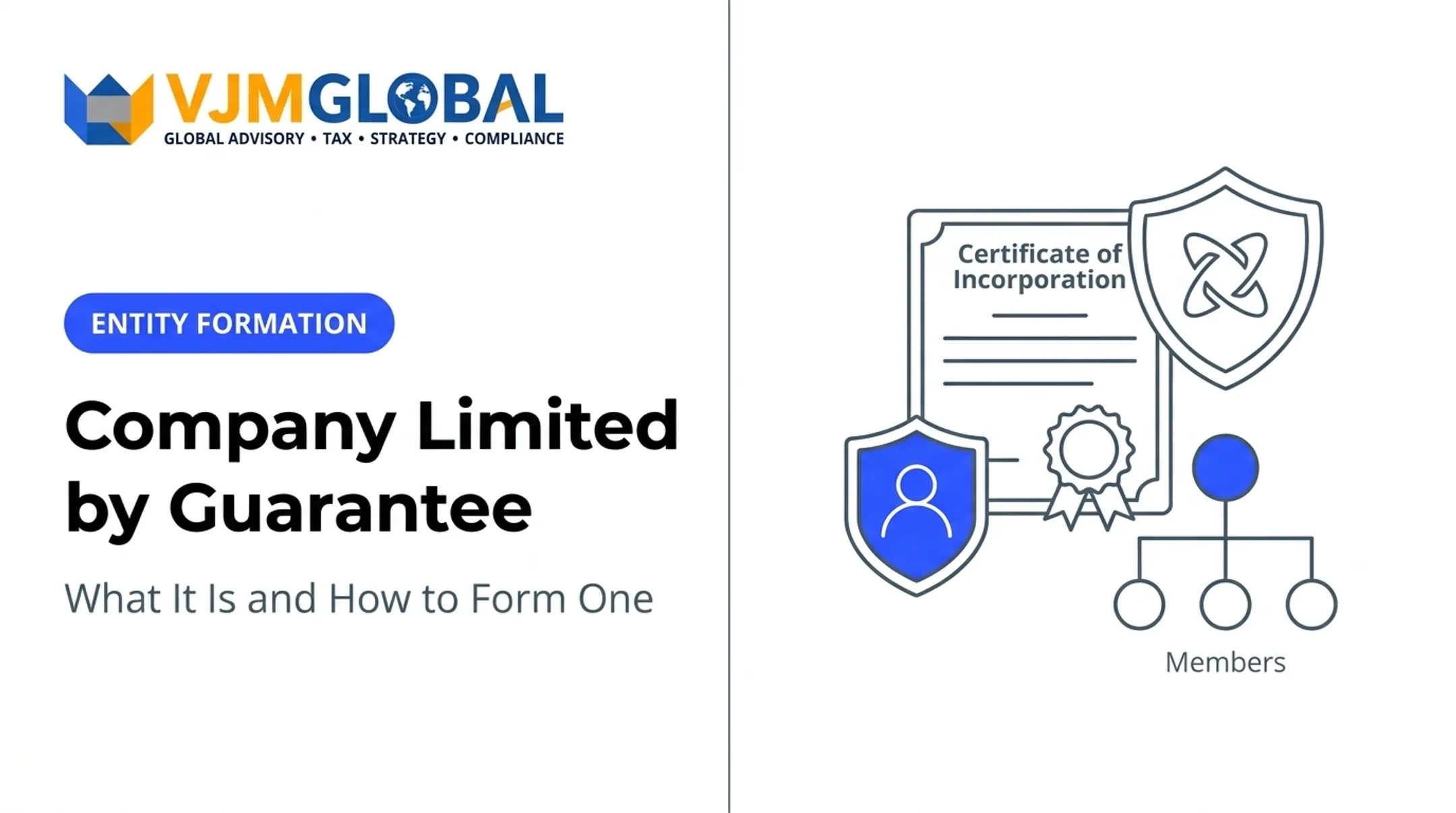
A CLG is an incorporated company owned by members (guarantors) instead of shareholders. Charities, professional associations, clubs, and social enterprises commonly use this structure because it delivers legal personality and limited liability without the equity baggage of a share-based company.
The guarantee mechanism works like this: each member agrees to pay a nominal amount — often £1 in the UK or the local equivalent elsewhere — but only if the company is wound up and can't pay its debts.
UK guidance treats this as the standard model: profits are reinvested into the organization rather than paid out. Companies House guidance describes CLGs as typically funded by grants, donations, or membership fees.
One point trips up a lot of first-time founders: a CLG is not automatically a charity. Charitable status is a separate registration with its own regulator. Companies House and the Charity Commission are different bodies in the UK, and the same split exists in Australia between ASIC and the ACNC.
Key structural features across jurisdictions:
- Separate legal identity from its members
- Limited liability capped at the guarantee amount
- At least one director (more in some countries)
- Constitutional documents: a Memorandum and Articles of Association
- No share capital, ever
For US founders building an international nonprofit, professional body, or membership organization, this structure signals credibility to regulators and funders alike.

Why Would a US-Based Founder Choose a CLG?
US-based founders choose a CLG when the goal is mission over ownership—not equity returns. Three scenarios come up most often:
- A US nonprofit expanding grant-funded programs into a new country
- A professional association establishing an international chapter
- A diaspora community group formalizing itself with a legal entity abroad
Compared with a company limited by shares, a CLG has no cap table to manage and no dividend expectations. Members share a purpose rather than an investment thesis.
The credibility boost is real and practical. A formally incorporated CLG:
- Strengthens grant applications with international funders
- Builds trust with local donors and partners
- Provides a recognized legal counterpart for cross-border agreements
- Signals long-term commitment rather than an informal, unregistered presence
If you're trying to convince a foundation to fund a program in Lagos or Dublin, "we have an incorporated local entity" carries weight that an informal chapter simply doesn't.
Step-by-Step: How to Register a CLG From the USA
1. Choose Your Jurisdiction and Confirm Naming Rules
Start by confirming the target country actually offers a CLG structure and check name availability. The UK uses Companies House; Nigeria uses the Corporate Affairs Commission (CAC). UK company names ending in "Limited" or "Ltd" are standard, though certain nonprofits can apply to omit that ending if their articles restrict dividends.
2. Appoint Directors and Guarantors
This is where jurisdictions diverge sharply:
| Country | Minimum directors | Residency requirement |
|---|---|---|
| UK | 1 | None (directors need not live in the UK) |
| Ireland | 2 | At least one EEA-resident director |
| Australia | 3 | At least 2 normally resident in Australia |
| Singapore | 1 | Must be ordinarily resident, or use a corporate service provider |
| Nigeria | Verify current CAC rules for CLGs | Verify current CAC rules |
The UK is the most remote-friendly option on paper: a single guarantor can also serve as the sole director. Australia, Singapore, and Ireland all require some form of local governance presence, so budget for a local officer or nominee arrangement if you're heading that direction.

3. Prepare Constitutional Documents
Your Memorandum and Articles of Association need to define:
- The organization's objectives (be specific — generic charity templates often get rejected)
- Governance structure and how members vote
- The guarantee amount each member commits to
4. Arrange a Registered Office in the Target Country
A US address won't satisfy any of these jurisdictions. The UK explicitly requires a physical, appropriate UK office capable of receiving and confirming post (no PO boxes allowed). Every jurisdiction in this guide has an equivalent rule.
5. Complete Identity Verification and File
UK identity verification became mandatory for directors and persons with significant control from November 18, 2025. Filings use GOV.UK One Login or an Authorised Corporate Service Provider. Companies House verification guidance confirms an ACSP can verify applicants from any country, which helps if you're filing from New York or Los Angeles.
6. Submit and Wait
Processing times vary:
- UK: Online filing costs £100 and is usually processed within 24 hours; postal filing costs £124 and takes 8–10 days
- Nigeria: CAC lists a 48-working-hour service target for Limited by Guarantee registration, once documents are complete
These are registrar targets, not guarantees—especially for foreign applicants working through unfamiliar paperwork.

Country-Specific Nuances: UK vs. Nigeria vs. Other Jurisdictions
United Kingdom
Registration runs through Companies House. You'll need a SIC code, Articles of Association, and a non-profit distribution clause confirming income goes back into the organization's objectives. A single director who also serves as guarantor meets the minimum requirement, making this one of the more accessible setups for a solo US founder.
Nigeria
Nigeria's Companies and Allied Matters Act 2020 requires the memorandum to state clear objectives, and CAMA explicitly prohibits incorporating a CLG for profit distribution to members. Authority from the Attorney-General of the Federation is required before registration.
Official CAC material does not confirm a specific minimum director or member count for a CLG. Don't confuse this structure with Nigeria's separate "Incorporated Trustees" route, which requires at least two trustees and is a different legal pathway entirely.
Other Jurisdictions at a Glance
- Australia: CLGs register as public companies with ASIC, needing 3 directors (2 Australia-resident) and a resident secretary
- Singapore: ACRA requires at least one ordinarily-resident director; foreign founders typically need a corporate service provider
- Ireland: Minimum 2 directors, all over 18, with an EEA-resident director required unless an exemption applies
Fees, minimum guarantors, and reporting cycles differ country to country. Verify local rules before filing rather than assuming one jurisdiction's process maps onto another.
Ongoing Compliance Obligations After Registration
Registration is just the start. Every jurisdiction expects ongoing filings:
- Annual accounts: the UK requires filing within 9 months of the accounting reference date for private companies
- Confirmation statements or annual returns: the UK's confirmation statement now costs £50 online and requires all directors to be identity-verified before acceptance
- Tax registration: Corporation Tax setup typically happens automatically at UK incorporation unless the company is dormant
Managing these deadlines from the US, across time zones and unfamiliar portals, gets complicated fast. Missing a confirmation statement or annual return deadline can trigger penalties or even involuntary strike-off in some jurisdictions.
UK rules are only one example: other CLG jurisdictions run their own annual returns, beneficial-ownership registers, and tax filings on different calendars. Local compliance support is what keeps those deadlines from slipping when you have no in-country team.

VJM Global handles entity formation and ongoing compliance in 100+ countries, including registered office and filing support in Ireland for the RBO beneficial-ownership filing, the CRO's B1 Annual Return, and the CT1 corporation tax return. For US founders running an overseas CLG, that coverage means statutory filings hit the right portal on time without building a local back office.
Frequently Asked Questions
How many directors does a company limited by guarantee need?
Most jurisdictions require a minimum of one director, though the exact number varies: the UK requires one, Ireland requires two, and Australia requires three. A director can typically also serve as a guarantor.
What are the requirements to register a company limited by guarantee in Nigeria?
Nigerian CLGs register through the CAC under CAMA 2020 with a memorandum of objectives, a registered office, proposed directors, and Attorney-General authority. Confirm any CLG-specific director minimum directly with CAC or Nigerian counsel.
Can a US citizen be a director or guarantor of a CLG registered abroad?
In the UK, directors don't need to live in the country, making it accessible for US founders. Australia, Singapore, and Ireland require at least some locally resident officers, and every jurisdiction still requires a local registered office.
Is a company limited by guarantee the same as a charity?
No. A CLG is a company structure; charitable status is a separate registration with its own regulator, applied for after incorporation. Australia's ACNC and the UK's Charity Commission both confirm this two-step process.
Can a CLG generate profit?
Yes, surplus income is allowed, but it must be reinvested into the organization's stated objectives. Members can't receive dividends or distributions. UK, Nigerian, and Australian rules all confirm this restriction.
How can VJM Global help a US-based founder register a CLG overseas?
VJM Global provides entity formation and compliance across 100+ countries, including registered-office support in Ireland and CAC-based formation in Nigeria. The firm handles document preparation and local regulatory navigation so founders don't need an in-country presence.