The process itself is fast and fully remote. But speed can be deceptive. Getting the registered office, banking setup, and cross-border tax reporting wrong between HMRC and the IRS causes far more headaches than the incorporation form ever will.
This guide walks through the step-by-step registration process, the documents you'll need from the US, realistic costs, ongoing tax obligations, and the mistakes that trip up American founders most often.
Key Takeaways
- Non-US residents can own 100% of a UK Ltd—no nationality or residency limits on directors or shareholders.
- Register fully online via Companies House; complete, accurate filings are usually approved quickly.
- A physical UK street address is legally required for your registered office — a PO box will get your application rejected.
- US persons stay taxed on worldwide income, so a UK Ltd can trigger IRS Form 5471 plus UK Corporation Tax.
- Cross-border firms like VJM Global help founders avoid costly UK formation and US tax filing errors.
Why Register a UK Private Limited Company from the USA
A UK Ltd gives American founders something a US LLC simply can't replicate when serving UK or EU clients: independent legal status inside the UK. An LLC operating informally overseas has no standing to trade, invoice, or bank as a UK entity. A Ltd does.
UK clients and investors are often more comfortable contracting with a UK-registered company. It also positions you for UK-based hiring, local banking relationships, and a cleaner path if you ever raise capital from UK or European investors.
Tax picture: UK Corporation Tax runs at 19% on profits below £50,000 and 25% above £250,000, with marginal relief for profits in between. Compare that to layered US federal and state corporate rates, and the UK structure often comes out favorably for companies generating most of their revenue from UK or EU customers.
The UK doesn't withhold tax on dividends paid to shareholders abroad. Profits distributed to a US shareholder aren't reduced at the UK border. You'll still owe US tax on that income separately.
In practice:
| Factor | US LLC operating in UK | UK Private Limited Company |
|---|---|---|
| Legal status in UK | None, informal presence only | Full UK legal entity |
| Can invoice UK clients directly | Limited, often awkward | Yes, standard practice |
| UK banking access | Very difficult | Standard onboarding process |
| Investor perception in UK/EU | Weaker | Stronger, familiar structure |
| UK Corporation Tax exposure | N/A (no UK entity) | 19%–25% on profits |
Step-by-Step Process to Register a Private Limited Company in the UK from the USA
The entire registration can be completed online without setting foot in the UK. That said, each step carries specific documentation and eligibility requirements. Skip one and you'll be stuck refiling.
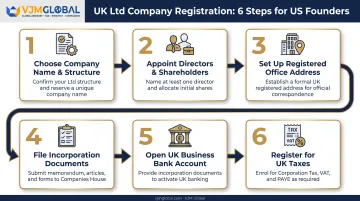
Step 1: Choose Your Company Structure and Name
For foreign founders, the Private Limited Company (Ltd) is the standard recommendation. It offers limited liability protection and considerably simpler reporting than a Public Limited Company, and it's a cleaner fit for international founders than operating as a Sole Trader.
Your company name must clear a few hurdles:
- Unique on the live Companies House register; names identical or "too like" an existing company can be rejected or challenged later
- Free of restricted words that imply a government connection or other sensitive terms (these need special permission under the official Annex A list)
- Clear of trademark conflicts: Companies House does not check trademarks, so run a separate search through the UK Intellectual Property Office
Step 2: Appoint Directors and Shareholders
The legal minimum is one director and one shareholder, and they can be the same person. There's no requirement for either to live in the UK or hold UK nationality.
For each appointee, you'll need to provide:
- Full legal name
- Residential address
- Date of birth
- Nationality
- Occupation
A company secretary is optional. Many single-founder Ltds skip it entirely. You may also want to issue share certificates to formally document ownership, particularly if you plan to bring in investors later.
Step 3: Set Up a UK Registered Office Address
This address receives all official correspondence from Companies House and HMRC. It must be a genuine UK street address. A PO box or mail-forwarding-only service isn't accepted, and this is where a surprising number of US applications stumble.
Since founders based in America rarely have a physical UK presence, a virtual office or registered address service is the usual solution. These services provide a compliant London or regional UK address, scan and forward mail, and cost relatively little compared with leasing UK office space you don't need.
Step 4: Prepare and File Incorporation Documents with Companies House
Three documents form the core of your filing:
- Form IN01 (or its online equivalent): the incorporation application itself
- Memorandum of Association: a short statement confirming founding members agree to form the company
- Articles of Association: governing rules for the company, either standard "model articles" or a customised version
You can file directly through Companies House WebFiling, or work with a formation agent or cross-border advisory firm. For overseas applicants, the latter often reduces the risk of rejected filings. A firm like VJM Global, which handles entity formation across multiple jurisdictions, can catch documentation issues that trip up first-time US filers before they cause delays.
Step 5: Open a UK Business Bank Account
This step often takes longer than incorporation itself. Non-resident directors typically need:
- Certified passport copy
- Proof of UK and/or US residential address
- Certificate of incorporation and other formation documents
Traditional UK banks can be slow and sometimes reluctant to onboard overseas directors without an in-person visit. Digital-first banks and electronic money institutions (including Wise Business and Revolut Business) have become the practical workaround, supporting remote account opening with video verification and digital document upload.
Step 6: Register for UK Taxes and Set Up Ongoing Compliance
Once your company starts trading, you must register for Corporation Tax with HMRC within three months and obtain a Unique Taxpayer Reference (UTR). Beyond that:
- VAT registration becomes mandatory once taxable turnover crosses the current threshold, or is expected to within 30 days
- PAYE registration is required if you hire UK-based employees, including if that employee is you drawing a salary as director
You will also file annual accounts and a confirmation statement with Companies House each year to stay in good standing.
Documents & Requirements Needed From the US
Incomplete or improperly certified paperwork is the single most common cause of delay for American applicants. Companies House and HMRC don't make exceptions for cross-border confusion.
Core documents you'll need to prepare:
- Certified passport copies for every director and shareholder
- Proof of US residential address: a recent utility bill or bank statement, typically dated within the last two months
- Signed incorporation documents, including the Memorandum and Articles of Association
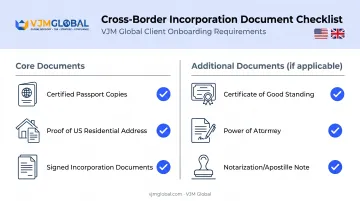
For certain structures, particularly subsidiaries of an existing US company, or situations where you need someone in the UK to act on your behalf — you may also need:
- Certificate of Good Standing from your US state of incorporation
- Power of Attorney authorising a representative to handle UK filings
One detail that catches founders off guard: some documents may require notarisation or an apostille before UK institutions or banks will accept them. Not every step needs this, so it's worth confirming with the specific recipient (bank, formation agent, HMRC) whether legalisation is actually necessary before you pay for it.
Costs and Ongoing Tax Compliance for US Founders
Incorporation itself is inexpensive. Staying compliant across two countries is where real cost and risk show up.
What You'll Pay to Get Started
| Item | Typical Cost |
|---|---|
| Companies House incorporation (online) | £100 |
| Companies House incorporation (paper) | £124 |
| Registered office address service | Roughly £39-£100/year, depending on provider |
| Business bank account / EMI setup | Often free to low-cost with digital providers |
| Annual accounting/compliance services | Varies by company complexity |
These figures cover the statutory minimum. Formation agents, cross-border advisory support, and comprehensive compliance packages cost more but reduce the odds of a rejected filing or missed deadline.
The UK Compliance Calendar
Once incorporated, your company owes Companies House and HMRC several recurring filings:
- Confirmation Statement: filed annually, £50 online
- Annual accounts: filed with Companies House every year, even for dormant companies
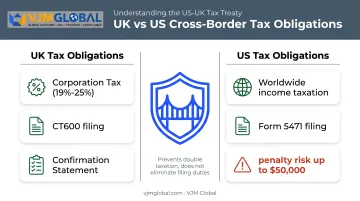
- Corporation Tax return (CT600): filed with HMRC annually
Miss these, and penalties escalate quickly. Late annual accounts start at £150 and climb to £1,500 for delays over six months, doubling again if you're late two years running. A late CT600 attracts a £200 penalty that becomes £1,000 after three consecutive late filings.
The US Side of the Equation
Here's what many founders overlook: incorporating in the UK doesn't reduce your US tax obligations. As a US citizen or resident, you're taxed on worldwide income, meaning your UK company can trigger IRS reporting requirements independent of UK Corporation Tax.
Depending on your ownership stake, this commonly means filing Form 5471 — a form the IRS takes seriously. Missing or filing it incorrectly can carry a $10,000 penalty, with additional penalties of up to $50,000 accruing if the issue isn't resolved after IRS notice.
The US-UK tax treaty exists to prevent double taxation on the same income, but treaty relief does not erase filing obligations in either country. It only stops you being taxed twice on the same profits.
Dual filings are easier when one team owns both sides. VJM Global pairs US-trained CPAs with UK-facing Chartered Accountants so Corporation Tax and Form 5471 are handled as one coordinated process, not two disconnected ones.
Common Mistakes to Avoid When Registering From the USA
Most incorporation problems aren't about the paperwork being hard. They're about founders assuming US business norms apply in the UK, or assuming UK registration erases US obligations. Neither is true.
Watch out for these:
- Using an ineligible registered office address. A PO box or a friend's mailbox doesn't meet the legal requirement, and Companies House will reject the application.
- Assuming no US tax obligations apply. Owning a UK company doesn't exempt you from IRS reporting — missing deadlines like Form 5471 can carry steep penalties.
- Delaying the bank account setup. Waiting until after incorporation to start the banking process can leave you unable to invoice clients or accept payments for weeks.
- Missing UK statutory deadlines. The Confirmation Statement, annual accounts, and CT600 all have hard deadlines. Miss enough of them and Companies House can strike your company off the register entirely.
Frequently Asked Questions
Can I open a company in the UK as a non-resident?
Yes. There's no nationality or residency restriction on directors or shareholders, provided you have a compliant UK registered office address and standard incorporation documents in place.
Do I need to visit the UK to register my company or open a bank account?
No. Incorporation is fully remote, and most digital banks support remote account opening, though some may require video verification or extra documentation.
What taxes will I owe in the US if I own a UK company?
UK Corporation Tax applies to your company's profits in the UK. As a US owner, you may also face IRS reporting obligations on worldwide income, with the US-UK tax treaty helping prevent double taxation.
How long does it take to register a UK private limited company from the USA?
Companies House usually processes complete online applications within one to two days. Times can vary if documents are incomplete or need manual checks.
Do I need a UK bank account to incorporate my company?
No, a UK bank account isn't legally required for incorporation. It's generally necessary once you start operating and need to invoice clients or pay expenses.
Can a US LLC be a shareholder of a UK Ltd company?
Yes, a US LLC can act as a corporate shareholder of a UK Ltd. This structure can add cross-border tax and reporting complexity, so review it with a cross-border tax advisor before you set it up.