Getting this right matters. It affects your tax treaty positioning, your ability to open a UK bank account, and how credible you look to UK and EU customers. Online, the process gets described as "fast and cheap." That's true on the Companies House side. What often goes unmentioned: identity verification, cross-border tax reporting, and remote banking add real friction for a US-based applicant.
This article covers what the process actually involves, how it works step-by-step, what drives cost and timeline, and when forming a UK company isn't the right move at all.
Key Takeaways
- Companies House filing is remote and fast; US founders still need ID checks, treaty planning, and non-resident banking
- No UK residency is required for directors or shareholders — 100% foreign ownership is permitted
- Digital incorporation costs £100 through Companies House; total costs rise with formation agent and compliance add-ons
- US–UK tax treaties and aligned HMRC/IRS filings help avoid double taxation
What Is UK Company Formation and Why US Businesses Use It
UK company formation is the registration of a private limited company under the Companies Act 2006, filed with Companies House. Once registered, the Ltd becomes a separate legal entity from its US owners, with its own liability shield and legal identity.
In practical terms, incorporation gives your business:
- A UK legal identity that customers and suppliers recognise
- Limited liability protection separate from your US company or personal assets
- A base for UK and European trade, plus GBP business banking and UK-based payment processors
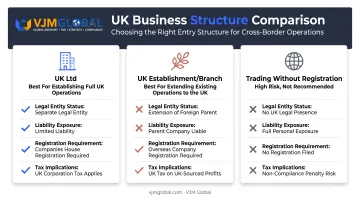
Ltd vs. Branch vs. Trading Without Registration
These three options get confused constantly, and the differences matter:
- UK Ltd: a new UK legal company with its own registration number
- UK establishment (branch): an existing overseas company registering a physical UK presence via form OS IN01; the US entity remains the legal company, not a new one
- Trading in from a US LLC with no UK presence: no Companies House registration required, but this doesn't settle your UK tax exposure on its own
Where US Businesses Typically Use This Process
Formation tends to get triggered by a specific business need, not curiosity. Common scenarios:
- US e-commerce sellers needing UK/EU fulfillment and VAT registration
- SaaS companies that want a UK billing entity for local invoicing
- US parent companies forming a UK subsidiary for hiring or added credibility
- Consultants who need to invoice clients in GBP
Incorporation is a one-time event, but it starts a recurring compliance cycle: annual accounts, confirmation statements, and tax filings that continue indefinitely. This isn't a "set it and forget it" structure.
How the UK Company Formation Process Works: Step-by-Step for US Businesses
From choosing a structure to receiving your Certificate of Incorporation, the entire flow can be completed from the US without a UK visit. Here's how it breaks down.
Step 1: Choose Your Structure, Name and UK Registered Office
Most US founders default to a Private Limited Company (Ltd) because it's simple, limits liability, and is well understood by UK banks and customers. Before filing, you'll need to:
- Check name availability on the Companies House register
- Avoid restricted words: sensitive terms or anything implying a government connection require separate permission
- Secure a UK registered office address
That last point trips people up. A physical UK address is mandatory, even if your company runs entirely from a US laptop, and a PO Box does not qualify. Virtual registered address services fill that gap by providing a compliant UK address without a UK office lease.
Step 2: Appoint Directors, Shareholders and Complete Identity Verification
There's no UK residency requirement for directors or shareholders. You can run a UK Ltd entirely from New York, Austin, or anywhere else in the US.
Documents typically needed include a valid passport and proof of US address (a recent utility bill or bank statement).
What's changed recently: identity verification became compulsory for incorporation and new director or PSC (person with significant control) appointments starting 18 November 2025. Existing directors and PSCs get a 12-month transition window to complete it.
This matters specifically for someone who's never set foot in the UK. Verification runs through GOV.UK One Login or an authorized Companies House agent (ACSP) who can confirm identity remotely. No UK visit is required if the agent is properly authorized.
Step 3: File Incorporation Documents with Companies House
The core filing is Form IN01, alongside the Memorandum and Articles of Association. This covers your company name, registered office, director and shareholder details, share capital, and SIC business activity code.
There are two filing routes:
| Route | Fee | Typical Timing |
|---|---|---|
| Digital (standard) | £100 | Usually within 24 hours |
| Paper IN01 | £124 | 8–10 days |
Formation agents typically file digitally on your behalf, and most claim same-day or next-day approval. Actual timing still depends on Companies House processing volume, so treat those claims as typical rather than guaranteed. Once approved, you receive your Certificate of Incorporation and company registration number.
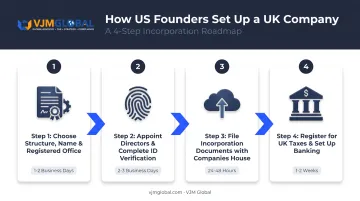
Step 4: Register for UK Taxes and Set Up Business Banking
Incorporation isn't the finish line. Active companies must notify HMRC within 3 months of starting their Corporation Tax accounting period. Companies incorporated through the official digital service are often auto-registered for Corporation Tax at the same time, unless the company is dormant.
VAT registration becomes mandatory once taxable turnover exceeds £90,000 over the previous 12 months, or is expected to exceed that threshold in the next 30 days.
For banking, non-resident directors do have remote-friendly options — several UK fintech and business account providers support online account opening without a UK visit, though approval still depends on the provider's own checks.
This is also where most US founders benefit from professional support. A UK subsidiary creates UK filing duties and can create US disclosure obligations as well. Certain US owners of foreign corporations face separate IRS reporting requirements.
Getting the UK and US sides to line up correctly is where firms like VJM Global typically get involved, coordinating entity formation with compliance obligations on both sides of the Atlantic.
Key Factors That Affect Cost, Timeline and Compliance for US Founders
Cost, timeline, and compliance aren't fixed for non-resident founders. They shift based on a handful of variables.
- Documentation quality: Complete, current passport and address proof speeds identity checks; documents older than 2–3 months are a common delay
- Filing route: An agent with direct Companies House filing access usually moves faster than a manual submission
- Verification provider access: Agents authorized as Companies House identity verification providers can complete checks without a UK visit
- Structural complexity: A single-director Ltd is quick; a subsidiary with UK payroll, VAT, and US-parent reporting takes longer
- US-specific regulatory layers: US foreign-corporation reporting, the UK-US tax treaty, and UK identity rules under recent economic crime law add steps UK-resident founders skip
None of these are deal-breakers. They're why a "24-hour incorporation" headline rarely matches the full US-founder timeline.
Common Mistakes, Misconceptions and When a UK Company Might Not Be the Right Fit
Common Mistakes and Misconceptions
A few assumptions cause real problems down the line:
- "Incorporated means operational." Tax registrations, banking, and US-side reporting are separate steps that still need to happen after incorporation.
- Confusing a UK Ltd with a US LLC "branch." These aren't interchangeable. Liability and tax outcomes differ significantly. A Ltd is its own legal entity; a branch keeps the US company on the hook.
- Mistaking fast approval for finished compliance. A same-day Certificate of Incorporation doesn't mean you're done. Annual accounts and confirmation statements are ongoing obligations, not one-time filings.
When a UK Company Might Not Be the Right Structure
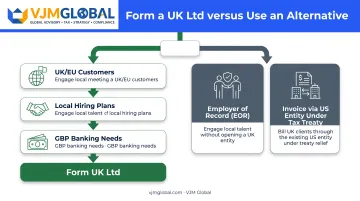
Not every US business needs a UK Ltd. Skip it if:
- You have no UK or EU customers currently
- You have no near-term plan to hire someone locally
- You don't need GBP banking or local invoicing
Alternatives worth considering:
- Employer of Record (EOR): hire a UK-based employee through a third-party employer without incorporating. VJM Global supports compliant EOR hiring across 100+ countries without a local entity.
- Invoice from your existing US entity under the UK-US tax treaty, if you don't yet need a formal UK presence.
If you're incorporating "just in case," with no clear revenue or hiring trigger in the UK, that's usually a sign to wait.
Conclusion
UK company formation itself is a fast, well-defined legal process. Companies House makes the mechanics straightforward. For US businesses, the real complexity sits in the cross-border layer: tax treaty positioning, dual reporting obligations, and setting up banking as a non-resident.
Understanding each step matters more than chasing a headline speed or price figure. Firms experienced in both US and UK compliance, including VJM Global, ensure the process fits your tax, reporting, and banking setup—not a generic checklist.
Frequently Asked Questions
How much does it cost to establish a UK company from the USA?
Companies House charges £100 for standard digital registration. Formation agents typically add their own service fee on top. Optional extras like a registered office address or ongoing accounting support cost more.
Can I set up a UK company from the USA?
Yes. There's no UK residency requirement for directors or shareholders, and the entire process can be completed remotely without visiting the UK.
How long does it take to set up a UK company from the USA?
Filing itself is often completed within a day or two through an agent. For US founders, identity verification tends to be the main variable affecting how quickly that happens.
Do I need a UK business bank account to register my company?
No. A bank account isn't required to incorporate, only to trade. Several remote-friendly banking and fintech options exist for non-resident directors.
Will my UK company be taxed in both the UK and the US?
The UK-US double tax treaty is designed to prevent double taxation, but the UK and US still have separate filing obligations. You'll typically need to file in both jurisdictions correctly to claim treaty relief.
What is the best business structure for a US company expanding into the UK?
A Private Limited Company (Ltd) is the most common choice for US businesses. A branch or establishment is different: it keeps your existing US entity as the legal company rather than creating a new one.