Introduction
US founders don't need a UK visa, a local partner, or a plane ticket to open a UK company anymore. Companies House now processes most digital incorporations in under 24 hours, and the entire process happens through a browser.
That speed creates a false sense of simplicity. Many US entrepreneurs get their Certificate of Incorporation fast, then stumble on registered office rules, identity verification requirements, or a US tax filing they didn't know existed.
This guide helps you decide whether a UK Ltd fits your business, then covers the exact registration steps and what you need before you start. You will also get current costs and tax rates, plus the mistakes that trip up American founders most often.
TL;DR
- No UK residency required for directors, shareholders, or company officers
- Online registration costs £100 and usually completes within 24 hours via GOV.UK
- A compliant UK registered office address and identity verification are mandatory
- US owners with 10%+ ownership typically file IRS Form 5471, separate from UK filings
- Corporation Tax registration with HMRC is due within 3 months of starting to trade
How to Register a Private Limited Company in the UK from the USA
Registering a UK Ltd from American soil follows a fixed sequence. Skip a step or get one wrong, and Companies House will simply reject the application.
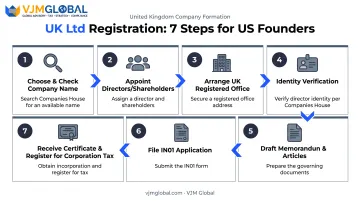
Step 1: Choose and Check Your Company Name
Run your proposed name through the Companies House name availability checker before anything else. Two rules matter most:
- The "same as" test rejects names identical to an existing company, ignoring minor differences like punctuation or common words
- Sensitive words (think "Royal," "Chartered," or anything implying a government connection) require special permission
Also run a quick search on the UK Intellectual Property Office's trademark database. A name can clear Companies House and still infringe a registered trademark—costlier to unwind after you incorporate.
Step 2: Decide Your Share Structure and Appoint Directors/Shareholders
A UK Ltd needs a minimum of one director and one shareholder. They can be the same person, and that person can be based in the USA full time. There's no residency requirement for either role, and no statutory minimum share capital.
One catch: anyone holding more than 25% of shares or voting rights must be registered as a Person with Significant Control (PSC). This isn't optional disclosure. It's a public record requirement Companies House enforces strictly.
Step 3: Arrange a UK Registered Office Address
This is where most US applications hit a wall. Companies House requires an "appropriate address," meaning:
- Someone at that address must be able to receive and acknowledge post
- The sender must be able to get delivery confirmation
- A US address, home address, or PO Box does not qualify
Most American founders use a UK formation agent that also provides a registered office address. Providers like VJM Global meet the appropriate-address standard and keep a director's personal home address off the public register.
Step 4: Complete Identity Verification for Directors and PSCs
Identity verification became a legal requirement in November 2025, with a 12-month transition window. Every director must supply a verified identity code with the incorporation filing itself, not afterward.
You have two options:
- GOV.UK One Login - free, and accepts biometric passports from any country, including US passports
- An Authorised Corporate Service Provider (ACSP) - typically an accountant or formation agent who verifies identity on your behalf, usually for a fee
Start this early. A stalled verification is one of the most common reasons US incorporations drag past a week when they should take a day.
Step 5: Draft Your Memorandum and Articles of Association
Most new companies don't need custom legal drafting. Companies House's model articles cover standard governance for most small and mid-sized companies. The memorandum is a short statutory statement, signed by the initial shareholders, confirming they agree to form the company.
Step 6: File the Incorporation Application (IN01) with Companies House
The IN01 form pulls everything together. You'll need:
- A SIC code matching your actual business activity
- A registered email address for Companies House correspondence
- PSC details and confirmed identity verification codes
- Share allocation details
- Current registration fee (paid via the online portal)
Step 7: Receive Your Certificate of Incorporation and Register for UK Corporation Tax
Your Certificate of Incorporation confirms the company legally exists and includes its unique company number. The online incorporation service usually registers you for Corporation Tax automatically, unless you flag the company as dormant.
Either way, you're required to notify HMRC within 3 months of starting to trade, not from the date of incorporation. That distinction matters and gets missed often.
When Registering a UK Ltd Makes Sense for US Businesses (And When It Doesn't)
A UK Ltd justifies its cost and compliance overhead in specific situations:
- Entering the UK market with a physical or commercial presence
- Invoicing UK clients in GBP without currency friction
- Building credibility with UK and European partners who expect a locally incorporated entity
- Holding a UK subsidiary under a US parent, a structure UK regulators and lenders already know
Full incorporation is often overkill if you're only running occasional UK sales or a short-term project. In those cases, two lighter alternatives exist:
- Overseas company branch (Form OS IN01): extends your existing US entity into the UK without creating a new legal entity
- Employer of Record (EOR): handles UK payroll, PAYE, and contracts so you can hire one or two UK staff without incorporating. VJM Global offers this when full formation is not needed
For professional or partnership-style setups, a UK LLP can fit better than a Ltd. Consultancies and advisory firms often prefer it when profit-sharing among partners matters more than a shareholder structure.
What You Need Before You Register From the USA
Before you start the IN01 filing, gather:
- A valid US passport or government photo ID for every director, shareholder, and PSC
- A UK registered office address that meets the appropriate-address standard (via a formation partner; US addresses, home addresses, and PO Boxes do not qualify)
- A SIC code that accurately reflects your business activity
- PSC disclosure details for anyone who owns more than 25% of shares or voting rights
- A plan for a company-specific Government Gateway ID, needed later for HMRC registrations such as VAT and PAYE
One step founders skip constantly: talk to a US accountant before incorporating, not after. Your UK entity triggers EIN considerations and cross-border filing obligations on the US side. Sorting that out in advance saves a scramble later.
Costs, Taxes and Ongoing Compliance for US-Owned UK Companies
Here's what registering and running a UK Ltd actually costs once you're past incorporation.
Companies House Fees
| Filing Method | Cost | Processing Time |
|---|---|---|
| Online (standard) | £100 | Within 24 hours |
| Paper (IN01) | £124 | 8-10 days |
| Same-day (software filing) | £156 | Same day |
| Confirmation statement (online) | £50/year | N/A |
Source: GOV.UK incorporation service
Corporation Tax and VAT
UK Corporation Tax runs on a tiered structure:
- 19% small profits rate for profits up to £50,000
- 25% main rate for profits above £250,000
- Marginal relief applies on profits between those two thresholds
Source: GOV.UK Corporation Tax rates
VAT registration becomes mandatory once taxable turnover crosses £90,000, though voluntary registration below that threshold is allowed.
Annual Compliance Deadlines
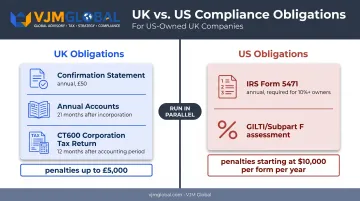
- Confirmation statement: due annually, within 14 days of the review period ending
- Annual accounts: first accounts due 21 months after incorporation; subsequent accounts due 9 months after the financial year ends
- CT600 return: due 12 months after the Corporation Tax accounting period ends, with payment due 9 months and 1 day after period end
Miss these, and penalties escalate fast. Late confirmation statements can trigger fines up to £5,000 and potential strike-off. Late accounts start at £150 and climb to £1,500 for delays over six months, doubling for repeat offenders.
The US Side: Form 5471
This is the piece most US founders forget entirely. If you own 10% or more of the vote or value of your UK company, you generally must file IRS Form 5471 annually, and may face GILTI or Subpart F income inclusions depending on the company's structure and earnings.
Source: IRS Instructions for Form 5471
Penalties for missing this filing start at $10,000 per form, per year and can rise sharply for continued non-compliance. This obligation is separate from anything filed in the UK, and it does not disappear because a UK accountant handles Companies House and HMRC.
UK formation and US reporting need to run in parallel, not in sequence. That coordination is where firms like VJM Global help US founders avoid gaps on either side.
Banking Options
- Challenger banks (Wise, Revolut, Airwallex): remote setup for US-resident founders; document requirements vary by provider
- Traditional UK banks: often need an in-person visit or UK-based signatory; overseas applications take longer
Common Mistakes US Founders Make When Registering a UK Company
US founders often clear Companies House filing, then stall on address rules, tax clocks, or dual-country reporting. Avoid these five mistakes:
- Using a non-compliant address. Virtual mailboxes and standard PO Boxes fail the "appropriate address" test and trigger outright rejection.
- Missing the 3-month Corporation Tax deadline. The clock starts when you begin trading, not when you incorporate.
- Forgetting Form 5471. Founders focus on UK compliance and miss a US filing that carries steep penalties.
- Assuming pass-through taxation. A UK Ltd is not taxed like a US LLC. Profits are taxed at the company level first, which changes how you should structure ownership.
- Delaying identity verification. Verification codes must accompany the incorporation filing, so last-minute ID checks stall the entire process.
Frequently Asked Questions
How much does it cost to register a private limited company in the UK?
Standard online registration costs £100 through Companies House. Add £50/year for the confirmation statement and ongoing fees for a registered office address if you use a formation provider.
How do I register a private limited company in the UK from the USA?
The entire process runs online through Companies House. You'll need a compliant UK registered office and completed identity verification. No physical visit to the UK is required.
Can a US citizen register a private limited company in the UK?
Yes. There's no UK residency requirement for directors or shareholders, provided you have a compliant UK registered address and complete the required identity verification.
Do I need to travel to the UK to complete registration?
No. Registration and identity verification, whether through GOV.UK One Login or an Authorised Corporate Service Provider, can both be completed remotely from the USA.
What US tax forms do I need to file after forming a UK company?
US owners holding 10% or more of the company generally need to file IRS Form 5471, and should assess GILTI and Subpart F exposure. Work with a cross-border tax advisor to get this right.
Can I open a UK business bank account while living in the USA?
Challenger banks like Wise, Revolut, and Airwallex generally offer fully online account setup for US-resident founders. Traditional UK banks often require an in-person visit or a UK-based signatory.