Incorporating in the UK is straightforward for a UAE resident or company. There's no residency requirement, no need to visit London, and the paperwork is lighter than most people expect. But getting the structure right, especially the tax position and documentation, is a different matter. One wrong move on share structure or dividend timing can create tax exposure that didn't need to exist.
This guide walks through the exact steps, eligibility rules, required documents, and tax considerations UAE-based founders need before setting up a UK holding company, along with the mistakes that trip up first-time applicants.
Key Takeaways
- UAE individuals or companies can own a UK holding company 100%, with no UK residency needed for directors or shareholders
- Companies House often registers within 24 hours once UAE documents are notarised and MOFA-attested
- The UK-UAE tax treaty and participation exemption keep dividend and capital gains flows tax-efficient
- Remote UK business bank account opening is usually the slowest step, so start it early
Step-by-Step Guide to Creating a UK Holding Company from the UAE
Step 1: Choose and Reserve Your Company Name
Your company name must be unique on the Companies House register. It can't be identical or too similar to an existing name or trademark, and it must end in "Limited" or "Ltd" for a private company.
Certain words trigger extra scrutiny:
- "Royal" requires a non-objection letter from the relevant body
- "Government" requires approval if it implies a UK government connection
- Offensive or misleading names are rejected outright
Many UAE parent groups choose a name that mirrors their existing brand for consistency across the corporate group. Run a free name-availability search on the Companies House register before you start the formation paperwork, so you're not stuck reworking documents later.
Step 2: Register the Company with Companies House
Once the name is cleared, registration requires:
- Company name and registered office address (must be a physical UK address)
- Registered email address
- At least one director's details
- Shareholder and statement-of-capital information
- Person with Significant Control (PSC) details
- The correct SIC code: 64209 – Activities of other holding companies
Online applications are typically processed within 24 hours, with a filing fee of £100. That turnaround is a real advantage when you are coordinating formation from the UAE.
UAE-based founders without a UK address usually work with a formation agent or cross-border advisory firm, such as VJM Global. The firm can provide a registered office, manage the Companies House filing, and coordinate documents remotely—travelling to the UK is not required at this step.
Step 3: Appoint Directors, Shareholders, and Declare the PSC
UK company law places no residency restriction on directors or shareholders. A UAE resident individual, or a UAE-incorporated company, can be the sole director and 100% shareholder of a UK company. The only requirement is that the director be at least 16 years old.
Where the UAE parent owns more than 25% of shares or voting rights, a PSC declaration is mandatory. This requires disclosing:
- Full name, date of birth, and nationality
- Country of residence and service address
- Date the person became a PSC
- Nature of control (percentage band of shares or voting rights held)
Director and PSC details, aside from residential addresses, are publicly visible on the Companies House register.
Step 4: Decide the Group and Share Structure
This step gets underestimated. Before filing, the UAE parent needs to settle:
- What percentage of each UK subsidiary the holding company will own
- Whether to issue multiple share classes (ordinary vs. preference shares affect dividend and voting rights differently)
- How profits and dividends will actually flow between the UAE parent and UK entities
Getting this wrong doesn't usually break anything immediately, but it can create avoidable tax friction once dividends start moving. It's worth taking tax advice at this stage rather than after the structure is already in place.
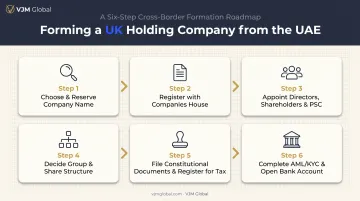
Step 5: File Constitutional Documents and Register for UK Taxes
Incorporation requires a Memorandum of Association, signed by the initial shareholders, and Articles of Association governing how the company operates. Online formation generates the memorandum automatically, and most holding companies use standard model articles rather than custom-drafted ones.
Registration for Corporation Tax with HMRC usually happens automatically during online incorporation, generating a Unique Taxpayer Reference (UTR). If the company will trade, VAT and PAYE registration may also apply above the relevant thresholds.
Even a non-trading holding company has ongoing obligations. Annual accounts and a Confirmation Statement must still be filed with Companies House at least every 12 months, regardless of whether the company is dormant.
Step 6: Complete AML/KYC Verification and Open a UK Bank Account
Banks require identity and address verification for all directors and PSCs, typically:
- Passport copy
- Emirates ID
- Proof of UAE residential address (utility bill or bank statement)
UAE-issued documents almost always need notarisation and certified translation before a UK bank will accept them. This is the step where timelines slip.
Official UK government guidance sets a benchmark of roughly four weeks to three months for account approval. Many banks still require an in-person meeting with a company representative to sign the mandate, and foreign ownership typically triggers additional checks.
Given this friction, many UAE-based founders lean on formation-agent-assisted digital banking partners to speed up remote account opening rather than waiting on a traditional high-street bank's process.
Documents and Eligibility Requirements for UAE-Based Applicants
Eligibility Criteria
The bar for eligibility is low:
- At least one director (any nationality, any country of residence)
- At least one shareholder (can be the same person as the director)
- A physical UK registered office address in the same jurisdiction as incorporation
- Minimum share capital of £1 for a private company limited by shares (even a 1p share can satisfy the legal minimum)
Document Checklist
Standard documentation for UAE-based applicants includes:
- Passport copies for all directors and Persons with Significant Control (PSCs)
- Emirates ID
- Proof of UAE residential address
- Board resolution authorising the UK entity, if the shareholder is a UAE company
- Power of Attorney, if signing authority is being delegated
A common misconception is that the UAE has joined the Hague Apostille Convention. It hasn't, so there is no simple apostille route for UAE-issued documents.
Documents typically need notarisation and attestation through the UAE Ministry of Foreign Affairs, with consular attestation sometimes required depending on the receiving institution. Certified English translation is required throughout.
Tax, Banking, and Compliance Considerations
UK-UAE Tax Treaty and Corporation Tax
UK Corporation Tax runs on a tiered system for accounting periods in 2024/25:
| Profit Level | Rate |
|---|---|
| Up to £50,000 | 19% (small profits rate) |
| £50,000–£250,000 | Marginal relief applies |
| Above £250,000 | 25% (main rate) |
Source: HMRC Corporation Tax rates
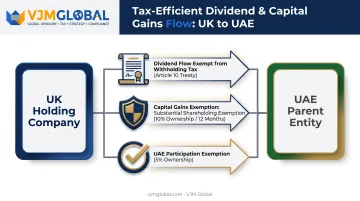
The real advantage for UAE-linked groups sits in the treaty network. Under Article 10 of the UK-UAE Double Taxation Convention, ordinary dividends are generally exempt from source-state withholding tax when the beneficial owner is resident in the other state.
A separate 15% rule applies to certain property-investment distributions, but it doesn't touch ordinary UK company dividends.
The UK's Substantial Shareholding Exemption (SSE) extends that treatment to exits. Under HMRC's CG53070 guidance, a UK holding company that holds at least 10% of a subsidiary's ordinary share capital continuously for 12 months can sell those shares without triggering UK capital gains tax on the disposal.
This pairs well with the UAE's own participation exemption, which generally requires at least 5% ownership (or AED 4 million acquisition cost) and a 12-month holding period. Structured correctly, a group can move dividends and capital gains between the UAE and UK with minimal friction on either side.
Group Relief and Dividend Treatment
Dividends received by a UK holding company from its subsidiaries, including overseas subsidiaries, are generally exempt from UK Corporation Tax under Part 9A of the Corporation Tax Act 2009. This exemption covers most ordinary distributions, though anti-avoidance rules can apply in specific cases.
Group relief is a separate mechanism. Where subsidiaries share a 75% group relationship, losses in one company can offset profits in another for UK tax purposes, subject to consent from the surrendering company.
Banking Considerations
Opening a UK business bank account for a non-resident-controlled holding company often takes longer than formation itself. Many UK banks want UK-resident directors or clear UK substance, plus full UBO documentation before onboarding.
UAE-based groups frequently keep operating accounts in the UAE and use the UK entity mainly for holding and treaty access. Plan GBP/AED payment corridors before the first capital injection or dividend.
Ongoing Compliance and Advisory Support
Running a UK-UAE group means tracking two separate compliance calendars simultaneously:
- UK side: Companies House Confirmation Statement, annual accounts, and HMRC Corporation Tax returns (form CT600)
- UAE side: Free zone or mainland licence renewals, UBO filings, and Economic Substance Regulations where applicable
VJM Global supports entity formation, tax compliance, and cross-border advisory across both markets—useful when a deadline in one jurisdiction affects filings in the other.
When to Set Up a UK Holding Company (and Mistakes to Avoid)
When It Makes Sense for a UAE-Based Business
A UK holding structure suits businesses that are:
- Running multiple trading businesses that would benefit from centralised ownership
- Planning genuine expansion into the UK or wider EU market
- Holding property or IP assets that should be ring-fenced from operational risk
- Preparing for a future partial sale, investment round, or succession plan
If none of these apply, a holding company adds compliance overhead without a clear payoff.
Common Mistakes UAE-Based Founders Make
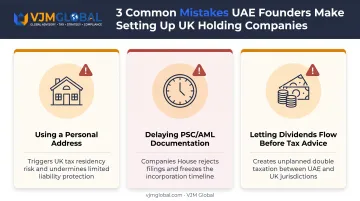
Three mistakes delay or undermine UK holding setups more than any others:
- Using a personal address as the registered office instead of a registered office service, which creates privacy issues and looks unprofessional to banks and investors
- Leaving PSC and AML documentation until the last minute, which is the single biggest cause of delayed bank account opening
- Letting dividends flow before getting tax advice, which can trigger withholding or reporting issues that proper sequencing avoids
UK Holding Company vs. Alternative Structures
A UK holding company isn't automatically the right answer. Weigh it against the alternatives before you commit.
UK Subsidiary vs. Branch vs. Representative Office
| Structure | Legal Identity | Liability | Best For |
|---|---|---|---|
| Subsidiary | Separate UK legal entity | Limited to the UK entity | Full liability protection, trading in own name |
| Branch/UK establishment | Not separate; parent remains liable | Parent company bears liability | Internal expansion where the group accepts risk |
| Representative office | Not separate | Parent bears liability | Market research and liaison, minimal local activity |
A subsidiary gives the cleanest separation and is what most people mean by a "UK holding company." A branch keeps things simpler administratively but exposes the UAE parent to UK liabilities directly. A representative office suits early market research and liaison only; it cannot trade in its own name.
Keeping the Holding Structure in the UAE (DIFC/ADGM) Instead
Some groups prefer to keep the holding entity in the UAE itself, using a DIFC Prescribed Company or an ADGM Special Purpose Vehicle. These work well for passive asset-holding and ring-fencing without adding a foreign jurisdiction.
The trade-off is treaty access. A UK holding company reaches one of the world's more extensive double tax treaty networks, which a purely UAE-based vehicle does not match. For groups with no near-term UK or EU trading ambitions, though, staying in DIFC or ADGM avoids an extra layer of cross-border compliance entirely.
Frequently Asked Questions
How do I start a holding company in the UK from the UAE?
A UAE resident or company registers a UK private limited company through Companies House, appoints directors and shareholders (no UK residency needed), and completes AML/KYC verification. Most founders use a cross-border formation agent to manage this remotely.
Can a UAE resident be the sole director and shareholder of a UK holding company?
Yes. Under the Companies Act 2006, there's no UK residency requirement for directors or shareholders. One person can hold both roles simultaneously.
Do I need to travel to the UK to set up the holding company?
No. Registration and most tax registrations can be completed entirely remotely from the UAE. Some banks still require an in-person meeting for account opening, though digital banking alternatives can avoid this.
Is there a double taxation treaty between the UK and UAE?
Yes, the UK-UAE Double Taxation Convention is in force. It generally exempts ordinary dividends from source-state withholding tax, making profit repatriation between the two jurisdictions more efficient.
Can a UAE free zone company own a UK holding company?
Yes. A UAE free zone entity can act as the corporate shareholder and Persons with Significant Control (PSC) of a UK company, provided it supplies the standard documentation, including a board resolution authorising the investment.
How long does it take to register a UK holding company from the UAE?
Companies House incorporation itself typically completes within 24 hours online. Full operational setup, including bank account opening and tax registrations, usually takes several additional weeks.