But setting up remotely from Australia isn't without friction. Founders regularly hit unfamiliar entity types, banking checks designed for residents, and government filings that assume you can walk into an office. This guide breaks down the structures, the registration steps, the real costs, and where professional support actually saves you time.
Key Takeaways
- Bahrain permits 100% foreign ownership in most sectors with no personal income tax
- Company registration runs digitally through the Sijilat portal by licensed activity
- Most businesses pay 0% corporate tax; only large multinationals face the Domestic Minimum Top-Up Tax
- Golden Residency and investor visas exist, but ownership and residency stay legally separate
- Cross-border advisors handle translation, banking, and compliance without a trip to Manama
Why Bahrain Appeals to Australian Entrepreneurs
Compared to the UAE or Saudi Arabia, Bahrain positions itself as the low-cost, English-friendly on-ramp to the wider GCC market. Government offices operate in English alongside Arabic, and the regulatory footprint is smaller, so you negotiate fewer layers before you're trading.
The tax picture is straightforward for most founders:
- No personal income tax on salary or dividends
- 0% corporate tax for the vast majority of business activities
- 46% rate only for oil and gas operators
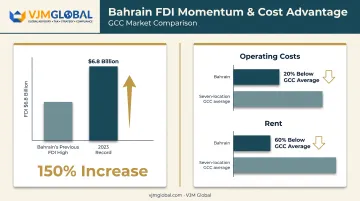
On cost, EY's 2025 GCC financial-services benchmark placed Bahrain's annual operating cost 20% below the seven-location average, with rent running 60% below average. That figure is for an 80-person financial hub, not a universal SME quote, but it still shows where Bahrain sits on the value scale.
Investment momentum backs this up. Bahrain's EDB reported $6.8 billion in FDI inflows in 2023, close to 150% above its previous high. That is a strong signal global capital sees Bahrain as more than a niche market.
Choosing the Right Business Structure
Your structure choice depends on whether you're trading locally, testing the waters, or planning to scale into a regulated entity.
WLL: The Default for Most Foreign Investors
The With Limited Liability Company (WLL) is where most Australian founders land. Bahrain’s commercial registration system, Sijilat, confirms:
- Partners' liability is limited to their capital shares
- Foreigners can own 100% in most activities
- No fixed minimum capital requirement for most business types
It can't operate in banking, insurance, or activities that invest funds on behalf of others. Those need a different licence tier entirely.
BSC, Branch, and Representative Office
- Bahrain Shareholding Company (BSC): needs at least two founders and suits capital-raising or regulated activity (banking, insurance) with authority approval. Higher governance overhead.
- Branch office: lets an Australian company operate directly under its own name, with the parent carrying full liability exposure.
- Representative office: allows marketing and liaison only. You cannot invoice Bahrain clients through it, which rules it out if local revenue is the goal.
Certain restricted sectors (media, defence, telecom) may require a local joint-venture partner. Exact rules vary by activity, so confirm through Sijilat’s activity search rather than assuming.
If you want to trade with limited liability, a WLL is usually the right fit. If you're only testing demand, a representative office avoids commitment but cannot generate revenue.
Step-by-Step Process to Register Remotely from Australia
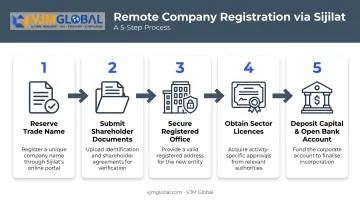
Sijilat is Bahrain's electronic registration and licensing system, and it's built to be used without setting foot in the country. Here's the sequence:
- Reserve your trade name in both English and Arabic, and classify your business activity under the MOIC system.
- Submit shareholder documents (passports, company details, and ownership structure) through the Sijilat portal.
- Secure a registered office address, which can be a compliant virtual office under municipal rules.
- Obtain sector-specific licences from the relevant regulator before your Commercial Registration (CR) is finalised.
- Deposit capital and open a corporate bank account as a non-resident. Expect extra due diligence: Australian applicants without a Bahrain presence typically face more scrutiny on source-of-funds documentation.
Processing generally runs into weeks rather than days. Sijilat's public information does not guarantee a fixed turnaround.
MOIC offices run Sunday to Thursday, 7am to 2pm Bahrain time. Plan calls accordingly: Friday requests simply sit until Sunday.
Remote applicants typically coordinate notarisation and any required translation through Australia before submission. Document requirements shift depending on the activity and entity type selected.
Costs, Capital Requirements, and Visas for Australians
Minimum Capital and Setup Costs
Most business types in Bahrain carry no fixed minimum capital requirement. That makes entry more accessible for smaller Australian investors than in jurisdictions with mandatory paid-up capital thresholds.
Setup costs break down into:
- CR registration fees (activity-dependent, check Sijilat's live fee calculator)
- Licensing fees specific to your business activity
- Office/virtual office costs
- Professional fees for structuring and filing support
Avoid relying on old fee figures floating around online. Sijilat's fee schedule is activity-specific, so pull current fees at the time of filing.
Visa and Residency Pathways
Ownership and residency are handled separately in Bahrain. Options include:
- Investor Visa: Tied to active business registration; confirm current shareholding thresholds for self-sponsorship when you apply
- Golden Residency: Permanent, no minimum stay, apply from outside Bahrain via property (BHD 130,000+), retirement income, or employment history
- Remote-income routes: Useful for Australians who want a foothold without relocating full-time
None of these automatically grant work permission — that still runs through Bahrain's labour authority separately.
Taxation and Ongoing Compliance Obligations
Here's where the "0% tax" narrative needs a footnote.
| Obligation | Rate/Threshold | Applies to |
|---|---|---|
| Corporate income tax | 0% (general) | Most businesses |
| Oil and gas tax | 46% | Oil/gas sector only |
| Domestic Minimum Top-Up Tax | 15% | MNE groups with €750M+ global revenue |
| VAT | 10% standard rate | Businesses above BHD 37,500 turnover |
| Audited financials | Mandatory annually | WLL, BSC, branch entities |
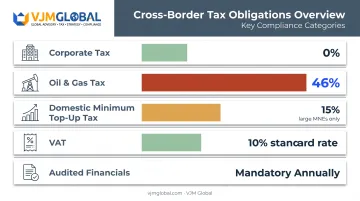
The 15% Domestic Minimum Top-Up Tax only applies to large multinational groups meeting the €750 million consolidated revenue test — an ordinary Australian SME won't fall into this bracket. Don't confuse it with a broader SME tax change.
On the double-taxation question: Australia and Bahrain have a Tax Information Exchange Agreement (signed 2011), which covers information sharing, not profit repatriation relief. If you're moving profits back to Australia, structure that conversation with a tax advisor early rather than assuming treaty protection exists.
Ongoing obligations once the entity is live include:
- Payroll registration and processing when you hire locally
- Social insurance contributions for local employees
- Annual Commercial Registration (CR) renewal
- Audited financial statements within 6 months of year-end
Managing this from Australia is entirely doable with the right partner. VJM Global works with Australian businesses on multi-jurisdiction entity formation and ongoing compliance, handling bookkeeping, payroll, and statutory filing so founders aren't chasing paperwork across time zones themselves.
Common Challenges Australians Face and How to Overcome Them
Three friction points show up repeatedly for Australian founders setting up in Bahrain without relocating:
- Time zone and distance. Bahrain sits roughly 7–8 hours behind Australian Eastern time, and government offices run Sunday to Thursday. Banking calls, notarisation, and approvals need a narrow overlap window, or a local representative who can act in Bahrain business hours.
- Arabic-language documentation. Trade names must be registered in English and Arabic, and some filings need certified Arabic versions. Confirm the exact Sijilat checklist for your activity and entity type rather than assuming a blanket rule.
- Banking due diligence. Non-resident applicants usually face deeper source-of-funds and beneficial-ownership checks. Build this into your timeline instead of treating it as a formality after CR issuance.
The practical fix is a cross-border advisory team that already works across multiple jurisdictions. VJM Global helps companies expand into new markets by handling local regulatory steps, entity formation, and post-incorporation compliance, so founders do not need to be on the ground or fluent in local procedures.
Frequently Asked Questions
How to start a small business in Bahrain?
Choose your structure (usually a WLL), register your trade name and activity through Sijilat, then secure the licences and office address required before your Commercial Registration is issued.
How much does it cost to set up a company in Bahrain?
Costs vary by activity and include CR fees, activity-specific licensing charges, and office setup. There's no fixed minimum capital for most business types, so total setup budgets vary widely by sector.
Can a foreigner own a business in Bahrain?
Yes, 100% foreign ownership is permitted in most sectors. Some restricted activities like media, defence, or telecom may require a local partner — confirm this per activity through Sijilat.
Which business is most profitable in Bahrain?
Fintech, trading, IT services, and food and beverage tend to show strong margins given demand and Bahrain's positioning as a regional services hub. Profitability still depends on execution and sector conditions.
Do I need to live in Bahrain to own a company there?
No. Ownership and residency are legally separate. You can own and operate a Bahraini company while living in Australia, though certain visas can be linked to active registration.
What visa options exist for Australian investors?
Options include the Investor Visa tied to business registration, Golden Residency (property, retirement, or employment-based routes), and remote-income pathways for those not relocating full-time.