The people driving this interest span a wide range: NRI founders who want a global base, Indian SMEs seeking an Asia-Pacific presence, and professionals exploring business migration pathways. What they share is a common frustration — the process looks straightforward until you hit the compliance details.
This guide cuts through that. It covers eligibility, structure selection, registration steps, tax obligations, and costs — everything you need to start an Australian company from India, whether you plan to operate remotely or relocate.
Key Takeaways
- Indians can fully own an Australian company but must appoint at least one Australia-resident director
- A Proprietary Limited Company (Pty Ltd) is the standard structure for Indian founders, offering limited liability and 100% foreign ownership eligibility
- Core registrations: ACN, ABN, TFN, and GST (required once turnover crosses AUD 75,000)
- Initial setup costs start from approximately AUD 656 (company registration + business name); annual compliance adds AUD 329+
- Company registration does not grant residency — visa applications are separate
What Indian Entrepreneurs Must Know Before Starting
The Resident Director Requirement
Indians can register and own an Australian company outright. The catch: the Corporations Act 2001 requires at least one director who ordinarily resides in Australia. This is the single most common compliance gap Indian founders overlook.
If you're operating from India with no Australian residency, you must appoint a local resident director — either a trusted contact or a professional nominee director service. This is not optional, and ASIC actively monitors compliance.
India-Side Obligations Under FEMA
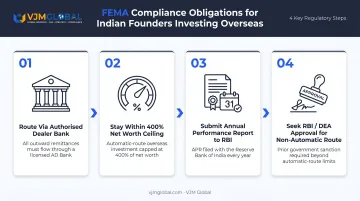
Setting up an Australian entity triggers obligations back home. Under the Foreign Exchange Management (Overseas Investment) Rules, 2022, Indian residents investing in foreign entities must:
- Route remittances through an Authorised Dealer (AD) bank
- Stay within the automatic-route ceiling (total financial commitment capped at 400% of net worth for Indian entities)
- Submit an Annual Performance Report (APR) to the RBI on the overseas entity's capital structure, financials, and repatriation data
- Seek prior RBI/DEA approval for commitments that fall outside automatic-route conditions
Non-compliance with FEMA carries significant penalties. Managing these India-side obligations alongside an Australian setup requires coordinating RBI filings, DTAA structuring, and ongoing APR submissions — areas where specialist cross-border advisory (such as VJM Global's FEMA and ODI practice) can prevent costly missteps.
Two Operating Models
| Model | Description | Key Requirement |
|-------|-------------|-----------------|
| Remote Setup | Register Australian entity, operate from India | Appoint local resident director + registered agent |
| Relocate & Operate | Move to Australia and run the business directly | Business Innovation visa (subclass 188) in addition to company registration |
Why Australia Makes Strategic Sense
Business Environment and Trade Access
Australia ranked 18th out of 69 countries in the IMD World Competitiveness Yearbook 2025 and offers a stable, transparent legal system that makes contract enforcement predictable. For Indian founders, that predictability matters — Australian courts enforce contracts reliably, intellectual property protections are robust, and the English-language legal system reduces friction that other Asia-Pacific jurisdictions introduce.
Australia now has 19 Free Trade Agreements in force, including the India-Australia ECTA, which provides tariff-free access for 90% of Australian goods exports to India and 100% of Indian goods imports into Australia. Those trade access terms, combined with a competitive tax environment, make Australia one of the more financially attractive jurisdictions for Indian-founded businesses looking to scale regionally.
Financial Incentives Worth Knowing
- R&D Tax Incentive: Companies under AUD 20 million aggregated turnover receive a 43.5% refundable offset on eligible R&D expenditure (25% corporate rate + 18.5% premium) — a direct cash benefit for tech founders in early growth stages
- Corporate tax rate: A flat 25% for base rate entities with aggregated turnover under AUD 50 million (from the 2021-22 income year)
- Export Market Development Grants (EMDG): Austrade co-funds export marketing costs for eligible Australian businesses — relevant for Indian-founded companies expanding into third markets beyond India
- Industry Growth Program: Grants of AUD 50,000–AUD 5 million for innovative SMEs in priority sectors (currently paused to new applications; check business.gov.au for reopening dates)
The India-Australia DTAA
The Double Taxation Avoidance Agreement between India and Australia (signed 1991, updated in 2011, and further modified by the Multilateral Instrument) prevents the same income from being taxed twice. It covers business profits, dividends, royalties, and capital gains.
For Indian founders earning income from both geographies, this treaty is critical. Without it, profits flowing from an Australian entity back to Indian promoters could face tax in both jurisdictions. With proper structuring under the DTAA, proper structuring under this agreement eliminates that double-tax burden entirely.
Business Structures Available to Indian Entrepreneurs
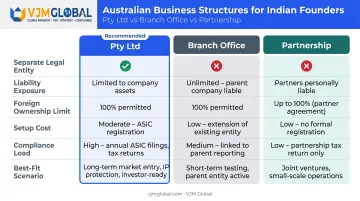
The structure you choose affects liability, tax, compliance load, and your ability to raise investment. Here is how the three main options compare:
| Feature | Pty Ltd | Branch Office | Partnership |
|---|---|---|---|
| Separate legal entity | Yes | No | No |
| Liability | Limited to company assets | Parent bears full liability | Joint/unlimited |
| Foreign ownership | Up to 100% (FIRB may apply in some sectors) | N/A — extension of Indian parent | Shared between partners |
| Setup cost | AUD 611 (ASIC registration) | Similar ASIC fees | Lower |
| Compliance load | Moderate | Moderate-High | Moderate |
| Best for | Most Indian entrepreneurs | Indian companies testing Australian market | Two or more co-founders |
Pty Ltd (Recommended for Most Founders)
A Proprietary Limited Company is a separate legal entity with limited liability protection. It requires at least one Australia-resident director and allows foreign nationals as shareholders. Foreign ownership can reach 100%, though FIRB screening applies in certain sectors and above specific acquisition thresholds — verify your sector's rules before assuming unrestricted ownership.
Branch Office
An Indian company can register an Australian branch instead of incorporating a new entity. The branch is not a separate legal entity — the Indian parent bears full liability for Australian obligations. ASIC assigns the branch an Australian Registered Body Number (ARBN), and a local agent must be appointed. This suits companies wanting to test the market without full incorporation, but the liability exposure is a significant trade-off.
Partnership
Suitable when two or more founders are sharing operations and profits. Partners have joint or unlimited liability depending on partnership type. The partnership needs its own Tax File Number (TFN) and must lodge annual ATO returns. Each structure carries a different compliance burden, so your choice here shapes everything from tax obligations to how you bring in investors later.
How to Register a Business in Australia from India — Step by Step
Registration can be completed entirely online without visiting Australia, but requires careful document preparation — including parallel compliance steps on the Indian side, such as RBI reporting obligations for outward investment.
Step 1 — Choose Your Structure and Business Name
Decide on structure first (Pty Ltd for most Indian entrepreneurs), then check name availability via ASIC's online register. A business name registered in India offers no protection in Australia — search both the ASIC register and IP Australia's trademark database before committing.
Step 2 — Appoint a Local Director and Obtain Director IDs
Every director of an Australian company must hold a Director Identification Number (Director ID), issued by the Australian Business Registry Services (ABRS). Directors appointed from 5 April 2022 must apply before appointment. The application is free.
Non-residents without Australian identity documents face an additional step:
- Cannot apply online — a paper application with certified identity documents must be submitted to the ABRS
- Factor in processing time before scheduling your company registration date
Step 3 — Register with ASIC and Obtain ACN and ABN
Submit your company registration through the Business Registration Service. You will need:
- Proposed company name
- Registered Australian address
- Director details and Director IDs
- Shareholder information
ASIC issues a 9-digit Australian Company Number (ACN) upon approval, typically within 2 business days. Apply for your Australian Business Number (ABN) at the same time — you may receive an ABN immediately, though manual reviews can take up to 20 business days.
The ABN is used for all invoicing, tax filings, and business dealings in Australia.
Step 4 — Register for Taxes
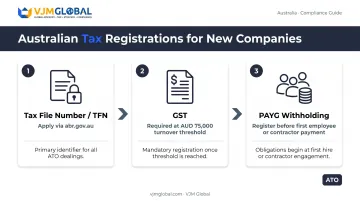
Three registrations to handle:
- Tax File Number (TFN): Apply online at abr.gov.au. Companies need a distinct TFN separate from any individual's personal TFN
- GST: Required when annual GST turnover reaches AUD 75,000. Below this threshold, registration is optional, though worth registering early: clients may withhold tax from your invoices if you lack an ABN
- PAYG Withholding: Register before making your first payment to employees or contractors
Step 5 — Open a Business Bank Account and Secure Licenses
Banking options for Indian founders:
- Traditional banks (Commonwealth Bank, ANZ, NAB, Westpac): Online verification is available in some cases, but branch visits may be required if identity cannot be verified digitally. Core documents needed: ABN, ACN, incorporation certificate, and director identity proof
- Fintech platforms (Airwallex, Wise Business): Airwallex supports local accounts in 20+ currencies with funds receivable from 70+ countries, making it a practical remote option for Indian founders handling multi-currency operations
For industry licenses, use the Australian Business Licence and Information Service (ABLIS) to identify state- and sector-specific requirements. Licensing requirements vary by state and industry — use ABLIS to identify what applies to your business before you launch.
Costs and Ongoing Compliance
Setup Cost Summary
| Item | Cost |
|---|---|
| Pty Ltd ASIC registration (Form 201C) | AUD 611 |
| Business name registration (1 year) | AUD 45 |
| Director ID application | Free |
| Registered agent service (~annual) | ~AUD 179/year |
| Approximate initial total | ~AUD 656+ |
Annual Compliance Obligations
- ASIC annual review fee: AUD 329 for a proprietary company
- Corporate tax return: Lodged with the ATO; 25% rate for eligible SMEs
- Business Activity Statements (BAS): Quarterly GST reporting if registered
- Registered Australian address: Must be maintained at all times
- Director duties: Ongoing obligations under the Corporations Act — non-compliance can lead to penalties, director disqualification, or deregistration
What Indian Founders Frequently Underestimate
These compliance areas most commonly catch founders off guard after incorporation:
- Maintaining financial records under Australian Accounting Standards
- Lodging ASIC annual reviews on time (late fees apply and escalate)
- Keeping ODI/FEMA reporting current in India — the APR is due annually, and lapses attract RBI scrutiny
Running a business across two jurisdictions means managing the ATO and ASIC in Australia alongside RBI and FEMA obligations in India. That dual-system load is where most compliance gaps appear. VJM Global works with Indian entrepreneurs on exactly this intersection — FEMA/ODI compliance, DTAA structuring, and Australian accounting support — so both sides of the structure stay current.
Frequently Asked Questions
Do I need an ABN if I earn less than AUD 75,000?
ABN registration is not legally required below the AUD 75,000 GST turnover threshold. That said, most businesses register anyway — without an ABN, clients must withhold 47% from payments, and you need one to register a business name, claim input tax credits, and invoice professionally.
What is the Significant Investor visa for Australia?
This is the Significant Investor stream under the Business Innovation and Investment (Provisional) visa (subclass 188). It requires at least AUD 5 million invested in complying Australian assets and offers a pathway to permanent residency via the subclass 888 visa — separate from the standard Business Innovation stream.
Can I register a company in Australia from India without visiting?
Yes — registration is completed online via the Business Registration Service. The constraint is the resident director requirement, not physical presence. Banking may require a branch visit at traditional banks if online identity verification fails, though fintech platforms allow fully remote account setup.
Do I need a local director to start a company in Australia?
At least one director must ordinarily reside in Australia under the Corporations Act 2001. Indian founders who are not Australian residents can appoint a professional nominee director or a trusted Australian-based contact to fulfil this requirement.
How long does it take to register a company from India?
ASIC registration typically takes 1–2 business days once documents are in order. Factoring in Director ID applications, ABN processing, and bank account opening, the full setup process usually takes 2–4 weeks.
What taxes does an Australian company pay?
Key obligations include corporate income tax at 30% (or 25% for eligible SMEs), GST at 10% once turnover exceeds AUD 75,000, and PAYG withholding for employees. The India-Australia DTAA prevents double taxation — consult a cross-border tax adviser to structure this correctly from the start.