
Introduction
Australia is becoming a serious option for UAE-based entrepreneurs looking beyond the Gulf.
Two-way trade between Australia and the UAE hit A$12.7 billion in 2024-25, with bilateral investment stock reaching A$23.7 billion, according to Australia's Department of Foreign Affairs and Trade.
But the systems couldn't be more different. UAE founders are used to free-zone setups, zero personal income tax, and same-day licence approvals. Australia runs on ASIC registration, resident director rules, and ATO tax filings, none of which have an equivalent in Dubai or Abu Dhabi.
This guide walks through eligibility, structure options, the registration process, visas, tax and banking, and where professional support actually helps.
Key Takeaways
- UAE nationals, residents, and UAE-registered companies can own 100% of most Australian businesses without residency
- A resident director or local agent based in Australia is legally required, even if you never relocate
- The Australia-UAE CEPA is now in force but does not raise FIRB investment thresholds for UAE investors
- Visas are only needed if you plan to personally live and work in Australia, not simply own a company there
Can a Foreigner from the UAE Start a Business in Australia?
Yes. There's no rule blocking UAE nationals, UAE residents of any nationality, or UAE-registered companies from owning an Australian business. The framework is the same one applied to any foreign founder, regardless of passport.
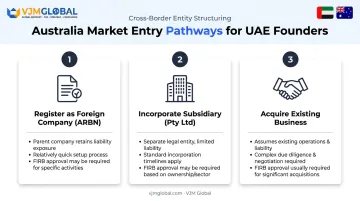
Three Ways to Enter the Market
- Register as a foreign company (ARBN): your existing UAE entity registers a branch in Australia
- Incorporate a new subsidiary (Pty Ltd): a separate Australian legal entity, owned by you or your UAE company
- Acquire or buy into an existing Australian business: straightforward for smaller deals, more complex above FIRB thresholds
Where FIRB Screening Comes In
The Foreign Investment Review Board (FIRB) only becomes relevant for larger transactions. Despite CEPA entering into force on 1 October 2025, it did not move the UAE into Australia's higher-threshold FTA-partner category.
- Private investors: Approval needed to acquire 20%+ of an Australian entity above A$347 million, per Australia's 2026 monetary threshold table
- FTA-partner comparison: Same figure used for sensitive businesses under FTA rules, but well below the A$1.498 billion non-sensitive threshold for US and other listed FTA partners
- Sovereign wealth funds and government-linked entities: Approval generally required for any direct interest in an Australian business, regardless of value
For most individual entrepreneurs and SMEs from the UAE, FIRB screening rarely applies. Company registration itself isn't a notifiable FIRB action unless you're a foreign-government investor or the business touches national security. You register, you comply, you operate.
Choosing the Right Business Structure for a UAE-Based Founder
Structure choice shapes your liability exposure, tax position, and how much setup work you're signing up for. UAE founders typically weigh two options seriously: a branch or a subsidiary.
| Factor | Branch (ARBN) | Subsidiary (Pty Ltd) |
|---|---|---|
| Legal identity | Same entity as your UAE company | Separate Australian legal entity |
| Liability | Parent company bears full liability | Limited to the subsidiary itself |
| Setup speed | Slower - paper-based lodgement | Faster - often 1-2 business days online |
| Local perception | Seen as a foreign entity | Treated as a local Australian business |
| Compliance | Annual financial statement lodgement | Annual review + ongoing ASIC fees |
Branch Office (ARBN): Shared Identity, Full Exposure
A branch retains your UAE parent company's identity. You're registering the existing entity, not creating a new one. Upfront costs can run lower, but ASIC lodgement is slower and more document-heavy, and the parent bears full liability for whatever happens in Australia. If a client sues the Australian branch, they're effectively suing your UAE company.
Subsidiary (Pty Ltd): Faster Setup, Real Separation
A Pty Ltd is its own legal entity with its own ACN, its own tax obligations, and its own liability shield. Banks and government tender processes generally treat it as a genuine local business, which matters if you're chasing Australian contracts or opening local credit lines.
Both structures share one non-negotiable requirement: someone physically based in Australia has to be legally responsible. Branches need a local agent; subsidiaries need at least one resident director. This is the single biggest gap for UAE founders unwilling to relocate, and it's usually where founders appoint a local agent or resident director through a professional services firm.
Which suits you?
- Testing the market or running a short-term project → branch office
- Building a lasting Australian presence, chasing government tenders, or needing easier local banking → subsidiary
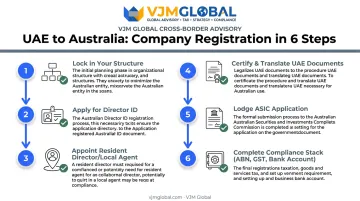
Step-by-Step: Registering Your Business in Australia from the UAE
Here's the practical sequence, from decision to bank account.
Lock in your structure. Decide between branch and subsidiary based on liability tolerance, budget, and how long you plan to operate in Australia.
Apply for a Director ID. Every director needs a Director Identification Number through the Australian Business Registry Services (ABRS). UAE-based applicants verify identity with certified documents via a notary public or an Australian diplomatic post. ABRS publishes no fixed overseas processing window, so build in buffer time.
Appoint your resident director or local agent. Since most UAE founders don't relocate, this role is usually filled by a professional services partner already based in Australia.
Certify and translate your UAE documents. Attest your trade licence, Certificate of Incorporation, MOA, and Emirates ID or passport copies through UAE notarisation and MOFA. Per the UAE Ministry of Foreign Affairs, digital attestation can finish within 2 hours during working hours; courier options take 1-3 business days. Certified English translation is a separate step and the friction point that catches most UAE founders off guard.
Lodge your ASIC application. Form 402 registers a foreign company (branch) for an ARBN; Form 201 registers a new Australian company (subsidiary) for an ACN. Online Form 201 filings typically clear within 1 business day when complete; paper takes about 2 business days. Form 402 has no published target, so plan several weeks once certification delays are included.
Finish the compliance stack. Apply for an ABN, register for GST once turnover crosses AUD 75,000, set up a compliant registered office address, and open an Australian business bank account. Banks apply extra KYC when signatories are overseas, so UAE-based directors should expect this step to take longer than it does for domestic founders.
Visa, Tax & Banking Considerations Between the UAE and Australia
Owning an Australian company from Dubai or Abu Dhabi doesn't require a visa. You only need one if you plan to personally live and work in Australia.
If You Plan to Relocate
- The Business Innovation and Investment Program (subclass 188/888) closed to new applications on 31 July 2024; only applications lodged before that date are still being processed
- The National Innovation Visa is the current active pathway for founders seeking to relocate permanently
- Visa programs shift frequently, so confirm current status before committing to a relocation plan
Resident vs Non-Resident Tax Treatment
- Australian resident companies (most Pty Ltd subsidiaries) are taxed on worldwide income at 25% for qualifying base-rate entities or 30% otherwise
- Non-resident structures, including most branch offices, are taxed only on Australian-sourced income
- Residency depends on where the company is incorporated and where central management and control actually sits, not just where it's registered
- GST registration is mandatory once turnover hits AUD 75,000, and must happen within 21 days of crossing that threshold
The DTA Gap Founders Should Know About
There is currently no Double Taxation Agreement between the UAE and Australia. The UAE doesn't appear on Treasury's list of Australian income tax treaties. Without one, standard ATO withholding rates apply on outbound payments to foreign residents:
- 10% on interest
- 30% on unfranked dividends and royalties
This matters directly for profit repatriation. Without treaty relief, UAE founders sending profits home from an Australian entity face the full domestic withholding rate rather than a reduced treaty rate.
Structuring the entity and payment flows correctly upfront makes a real difference here.
Banking Friction Points
Cross-border banking adds cost and delay. AED-to-AUD conversion fees eat into margins on smaller transactions, and remote KYC checks slow account opening for overseas-based signatories.
Common Challenges for UAE Founders & How VJM Global Can Help
UAE founders run into friction that domestic Australian founders never see:
- Document attestation delays - MOFA processing plus Australian consular requirements often run longer than founders plan for
- Time-zone gaps - a compliance deadline on an Australian business day can land on a UAE weekend, and vice versa
- Unfamiliar filing calendars - ASIC's annual review and the ATO's BAS/PAYG cycle look nothing like UAE free-zone licence renewals
There's also a quieter problem: running separate advisors in each country. A UAE accountant who doesn't understand ASIC deadlines and an Australian firm unfamiliar with UAE document attestation often talk past each other. Deadlines slip. Fees duplicate. Nobody owns the full picture.
VJM Global works across both markets under one engagement. As a chartered accountancy and cross-border services firm that has supported 250+ Australian business setups, it coordinates entity formation, resident director and local agent facilitation, accounting, tax, and ongoing compliance. UAE founders work with one accountable partner instead of juggling two disconnected advisory relationships.

Frequently Asked Questions
Can a US citizen start a business in Australia?
Yes, under the same core framework: structure choice, resident director or local agent, and FIRB screening where applicable. The main difference is the FIRB threshold itself, since the US sits in a higher-threshold FTA category than the UAE.
Do UAE residents need a visa to start a business in Australia?
No. A visa is only required to personally live and work in Australia. You can own and register a company remotely from the UAE without one.
Is there a double tax agreement between the UAE and Australia?
No. Australia and the UAE do not have a DTA, so profit repatriation is subject to standard ATO withholding rates rather than a reduced treaty rate.
Can I manage my Australian company remotely from Dubai or Abu Dhabi?
Yes, this is common practice. A resident director or local agent based in Australia handles the regulatory and compliance obligations that require local presence.
Do I need FIRB approval as an investor from the UAE?
Usually no. Most standard SME registrations sit well below FIRB thresholds. Larger investments or government-linked UAE entities should verify current thresholds before proceeding.
How long does company registration take for a UAE-based founder?
A Pty Ltd subsidiary typically registers within 1-3 business days once documents are ready. A branch office (ARBN) takes longer, generally 2-4 weeks, plus additional time for UAE document certification and translation.