But "accessible" doesn't mean simple. Many UK founders assume the process mirrors Companies House registration, only to discover a sequenced compliance chain involving ASIC, the ATO, the ABRS, state licensing bodies, and ongoing dual-jurisdiction obligations. Getting the order wrong adds months of delay and real cost.
This guide covers everything you need to know — from structure choices and registration steps to tax obligations and the compliance details that trip up most foreign-owned setups.
Key Takeaways
- UK citizens can fully own an Australian business remotely, but must appoint at least one Australian-resident director
- A Proprietary Limited (Pty Ltd) company is the recommended structure for most UK nationals entering Australia
- Required registrations include ASIC, the ATO (ABN, TFN, GST), and the ABRS for Director ID
- GST registration is required once annual turnover reaches AUD 75,000
- Budget AUD 1,500–6,000+ for startup costs, depending on your compliance requirements
Why UK Businesses Are Looking to Australia Right Now
The numbers behind UK-Australia trade make a straightforward case for expansion. According to DFAT's 2024 country brief, two-way goods and services trade reached AUD 35.9 billion, with the UK ranking as Australia's second-largest source of total foreign investment stock at AUD 698 billion. This is a mature, high-value economic relationship — not an exploratory one.
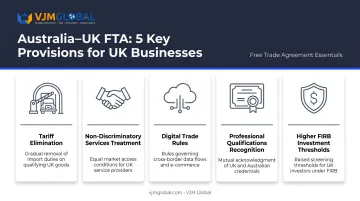
The A-UKFTA adds meaningful trade advantages. Key provisions include:
- Tariff elimination on major UK exports including vehicles and whisky
- Non-discriminatory treatment for UK service suppliers operating in Australia
- Digital trade rules addressing data localisation and electronic trade documents
- A professional qualifications framework supporting recognition of UK credentials
- Higher monetary thresholds for some UK investments requiring FIRB screening
Sectors where UK businesses are finding traction include financial services, fintech, cyber security, professional services, and infrastructure development. Australia's position in the Asia-Pacific also creates secondary market access opportunities that a UK-only footprint simply can't replicate.
That said, the FTA is a commercial advantage, not a compliance shortcut. ASIC registration, ATO obligations, licensing, and employment law all apply in full to UK-owned Australian entities — and getting these right from day one matters.
What to Know Before You Start
The Visa Question
If you plan to be physically present in Australia to operate your business, you need an appropriate visa. The two business-specific pathways most commonly referenced — the Business Innovation and Investment visa (subclass 188) and the Business Talent visa (subclass 132) — are both closed to new applications (as of 31 July 2024 and 1 July 2021 respectively). Check the Department of Home Affairs directly for current options.
The good news: physical relocation isn't required. UK nationals can legally own and manage an Australian company remotely. This is the most common approach, and it's fully compliant — provided you meet the structural requirements below.
Three Requirements That Catch Most UK Founders Off Guard
1. Resident director obligation Every Australian Proprietary Limited company must have at least one director who ordinarily resides in Australia. If you don't have a local partner, you'll need a formal nominee director arrangement — someone who carries genuine legal responsibility under the Corporations Act.
2. Registered Australian office address ASIC requires a physical street address in Australia. PO boxes are not accepted. Compliant virtual office solutions that provide a real street address and written occupier consent are an accepted option.
3. Director Identification Number (DIN) Every director of an Australian company — including non-resident directors — must obtain a DIN through the Australian Business Registry Services (ABRS) before being appointed. Founders often treat this step as an afterthought, and it ends up delaying registration.
The Dual Compliance Reality
Running a UK-owned Australian company means meeting obligations in two jurisdictions simultaneously — and neither pauses for the other:
- UK obligations: Companies House filings, HMRC reporting, and VAT requirements continue regardless of your Australian activity
- Australian obligations: ASIC compliance, ABN registration, GST registration (if turnover exceeds AUD 75,000), and BAS lodgements begin the moment your company is registered
This dual compliance load is one of the most underestimated challenges for UK founders. Engaging cross-border advisory support early — before errors compound across two tax authorities — is rarely optional in practice.
Choosing the Right Business Structure
The structure decision shapes everything: tax obligations, liability exposure, banking access, and how local customers and regulators view your business.
Proprietary Limited Company (Pty Ltd)
This is the right structure for the vast majority of UK nationals entering Australia permanently or on an ongoing commercial basis. A Pty Ltd:
- Creates a separate Australian legal entity (the UK parent is not liable for Australian operations)
- Limits liability to invested share capital
- Is straightforward for local contracting, hiring, and banking
- Requires at least one Australian-resident director and ASIC registration
Registering as a Foreign Company (Branch)
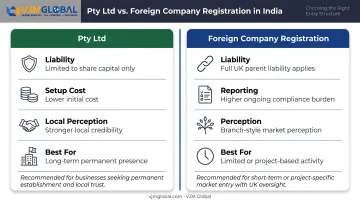
If Pty Ltd doesn't fit — for instance, if you're running a defined project or want to avoid setting up a separate entity — your existing UK company can register directly with ASIC as a foreign company. You appoint a local agent, maintain an Australian registered office, and keep Australian operations legally tied to the UK entity. The trade-off: the UK parent carries full liability for Australian activities, and ongoing ASIC reporting obligations are heavier.
Quick comparison:
| Factor | Pty Ltd | Foreign Company Registration |
|---|---|---|
| Liability | Limited to invested share capital | Full UK parent liability |
| Setup cost | Lower | Higher ongoing reporting |
| Local perception | Stronger (local entity) | Branch-style |
| Best suited for | Long-term Australian presence | Limited or project-based activity |
Two other structures come up occasionally but rarely make sense at entry stage:
- Sole trader / partnership — not practical for non-residents based in the UK
- Trust structures — available but add significant complexity rarely justified until you're established
How to Start a Business in Australia from the UK — Step by Step
The most common mistake UK founders make: treating registration as a single task rather than a sequenced process where order matters.
Step 1 — Confirm Your Right to Operate and Appoint a Resident Director
Start by deciding how you'll operate:
- Physically present in Australia: You'll need an appropriate visa before commencing work
- Managing remotely from the UK: You'll need a resident director based in Australia
If you go the nominee director route, the arrangement must be formal and documented. This person carries real legal responsibility under Australian law — it's not an administrative formality.
Then obtain Director Identification Numbers. Every director, including non-residents, must apply through ABRS before appointment. Build this into your pre-incorporation checklist, not your post-registration cleanup.
Step 2 — Register Your Company with ASIC
The registration process involves:
- Check name availability via ASIC Connect
- Prepare a constitution or adopt the replaceable rules under the Corporations Act 2001
- Lodge Form 201 to receive your Australian Company Number (ACN)
Current ASIC fees (as at 23 June 2026):
- Application to register a proprietary company: AUD 611
- Annual review fee: AUD 329 (increasing to AUD 342 from 1 July 2026)
Using a Private Service Provider (PSP) is worth considering for overseas founders. PSPs have direct ASIC system access and typically reduce processing delays for foreign applicants.
Step 3 — Register for Tax Identifiers with the ATO
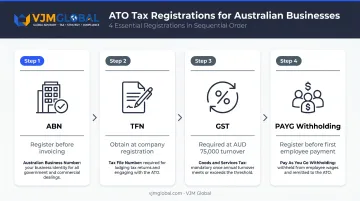
Four registrations to complete, in order:
| Registration | Trigger | Notes |
|---|---|---|
| ABN | Before invoicing or GST registration | Required for business identity |
| TFN | At company registration | Apply online via the Australian Business Register |
| GST | When turnover reaches AUD 75,000 | 10% rate on most goods and services |
| PAYG withholding | Before first payment to employees | Register before hiring begins |
One obligation that catches UK founders by surprise: the public officer requirement. Every company carrying on business in Australia must appoint an Australian-resident public officer within three months of commencing. This is separate from the ASIC resident director requirement. Missing it can attract penalties, so treat it as a parallel compliance task, not an afterthought.
Step 4 — Registered Office and Business Bank Account
For the registered office, ASIC requires a physical Australian street address with written consent from the occupier. A compliant virtual office solution works fine for remotely managed businesses.
Banking is where UK founders consistently hit friction. Major Australian banks require in-person or branch-based processes for foreign entities; online applications are generally restricted to Australian-resident applicants. Factor in several extra weeks for this step. Fintech options offering multi-currency accounts with fully online onboarding can serve as a practical bridge while traditional banking processes complete.
Step 5 — Register Your Business Name and Protect Your IP
Two actions to complete before trading:
- Business name: If trading under any name other than the legal company name, register it separately with ASIC
- Trade mark: Your UK trade mark does not automatically protect your brand in Australia. Check availability with IP Australia and file an Australian trade mark registration — brand protection should be treated as a priority, not an optional extra.
Step 6 — Obtain Required Licences and Permits
ASIC registration is not a licence to operate. Many sectors require additional approvals before trading:
- Financial services: An Australian Financial Services (AFS) licence is required unless exempt
- Food businesses: Registration or notification with the relevant local council (requirements vary by state)
- Healthcare, construction, childcare, import/export: All have sector-specific licensing frameworks
Use the Australian Business Licence and Information Service (ABLIS), a free government tool, to identify what applies to your industry and the specific state or territory where you'll operate.
Tax and Ongoing Compliance Obligations
Company Tax
Australian company tax rates apply as follows:
- 25% for base rate entities (aggregated turnover below AUD 50M, with 80% or less passive income)
- 30% for all other companies
The UK-Australia Double Taxation Agreement
The UK-Australia Double Taxation Convention prevents double taxation on the same income. Key provisions for UK founders:
- Article 7: Business profits are taxed only in the country of residence unless there's a permanent establishment in the other state
- Article 10: Dividend withholding capped at 15% generally (5% where the company holds at least 10% voting power)
- Article 12: Royalties capped at 5% of gross amount
Correct structuring from day one is critical, particularly around whether your Australian operations trigger a permanent establishment under Article 7.
Employment Compliance
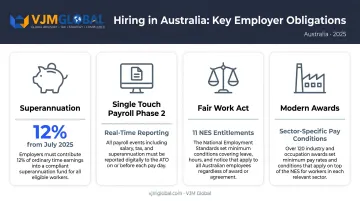
If you hire in Australia, these obligations apply immediately:
- Superannuation: Employer contributions at 12% from 1 July 2025
- Single Touch Payroll (STP) Phase 2: Real-time payroll reporting through ATO-compliant software
- Fair Work Act 2009: 12 minimum entitlements under the National Employment Standards
- Modern awards: Industry or occupation-specific minimum pay and conditions (distinct from the UK national minimum wage framework)
ASIC Ongoing Obligations
Recurring ASIC obligations include:
- Annual review filing and fee payment to ASIC
- Updating director and shareholder records within required timeframes
- Maintaining company registers (members, officers, charges)
- Reporting changes to registered office address or company constitution
Most compliance failures in foreign-owned companies occur 12 to 18 months after setup, when annual review deadlines are missed or director changes go unreported. Managing these across two time zones requires a reliable local process — not a calendar reminder.
Conclusion
Starting a business in Australia from the UK is genuinely achievable. Full foreign ownership is permitted, physical relocation is optional, and the registration process follows a clear sequence once you know the steps.
Where most UK founders run into trouble is the compliance layer that follows registration: the resident director obligation, the public officer appointment, dual tax treatment, banking onboarding, and the annual ASIC and ATO reporting cycle.
Get the foundation right — structure, registrations, correct sequencing — and ongoing compliance becomes routine. Gaps in setup, by contrast, tend to create disproportionate problems later: missed ASIC deadlines, unexpected ATO liabilities, or a director obligation that was never properly fulfilled.
Frequently Asked Questions
Can a UK citizen start a business in Australia?
Yes. UK citizens can fully own and operate an Australian company without any restriction on foreign ownership. The main requirements are appointing at least one Australian-resident director and obtaining an appropriate visa if you intend to be physically present in Australia.
How much does it cost to start a business in Australia from the UK?
Typical startup costs for a foreign-owned Pty Ltd range between AUD 1,500 and AUD 6,000+, covering the ASIC registration fee (AUD 611), annual review fee (AUD 329), ABN setup, registered office, and nominee director arrangements if needed. Ongoing compliance costs depend on your structure and advisory model.
Do I need to relocate to Australia to run my business from the UK?
No. UK nationals can own and manage an Australian company entirely from the UK. You must appoint a resident director and maintain a registered Australian office address, but neither requires you to live in Australia.
Do I need an Australian resident director if I'm based in the UK?
Yes. Every Proprietary Limited company in Australia must have at least one director who ordinarily resides in Australia. If you don't have a local partner, a formal nominee director arrangement through a professional services provider is the standard approach.
What is the difference between setting up a Pty Ltd and registering as a foreign company?
A Pty Ltd is a new, separate Australian legal entity, meaning the UK parent is not liable for its debts or obligations. A foreign company registration lets the UK parent operate directly in Australia without forming a new entity, but it carries full liability for Australian activities and faces heavier ongoing ASIC reporting requirements.
Is AUD 10,000 enough to set up and move to Australia?
AUD 10,000 can cover initial business registration and basic setup costs for a lean operation. It won't comfortably cover both business setup and personal relocation expenses — these budgets should be planned separately, as personal living costs in Australian cities are substantial.