We're seeing interest from three groups: UK SMEs expanding trade routes, freelancers and consultants chasing EU clients, and larger companies setting up EU subsidiaries now that London no longer guarantees passporting rights.
This guide walks through legal structures, registration steps, realistic costs, and the compliance obligations that follow once your Belgian entity is live.
TL;DR
- Belgium gives UK firms EU market access, strong logistics, and clear structure choices (SRL/BV, SA/NV, branch, subsidiary)
- Register via the Crossroads Bank for Enterprises (CBE), plus VAT and social security
- Post-Brexit, UK nationals are non-EU/EFTA, so self-employed activity generally requires a Professional Card
- Setup costs run from a few hundred to several thousand euros, by structure and support level
- Corporate tax, VAT, and payroll need ongoing local compliance support after launch
Why Belgium Is an Attractive Market for UK Businesses
Belgium calls itself the "crossroads of Europe" for good reason. It borders four major economies and puts UK exporters within a day's drive of over 500 million EU consumers.
Brussels also hosts the EU and NATO headquarters, which creates a dense concentration of institutional buyers, policy contacts, and B2B networking opportunities that smaller EU capitals simply don't offer.
Sectors performing well for foreign entrants include:
- Logistics and freight forwarding, thanks to the port of Antwerp
- Biotech and pharmaceuticals, concentrated around Wallonia and Flanders
- Financial services, drawn to Brussels' regulatory proximity
- IT and tech consulting
- Manufacturing, particularly precision engineering
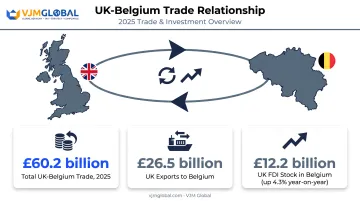
The commercial case isn't theoretical. UK-Belgium trade reached £60.2 billion in calendar 2025, including £26.5 billion in UK exports, according to the UK government's Belgium trade and investment factsheet.
UK outward FDI stock in Belgium stood at £12.2 billion at the end of 2024, up 4.3% year on year. Belgium is already an established market for UK firms, with real commercial depth.
What UK Entrepreneurs Should Know Before Starting a Business in Belgium
Since Brexit, UK nationals are treated as non-EU/EFTA nationals under Belgian law. This doesn't make starting a business impossible; it just adds steps that EU nationals skip entirely. Know these requirements up front so you can plan capital, visas, and launch timing with fewer surprises.
The Professional Card Requirement
A UK national planning self-employed activity in Belgium generally needs a Professional Card (beroepskaart in Flemish, carte professionnelle in French). Brussels-region guidance treats this card as mandatory for non-EU nationals exercising independent activity, and its validity is tied to your right of residence.
Anyone staying beyond 90 days also needs authorisation to stay longer, typically via a D visa. Fees vary by region: Brussels currently charges roughly €140 on application plus €90 on issue, and a complete file takes around three months to process.
Regional Differences Matter
Belgium's three regions — Flanders, Wallonia, and Brussels — operate in different languages and with different administrative habits:
- Flanders: Dutch-language administration, business-friendly reputation
- Wallonia: French-language administration
- Brussels: Bilingual, home to most EU/international institutions
This affects contracts, employment paperwork, and which local counter you'll deal with.
Set Realistic Timelines
CBE registration itself moves quickly. But Professional Card approval, bank account opening, and permit applications can stretch the full process out to several months. Plan around the slowest step, not the fastest.
Legal Structures and Early Decisions When Setting Up in Belgium
Most early setbacks for UK founders trace back to one thing: picking the wrong entity or underestimating what it actually takes to fund and run it.
Your main options:
| Structure | Minimum capital | Liability |
|---|---|---|
| Sole proprietorship | None | Unlimited personal liability |
| SRL/BV (private limited) | No statutory minimum | Limited to company assets |
| SA/NV (public limited) | €61,500 | Limited to company assets |
| Branch office | N/A | Extends UK parent's liability |
| Subsidiary | Depends on chosen form | Separate legal entity |
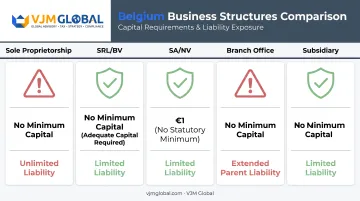
The SRL/BV is the go-to for most owner-managed businesses. Fednot, Belgium's notarial body, confirms there's no fixed capital floor. That doesn't mean zero funding works. A notary will still test whether your contribution is adequate for the planned activity before signing off.
Branch vs Subsidiary
A branch simply extends your UK company's liability into Belgium. If something goes wrong locally, the UK parent is on the hook. A subsidiary (typically an SRL/BV) is a separate legal entity, so liability stays contained within Belgium.
Decisions Founders Often Skip
- Real notary and publication costs — not just the headline registration fee
- Region and language choice — affecting which counter and which language your paperwork runs in
- Whether the Professional Card delays launch — this can push a "quick" registration out by months
Specialist entity-formation advisors such as VJM Global help UK companies weigh structure against liability exposure and manage documentation across both jurisdictions at once.
How to Start a Business in Belgium from the UK – Step by Step
Rushing incorporation without a financial plan is the single most common mistake we see. Here's the practical sequence.
Step 1 – Choose a Legal Structure and Check Eligibility
Decide between SRL/BV, SA/NV, branch, or subsidiary based on your liability appetite, available capital, and growth plans. At the same time, check whether you, as a UK national, will need a Professional Card for the activity you're planning.
Step 2 – Prepare Documentation and a Financial Plan
Gather the core filings before you book the notary:
- Articles of association
- Financial plan for the first two years
- ID and proof of address for every founder
A weak financial plan is a frequent gap. It can delay notarisation for SRL/BV entities significantly.
Step 3 – Set Up a Registered Office and Belgian Bank Account
Secure a registered business address and open a local business bank account. Banks apply strict KYC/AML checks for foreign-owned entities, and this step often takes longer than founders expect.
Step 4 – Register with the Crossroads Bank for Enterprises (CBE)
Register your company, obtain a company number (this doubles as your VAT and social security identifier), and select the correct NACE activity code. Get the code right: it drives which regulatory obligations apply to you.
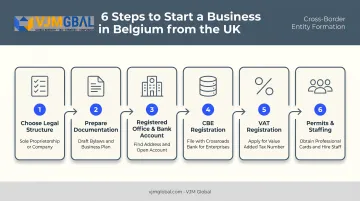
Step 5 – Register for VAT and Applicable Taxes
Complete VAT registration where taxable supplies apply, using your CBE enterprise number. Confirm your rate: 21% standard, 12% intermediate, or 6% reduced, depending on the goods or services you supply.
Step 6 – Handle Permits, Social Insurance, and Staffing
Close out the operating requirements that sit alongside incorporation:
- Apply for any sector-specific permits
- Join a social insurance fund if you are self-employed
- Register as an employer with the NSSO if you are hiring
Belgian employment rules do not mirror UK practice. Minimum wage, contract types, and notice periods differ substantially.
Costs, Taxes, and Ongoing Compliance for UK-Owned Businesses in Belgium
Setup Costs
- CBE registration: roughly €111.50 (indexed annually — confirm the live figure)
- VAT activation: charged by the accredited counter processing your application
- Notary fees for an SRL: fixed honorarium plus admin fee, typically several hundred euros before publication
- SA/NV incorporation: higher, given the €61,500 capital requirement and more complex filing
Get a written quote from your chosen notary before committing. Fee benchmarks age quickly.
Tax Rates You Need to Know
Belgium's standard corporate income tax rate is 25%. Qualifying SMEs can access a 20% rate on the first €100,000 of profit, subject to conditions. That rate is not automatic, so confirm eligibility before modelling it into your plan.
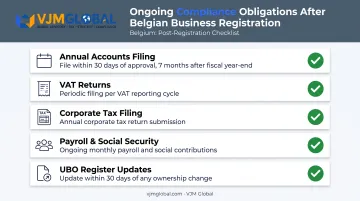
Ongoing Obligations
Once trading, expect:
- Annual accounts filing (within 30 days of approval, no later than seven months after year-end)
- Recurring VAT returns
- Corporate tax filing
- Payroll and social security contributions if you employ staff
- UBO register updates within 30 days of any change
Coordinating UK and Belgian Tax
Belgian filings are only half the picture; UK tax residence and treaty relief still need to line up.
The UK–Belgium double taxation convention limits source taxation and allocates business profits by permanent establishment. Dividend withholding is generally capped at 10%, with exemptions for qualifying shareholdings. Many UK founders underestimate the mapping required: where management sits, where staff work, and how contracts are structured all affect treaty relief.
VJM Global helps UK companies with that coordination—entity formation, tax compliance, and payroll across 100+ countries—so you are not juggling separate advisors in each jurisdiction who never speak to each other.
Conclusion
Starting a business in Belgium from the UK is straightforward on paper. The registration mechanics themselves — CBE, VAT, NACE codes — are well-documented and fast.
What trips people up is everything around the edges: post-Brexit permit rules, regional administrative quirks, and the financial plan a notary won't wave through if it's thin.
Get the legal structure and capital plan right before you file, and most of the delays disappear. An advisor who knows both UK and Belgian requirements, such as VJM Global, helps you launch once, correctly, rather than twice.
Frequently Asked Questions
How much does it cost to start a business in Belgium?
Expect roughly €111.50 for CBE registration, plus VAT activation fees, notary fees, and publication costs for limited companies. Total setup costs often run to several hundred euros before professional service fees.
What is the most profitable business in Belgium?
Logistics, biotech/pharma, financial services, and IT/tech consulting often perform well for foreign entrants. Profitability still depends on your niche, pricing, and local demand.
Do UK nationals need a permit to start a business in Belgium after Brexit?
Generally yes. UK nationals are now treated as non-EU/EFTA nationals and typically need a Professional Card for self-employed activity, plus a residence permit if relocating.
How long does it take to register a company in Belgium?
CBE registration itself is quick. But permits, bank account opening, and Professional Card approval can extend the full process to several weeks.
Can a UK company open a branch instead of a subsidiary in Belgium?
Yes. A branch extends the UK parent company's liability into Belgium, while a subsidiary limits liability to the Belgian entity itself.
Do I need a Belgian bank account to register my business?
Yes, particularly for capital deposit requirements in SA/NV companies. Foreign owners should expect thorough KYC/AML checks that can extend onboarding time.