Freelancers, Dutch companies scouting regional expansion, and remote-first founders relocating within the EU are all part of this shift. The draw is simple: short travel distance, no minimum capital requirement for a BV/SRL, and access to a larger EU footprint without leaving your comfort zone entirely.
This guide walks through what actually changes when you move a business idea from Dutch soil to Belgian paperwork, step by step.
TL;DR
- Dutch and EU/EEA nationals can start a Belgian sole proprietorship or BV/SRL without a permit
- Pick a structure, register with the KBO (Crossroads Bank for Enterprises), open a Belgian bank account, then handle VAT and social security
- Corporate tax is 25% (20% on the first €100,000 for qualifying SMEs); standard VAT is 21%
- Harder than registration: reconciling Dutch and Belgian tax residency, VAT, and payroll at the same time
What Is Starting a Small Business in Belgium as a Dutch Resident?
Starting a small business in Belgium as a Dutch resident means legally registering a business activity in Belgium while you remain based in the Netherlands, or keep strong operational ties there. It covers a few different scenarios:
- Relocating fully to Belgium and starting fresh
- Commuting or working remotely while operating a Belgian entity
- Extending an existing Dutch company into Belgium via a branch
Common formats include a sole proprietorship (eenmanszaak in Dutch, entreprise individuelle in French), a BV/SRL private limited company, or a Belgian branch of your existing Dutch business. Each carries different paperwork, liability exposure, and tax consequences.
What to Know Before You Start a Business in Belgium
Dutch founders often assume Belgium's process mirrors the Netherlands' KVK system. It doesn't. The Crossroads Bank for Enterprises (KBO) runs on its own rules, timelines, and documentation requirements.
Permits, Language, and Paperwork
- Professional Card: Only required for non-EU nationals. Dutch and other EEA citizens are exempt, according to FPS Economy's official guidance.
- Language rules: Flanders operates in Dutch, Wallonia in French, and Brussels accepts either. This affects contracts, statutory documents, and registration paperwork.
- Notary requirements: A sole proprietorship registers quickly through an accredited business counter. A BV/SRL needs a notarial deed before that counter can even process the KBO registration.
Tax Residency Questions
Where you're taxed depends on where your "centre of economic interests" sits, not just where you sleep at night. The Netherlands-Belgium double tax treaty, in force since 2002, uses tie-breaker rules (permanent home, economic ties, habitual residence) to settle dual-residency cases.
How Long Setup Usually Takes
Entity choice and paperwork drive the calendar as much as tax residency does. Sole proprietorship registration can wrap up within a week through an accredited counter. A BV/SRL needs a notary and financial plan first, so it usually takes longer before a bank account, VAT number, and social insurance fund membership are all in place.
Why Start a Business in Belgium From the Netherlands? (When It Makes Sense)
This isn't a blanket recommendation. It makes sense under specific conditions.
Belgium pulled in USD 23 billion in foreign direct investment in 2023, per UNCTAD's country profile, signalling a market that still draws outside capital.
Reasons it might work for you:
- Proximity: Rotterdam to Antwerp is under an hour by train; Amsterdam to Brussels is roughly two hours
- EU institutional access: Brussels hosts EU headquarters, useful if your business touches policy, lobbying, or EU-facing services
- Low capital barrier: BV/SRL has no fixed minimum capital, though you still need a credible financial plan
- Dual-market reach: Serve Dutch and Belgian clients from one EU base without duplicating your entire operation
None of this guarantees success. It just lowers the entry barrier compared to setting up further afield.
Early Decisions and Legal Setup That Matter
Most cross-border founders underestimate the overlap between Dutch and Belgian compliance, not the Belgian registration process on its own.
Areas that catch people out:
- True setup costs — notary fees for a BV/SRL, plus translation if documents must move between Dutch and French
- Branch vs. new entity — a Belgian branch of your Dutch company carries different liability and tax attribution than a new Belgian entity
- VAT registration triggers — selling goods or services across the NL–BE border can create VAT obligations sooner than expected
When these choices overlap, a firm experienced in multi-jurisdiction entity formation, such as VJM Global, can align your Belgian registration with existing Dutch obligations instead of treating the two as separate projects.
How to Start a Small Business in Belgium From the Netherlands – Step by Step
The process breaks into six practical stages. Common mistakes include assuming Dutch KVK processes transfer directly, delaying VAT registration until it is overdue, and underestimating notary costs for a BV/SRL.
Step 1 – Choose Your Legal Structure
| Structure | Liability | Notary Required | Best For |
|---|---|---|---|
| Sole proprietorship (eenmanszaak) | Unlimited personal liability | No | Freelancers, solo consultants |
| BV/SRL | Limited to company assets | Yes | Growing operations, multiple stakeholders |
| Belgian branch of Dutch company | Extends parent company liability | No, but registry filing needed | Existing Dutch companies testing Belgium |
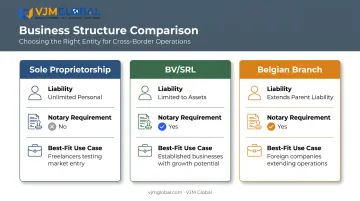
Consider your tax treatment carefully. A branch keeps profits taxed as part of your Dutch entity's activity attributable to the Belgian permanent establishment, while a standalone BV/SRL is a fully separate Belgian taxpayer.
Step 2 – Handle Residency, Tax, and Registration Basics
- Confirm your Professional Card status — not needed for Dutch/EU nationals
- Register with the KBO via an accredited business one-stop-shop (this is Belgium's equivalent of KVK, but not interchangeable with it)
- Determine tax residency under the NL-BE double tax treaty, based on permanent home and centre of economic interests
Step 3 – Open a Belgian Business Bank Account
You'll need a Belgian account, separate from any Dutch business account you already hold. Belgian banks typically require:
- Valid ID
- Your KBO enterprise number
- Proof of a registered Belgian office address
Skipping this step delays everything downstream, since your enterprise number and bank details feed into VAT registration.

Step 4 – Register for VAT and Social Security
Activate a Belgian VAT number if you're selling taxable goods or services in Belgium. The standard rate is 21%, with reduced rates of 12%, 6%, and 0% for specific categories, per FPS Finance.
Self-employed founders must also join a Belgian social insurance fund before starting activity, with companies given three months after formation to do the same.
Step 5 – Set Up Cross-Border Compliance and Accounting
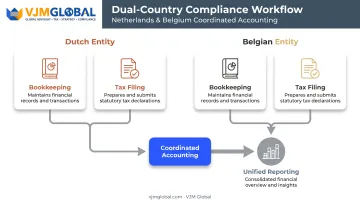
Your Belgian entity needs bookkeeping that satisfies Belgian standards while staying reconcilable with any Dutch entity records you maintain. This is where most founders get stuck. Two sets of statutory accounts, two tax authorities, one business.
Cross-border advisors such as VJM Global can run dual-country filings so you keep one coherent finance process instead of two disconnected stacks.
Step 6 – Launch and Build Local Credibility
Decide how you'll market to Belgian customers. Flemish clients expect Dutch-language communication; Walloon clients expect French. Brussels gives you flexibility, but don't assume one language covers the whole country.
Track your early performance for the first few months before expanding across Belgium's three regions. Stabilise one market segment first.
Conclusion
Starting a business in Belgium from the Netherlands is manageable, thanks to geographic proximity and EU freedoms that remove most legal barriers for Dutch citizens. Registration itself is straightforward. The real work is getting tax residency, VAT, and dual-country compliance right from day one.
Validate your structure and compliance requirements before you commit capital. Cross-border founders who treat this as a one-time setup task, rather than an ongoing dual-country obligation, tend to run into friction later. Plan for recurring filings, residency checks, and reporting on both sides—not a single setup sprint.
Frequently Asked Questions
Is €4,000 a good salary in Belgium?
Belgium's average gross monthly salary was €4,076 in 2022, according to Statbel. A €4,000 salary is near average and above minimum wage, though comfort still depends on region and household costs.
Do I need a permit to start a business in Belgium as a Dutch citizen?
No. EU/EEA nationals, including Dutch citizens, don't need a Professional Card or work permit to run a business or work self-employed in Belgium.
What is the minimum capital needed to start a business in Belgium?
A BV/SRL has no fixed minimum capital but requires a credible financial plan covering at least two years. An NV/SA requires €61,500 in minimum capital.
Can I run a Belgian business while living in the Netherlands?
Yes, but you'll need a registered Belgian address and clarity on which country holds your tax residency under the NL-BE treaty. This affects where profits get taxed.
How long does it take to register a business in Belgium?
You can register a sole proprietorship within days through an accredited business counter. BV/SRL incorporation needs a notary and financial plan, so it takes longer than a sole proprietorship.
Do I have to pay tax in both Belgium and the Netherlands?
Not on the same income twice. The NL-BE double tax treaty uses residency rules and exemption-with-progression methods to prevent double taxation, depending on where the income is generated and where you are resident.