Still, setting up a business in Brazil as a Canadian is genuinely complex. There's no Canada-Brazil free trade agreement in force, a new visa requirement took effect in April 2025, and Brazil's regulatory environment is notoriously layered. These aren't dealbreakers, but they do require preparation.
This guide covers exactly what Canadian entrepreneurs need to know: visa requirements, entity selection, the registration process step by step, and the tax obligations that will shape your planning before you sign anything.
Key Takeaways
- Canadians can legally own a business in Brazil — no nationality restrictions apply to most sectors
- As of April 10, 2025, Canadian citizens require a VIVIS visitor visa before entering Brazil for business
- The LTDA (Limited Liability Company) is the most practical structure for most foreign investors
- Registration takes 30–90 days across sequential approvals from multiple government authorities
- Brazil and Canada have a bilateral tax treaty (since 1985), though Brazil's tax burden ranks among the highest globally — get professional tax advice early
Why Brazil Is a Strategic Market for Canadian Entrepreneurs
Brazil is Latin America's largest economy, with a GDP of $2.28 trillion and a population of over 212 million people. The OECD identifies Brazil as the region's economic anchor — and for Canadian businesses, it's increasingly a strategic target rather than an afterthought.
The bilateral relationship has real depth. Canada-Mercosur FTA negotiations were relaunched in October 2025, with public consultations running into early 2026. A concluded agreement would meaningfully reduce trade barriers — but Canadian companies aren't waiting. Many are already establishing a foothold.
Where the Opportunity Is
The Canadian Trade Commissioner Service has identified several sectors where Canadian companies hold a genuine competitive edge in Brazil:
- Clean technologies — Brazil's energy transition is creating demand Canadian firms are positioned to serve
- Agriculture and agri-tech — Brazil is a global food producer; precision agriculture tools have strong uptake
- Infrastructure — ongoing investment in roads, ports, and urban systems
- ICT and digital technologies — a growing digital economy with a large urban consumer base
- Mining services — complementary expertise between two major resource economies
- Aerospace — a sector where Canadian firms already have Brazilian relationships
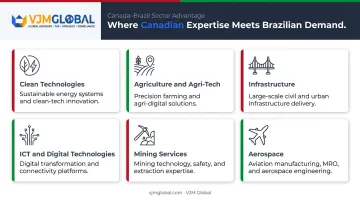
The common thread across these sectors: Brazilian demand and Canadian capability overlap in ways that create durable commercial opportunities, not one-off export deals.
What Canadians Should Know Before Setting Up in Brazil
Before diving into entity structures and registration steps, five realities shape every Canadian's Brazil entry experience. Understanding them upfront prevents costly surprises.
The "Brazil Cost" Is Real
Brazilians have a term for it: Custo Brasil — the cumulative overhead of operating in one of the world's most complex regulatory environments. Brazil's Ministry of Development (MDIC) tracks this formally across eight axes, including infrastructure, tax system complexity, access to capital, and bureaucratic friction.
According to World Bank Doing Business 2020 data, Brazil ranked 184 out of 190 countries on the Paying Taxes indicator, with businesses spending an average of 1,501 hours per year on tax compliance. Price this into your planning from day one. It requires local expertise, not avoidance.
Restricted Sectors for Foreign Investors
Foreign ownership is permitted in most industries, but certain sectors carry restrictions under Brazilian law:
- Media and broadcasting — at least 70% of total and voting capital must belong to native Brazilians or naturalized citizens of more than 10 years
- Rural land — foreign-owned rural land cannot exceed 25% of a given municipality
- Nuclear activities — a Union monopoly; material transfer requires specific government authorization
- Financial services and energy — additional licensing from sector regulators (the Central Bank or ANEEL) is required before operations begin
Always verify current sector rules with a local legal advisor before selecting your entity structure.
Language, Documentation, and Business Culture
Under Brazil's Civil Code (Article 224), documents written in a foreign language have no legal effect unless translated into Portuguese. Every contract, filing, and government submission must be in Portuguese, and certified translation of foreign documents is mandatory.
Cultural preparation matters just as much. Brazilian business culture places significant weight on personal relationships and trust before deals close. Canadians accustomed to direct, transactional deal-making often underestimate how much time relationship-building takes, and how much it shapes outcomes.
The Resident Legal Representative Requirement
Brazilian law requires at least one company director or legal representative to be a Brazilian resident (not simply a citizen). This person signs official documents, interfaces with government authorities, and carries compliance responsibility on behalf of the company.
Foreign founders must formally delegate authority to this representative through a notarized power of attorney. This has both practical and legal implications — choosing the right person is not a formality.
Timeline and Cost Expectations
| Factor | Estimate |
|---|---|
| Registration timeline | 30 to 90 days (longer with foreign parties) |
| Legal and translation costs | BRL 5,000 to BRL 20,000+ (Brazilian Reais) depending on scope |
| Bank account opening | Additional time after CNPJ issuance |
Working with a local Brazilian legal advisor or an international firm with verified Brazil experience helps avoid the compliance missteps that routinely extend timelines when foreign founders navigate this process alone.
Choosing the Right Business Structure in Brazil
Two structures cover the vast majority of foreign investor scenarios. A third option (the Branch of a Foreign Company) technically exists but requires Executive Branch approval and is rarely used by new entrants.
LTDA (Sociedade Limitada)
The LTDA is the default choice for most foreign investors entering Brazil. Under Brazil's Civil Code (Article 1,052), it can be formed by one or more persons, with capital divided into quotas. Key characteristics:
- No statutory minimum capital requirement
- Personal liability protection for shareholders
- Simpler and faster to establish than an SA
- Requires at least one Brazilian-resident manager or administrator
Norton Rose Fulbright's 2024 Brazil guide confirms that foreign shareholders in an LTDA generally appoint a Brazil-resident attorney to fulfill the administrative residency requirement.
SA (Sociedade Anônima)
The SA is better suited to larger businesses that anticipate seeking external capital, taking on institutional investors, or working toward a public listing. Under Law 6,404/1976, incorporation requires at least two subscribers. It carries stricter governance requirements: a mandatory board of directors, defined executive board structures, and more complex compliance obligations.
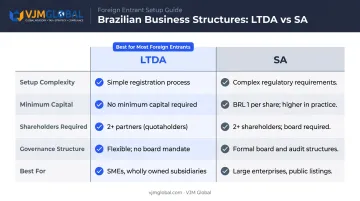
LTDA vs. SA at a Glance
| Dimension | LTDA | SA |
|---|---|---|
| Setup complexity | Lower | Higher |
| Minimum capital | None (statutory) | None (privately held) |
| Shareholders required | 1 or more | 2 or more |
| Governance | Simpler | Board-required |
| Best for | Most private foreign entrants | Capital-raising or larger businesses |
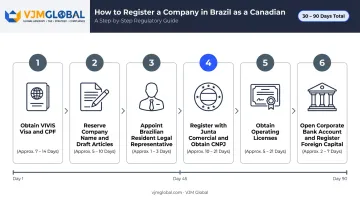
How to Register Your Business in Brazil as a Canadian: Step by Step
Brazilian company registration moves sequentially through federal, state, and municipal authorities. Skipping or rushing any step causes delays, sometimes by weeks.
Step 1 – Obtain Your VIVIS Visa and CPF
Since April 10, 2025, Canadian citizens must obtain a VIVIS (visitor visa) before entering Brazil for business purposes. The e-Visa route is available for Canadian passport holders. Core documents include:
- Valid signed passport with at least two blank pages
- Completed visa application form and passport-style photo
- Proof of financial means and round-trip travel evidence
Separately, every foreign individual investing in or directing a Brazilian company must obtain a CPF (Cadastro de Pessoas Físicas — Brazil's individual taxpayer number). Canadians resident abroad apply in person at a Brazilian consular post, presenting a passport and the FCPF form.
Step 2 – Reserve Your Company Name and Draft Articles of Incorporation
The company name must reflect the business activity and comply with Brazilian naming conventions. The reservation is filed with the state-level Commercial Registry (Junta Comercial).
The Articles of Incorporation — Contrato Social for an LTDA, Estatuto Social for an SA — must be drafted in Portuguese and signed by all shareholders. These documents define the company's purpose, share structure, and governance arrangements.
Step 3 – Appoint a Brazilian Resident Legal Representative
Brazilian law requires every foreign-owned company to designate a resident legal representative. Your chosen representative will:
- Sign all official documents on behalf of the company
- Interact with government authorities
- Bear compliance responsibility within Brazil
Foreign shareholders formally delegate authority through a notarized power of attorney, which must be translated into Portuguese and authenticated. The scope of authority granted — and any limitations on it — should be carefully drafted with legal counsel.
Step 4 – Register with the Junta Comercial and Obtain Your CNPJ
The founding documents are submitted to the state Board of Trade (Junta Comercial) for review. Once approved, the company receives its CNPJ (Cadastro Nacional da Pessoa Jurídica) — Brazil's federal business tax ID number.
The CNPJ is required for:
- Entering into contracts
- Hiring employees
- Issuing invoices
- Opening a corporate bank account
CNPJ registration also triggers enrollment with state and municipal tax authorities.
Step 5 – Obtain Operating Licenses and Sector-Specific Approvals
After CNPJ issuance, the company must obtain a municipal operating permit (Alvará de Funcionamento). Depending on the business type, additional requirements may include:
- Health permits (for food, medical, or pharmaceutical operations)
- Environmental licenses
- Fire department clearances
- Sector-specific regulatory approvals (Central Bank for financial services, ANEEL for energy)
Requirements vary significantly by municipality. Confirm the full list with local authorities or your legal representative before proceeding.
Step 6 – Open a Corporate Bank Account and Register Foreign Capital
A Brazilian corporate bank account is required before operations begin. Banks typically require:
- CNPJ certificate
- Company registration documents
- Identity documents for all directors
Foreign capital invested into the Brazilian company must be formally registered with the Brazilian Central Bank (Banco Central do Brasil) through the SCE-IED system. This step establishes the legal basis for repatriating profits and dividends back to Canada. Skipping it complicates future profit repatriation and can trigger additional withholding obligations.
Tax and Compliance Obligations for Canadian Business Owners in Brazil
Brazil's Corporate Tax Structure
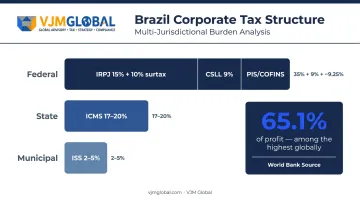
Brazil's tax system layers multiple obligations across federal, state, and municipal levels:
| Tax | Rate |
|---|---|
| IRPJ (Corporate Income Tax) | 15%, plus 10% surtax on profits above BRL 240,000/year |
| CSLL (Social Contribution on Net Income) | 9% |
| Combined standard rate | ~34% |
| PIS/COFINS (federal indirect taxes) | 0.65%/3% (cumulative) or 1.65%/7.6% (non-cumulative) |
| ICMS (state VAT) | ~17%–20% depending on state and product |
| ISS (municipal services tax) | 2%–5% |
The total tax and contribution rate was measured at 65.1% of profit in World Bank benchmarking — among the highest globally. Professional tax planning before you incorporate — not after — is the only way to avoid costly structural mistakes.
The Canada-Brazil Tax Treaty
Unlike the outline's original framing, Canada and Brazil do have a bilateral tax convention — signed in 1984 and in force as CTS 1985 No. 11. This treaty allocates taxing rights between the two countries on income categories including dividends, interest, royalties, and capital gains.
A treaty, though, doesn't eliminate complexity. Brazilian withholding taxes interact with Canadian foreign tax credit rules in ways that require jurisdiction-specific structuring — the treaty's provisions won't automatically produce the optimal tax outcome. Engage an advisor with hands-on experience in both systems before committing to an entity structure.
Brazil's Ongoing Tax Reform
Brazil is mid-way through one of its most significant tax overhauls in decades. The reform replaces PIS, COFINS, IPI, ICMS, and ISS with a dual VAT model:
- CBS (federal level) and IBS (state and municipal level)
- 2026: Test rates — 0.9% CBS and 0.1% IBS
- 2027: CBS enters full operation
- 2029–2032: ICMS and ISS phase out progressively
- 2033: Full implementation
For Canadian businesses entering Brazil now, this means your invoicing systems, import cost calculations, and compliance procedures will need to adapt across multiple transition phases through 2033. Build that timeline into your accounting infrastructure from the start — retrofitting it later is significantly more disruptive than anticipating it upfront.
Frequently Asked Questions
Can a foreigner start a business in Brazil?
Yes. Foreigners — including Canadians — can legally establish and own a company in Brazil, with no general nationality restrictions on business ownership. Certain restricted sectors exist (media, rural land, nuclear activities), and at least one Brazilian-resident legal representative is required regardless of ownership structure.
Is there a tax treaty between Brazil and Canada?
Yes. Canada and Brazil have a bilateral tax convention signed in 1984, in force since 1985. It covers key income categories including dividends, interest, and royalties. Treaty benefits don't apply automatically, though — proper structuring is required to maximize their effect, so cross-border tax advice from professionals with expertise in both jurisdictions is advisable.
What visa do Canadian citizens need to do business in Brazil?
Since April 10, 2025, Canadian citizens must obtain a VIVIS (visitor visa) before entering Brazil. The e-Visa route is available. Required documents include a valid passport with at least two blank pages, a completed application form, a passport-style photo, and proof of financial means and travel.
How long does it take to register a company in Brazil?
The process typically takes 30 to 90 days from document submission to receiving the CNPJ — cases involving foreign parties often run longer. Opening a corporate bank account adds further time after the CNPJ is issued.
What is the most common business structure for foreign investors in Brazil?
The LTDA (Sociedade Limitada) is by far the most common choice. It requires no minimum capital, offers personal liability protection, and is simpler to establish and maintain than the SA. Larger businesses anticipating external investment or public market participation typically choose the SA structure instead.
Do I need to be a resident of Brazil to own a company there?
No. Foreign nationals can own a Brazilian company without being residents. However, they must appoint at least one Brazilian resident as a legal representative or director. All foreign shareholders also need a CPF (individual taxpayer number), which can be obtained at a Brazilian consular post abroad.