Proximity to APAC supply chains helps too. So does Cambodia's heavily dollarised economy, which reduces AUD/KHR currency exposure for Australian founders, and the absence of restrictions on repatriating capital once profits are made.
The interest is coming from a mix of players: Australian SMEs testing export or import channels, sole traders scaling a niche product line, and investors chasing opportunities in manufacturing, tourism, and agribusiness. This guide walks through what actually happens when you register a business in Cambodia from Australia, including the compliance obligations that follow you home.
TL;DR
- Cambodia permits 100% foreign ownership in most sectors, no local partner required
- Register via the Online Business Registration (OBR) portal with Commerce, Tax, and Labour
- Australian tax residency and Controlled Foreign Company (CFC) rules still apply to your Cambodian entity
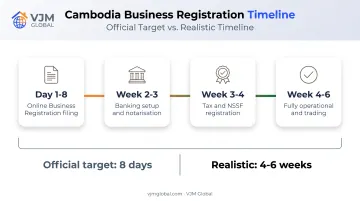
- Official target is 8 working days; plan on 2–4 weeks once banking and licensing are included
- Cross-border advisors help you keep Australian and Cambodian compliance aligned from day one
What Does It Mean to Start a Business in Cambodia from Australia?
In simple terms, it means incorporating and operating a legal entity in Cambodia while remaining an Australian tax resident, or while your existing Australian company owns and controls that entity.
Two approaches sit behind that definition:
- Physically relocating: you move to Cambodia, run day-to-day operations on the ground, and possibly change your own tax residency
- Directing remotely: you stay in Australia, hire local staff or a registered agent, and manage the Cambodian entity from a distance
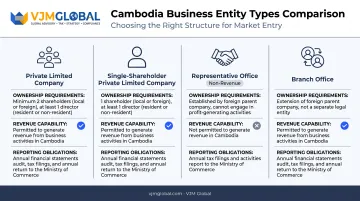
Most Australian founders use one of these structures:
- Private limited company (most common, allows multiple shareholders)
- Single-shareholder private limited company
- Representative office (non-revenue generating, for market research or liaison only)
- Branch of an existing Australian company
Choosing the wrong structure early creates problems later—especially if you open a representative office and then try to generate revenue through it.
What to Know Before You Start a Business in Cambodia from Australia
Many Australian founders underestimate how much coordination two jurisdictions actually demand. Before you commit time and money, set realistic expectations on presence, tax residency, language, and timelines.
Presence and Timing
You don't need to live in Cambodia to register a company, but certain steps benefit from in-country presence:
- Opening a corporate bank account often requires signatories to appear in person, depending on the bank
- Notarising and legalising Australian-issued documents takes longer when coordinated remotely
- Time zone gaps (Cambodia is 3-4 hours behind AEST depending on daylight saving) can slow down back-and-forth with authorities and staff
Tax Residency Complications
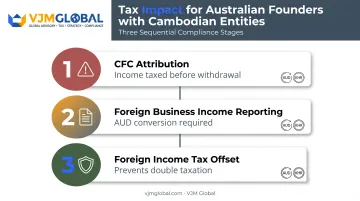
Incorporating in Cambodia doesn't remove your Australian tax obligations. If you're an Australian tax resident, Australia's Controlled Foreign Company (CFC) rules can attribute a share of the Cambodian entity's income back to you for Australian tax purposes, even before any dividend is paid out.
The ATO's CFC guidance confirms this applies to Australian residents with a substantial interest in a controlled foreign company. It doesn't specify a fixed control percentage, so assess this against your specific shareholding structure.
Language and Documentation Gaps
Cambodian filings are conducted in Khmer, with English translations required for company names and Articles of Incorporation. Documents issued in Australia (passports, proof of address, director identification) typically need notarisation and legalisation before Cambodian authorities will accept them.
Realistic timeline check: Incorporation itself can move fast, but banking, tax registration, and NSSF setup routinely push the full process to 4-6 weeks before you're actually trading.
Why Australians Are Choosing Cambodia for Business Expansion
Cambodia makes sense under certain conditions, not as a universal win for every Australian investor. Here's what's drawing attention:
- 100% foreign ownership in most sectors: no local partner needed, though rice milling, gemstone processing, and film production still carry restrictions
- Competitive labour costs compared with Australia and several regional peers
- Tax holidays for Qualified Investment Projects (QIPs) in manufacturing, agribusiness, and tourism
- USD-based economy: deposits have run above 90% US dollar-denominated for two decades, which reduces AUD/KHR exposure for founders who bill or hold funds in USD The Council for the Development of Cambodia sets QIP income-tax exemptions at 3, 6, or 9 years by project type, then a stepped rate schedule. Those terms only apply after approval. Incentives are only half the picture; market-size claims need the same scrutiny. A 2019 IFC/World Bank study using 2014 census figures found SMEs were just over 2% of Cambodia's 513,759 enterprises and 13% of employment. That is not a current GDP share, so treat headline "SMEs contribute X% of GDP" lines with caution. QIP incentives and ownership flexibility are real, but only for approved, eligible projects. Ordinary trading companies should model the standard 20% corporate tax rate as the base case, not the incentivised rate.
Early Decisions Australians Must Get Right Before Registering
Most problems Australian founders hit in Cambodia trace back to underestimating cross-border compliance, not lack of effort on the ground.
Direct Entity vs Employer of Record
If you're not ready to commit to a full Cambodian entity, an Employer of Record (EOR) lets you hire staff and test the market without incorporating. That buys time to validate demand before you spend on registration.
When you do incorporate, match the vehicle to your plans. A private limited company with two or more shareholders and a single-member private limited company have different governance and reporting requirements. Choose based on how many people are involved and how you intend to raise capital later.
Setup Costs and Australian Tax Impact
Budget beyond the headline registration fee for:
- Registered agent and registered office fees (mandatory under Cambodian law)
- Company seal creation
- Notarisation and translation of Australian documents
- Professional service fees that vary by entity structure and scope
Every dollar of income your Cambodian entity earns can create an Australian tax consequence:
- CFC attribution may apply before you've taken a cent out of the business
- Foreign business income must be reported on your Australian return, converted to AUD
- A foreign income tax offset may prevent double taxation where foreign tax has been paid and matched to income reported in Australia
Banking and Repatriation Timing
Cambodia has no general restriction on repatriating profits through authorised banks, though transfers of USD 10,000 or more get reported to the National Bank of Cambodia. Build that reporting step into your cash flow planning rather than treating it as a surprise.
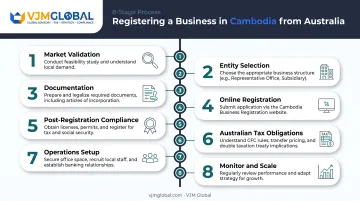
How to Start a Business in Cambodia from Australia – Step by Step
The process breaks into practical stages, whether you run things remotely from Australia or spend time on the ground in Phnom Penh.
Common mistakes to avoid from the outset:
- Assuming Australian company documents transfer automatically without legalisation
- Skipping local legal review of Khmer-language filings
- Underestimating how much compliance continues after the certificate arrives
Step 1 – Validate the Cambodian Market Opportunity from Australia
Research demand using Cambodian trade data and sector reports before committing capital. Decide early whether Cambodia is your end market or a springboard into the broader Southeast Asian region.
Common miss: assuming an Australian business model transfers directly. Local pricing, distribution, and consumer behaviour often require real localisation.
Step 2 – Choose Your Business Structure and Entity Type
Compare private limited company, single-member LLC, representative office, and branch options against your operating model: remote from Australia, or hands-on in-country.
Common miss: registering a representative office when the actual intent is revenue-generating trade. Representative offices cannot legally invoice or generate sales.
Step 3 – Prepare Documentation and Appoint a Registered Agent
- Appoint a Cambodia-resident registered agent, a legal requirement for maintaining a registered office
- Draft Articles of Incorporation in both English and Khmer
- Gather and notarise Australian passport, identification, and proof-of-address documents
Common miss: submitting Australian documents without the legalisation Cambodian authorities require, which causes rejected applications and lost weeks.
Step 4 – Register via the Online Business Registration Portal
- Reserve your company name in Khmer (with an English translation) via the government portal built on CamDX
- Submit one application that reaches the Ministry of Commerce, General Department of Taxation, and Ministry of Labour simultaneously
- Expect 8 working days for complete applications; incomplete filings or specialised licences often stretch this to 2-3 weeks
Common miss: incomplete or incorrect SIC (industry classification) code selection, which delays approval at the first checkpoint.
Step 5 – Complete Post-Registration Compliance
- Create and register an official company seal
- Register with the General Department of Taxation and the National Social Security Fund (NSSF)
- Upload company bank account details within 15 working days after tax approval
Common miss: missing the 15-working-day bank details deadline, which risks complications with your tax certificate status.
Step 6 – Manage Australian-Side Tax and Reporting Obligations
This is where founders most often lose track of parallel obligations. A Cambodian entity you own or control can trigger CFC attribution in Australia, so a share of its income may be taxable to you before any distribution. You also need to check whether the entity is a reportable foreign business interest on your Australian return, and whether an International Dealings Schedule applies.
Firms like VJM Global handle this dual-jurisdiction work for Australian founders: entity formation abroad paired with Australian tax returns, GST and BAS compliance, and year-end reporting so both sides stay aligned.
Step 7 – Set Up Operations, Staffing, and Local Banking
Decide between hiring locally, using a Cambodia-based Employer of Record, or running the operation remotely with minimal local headcount.
If you do hire in Cambodia, register with the Ministry of Labour and set up NSSF contributions. Note that the old "8 employees or more" threshold is outdated. Current rules require NSSF registration from your very first employee, generally within 30 days of starting operations.
Common miss: assuming labour compliance only kicks in once headcount reaches a certain size. It doesn't anymore.
Step 8 – Monitor, Repatriate Profits, and Scale
Track compliance deadlines across both the Cambodian and Australian financial years. They don't align, and missing one because you were focused on the other is a common trap.
Cambodia places no general restriction on repatriating profits through authorised banks, though larger transfers get reported to the National Bank of Cambodia. Confirm your remittance process well before you need to move money.
Common miss: scaling headcount or revenue before you've built a stable reporting system spanning both jurisdictions. Growth without compliance infrastructure creates a backlog that's expensive to unwind.
Conclusion
Starting a business in Cambodia from Australia is achievable. Open foreign ownership rules and a streamlined registration portal lower the entry barrier. Success still depends on managing compliance on both sides of the border, not only on clearing Cambodian registration.
Validation, the right entity choice, and early coordination with advisors who understand both markets matter more than how fast you incorporate. Long-term success comes from keeping that compliance consistent as the business grows.
Firms with dual-market expertise, such as VJM Global, can support Australian founders through both the Cambodian entity setup process and the Australian reporting requirements that follow it home.
Frequently Asked Questions
How much does it cost to start a business in Cambodia?
Costs include government registration fees (which vary by entity type and activity), registered agent and office fees, notarisation and translation of documents, and professional service fees. There's no fixed total. Get a written quote based on your specific structure.
How do I start a business in Cambodia as a foreigner?
Choose the right entity type, then register through the government's Online Business Registration portal, which coordinates with the Ministry of Commerce, the tax authority, and the Ministry of Labour. Post-registration steps like tax and NSSF registration follow before you can trade.
Which business is most profitable in Cambodia?
Manufacturing, tourism, agribusiness, and consumer retail are currently attracting the strongest foreign investment, particularly manufacturing and agribusiness projects that qualify for Qualified Investment Project tax incentives.
Can I get a 10-year golden visa for Cambodia?
Cambodia has investment-linked residency options, but verified details on minimum investment amounts and eligibility criteria from official government sources are limited. Treat marketing claims from private visa providers with caution and confirm directly with Cambodian authorities.
Do foreigners pay tax in Cambodia?
Yes. The standard corporate tax rate for legal persons is 20%, rising to 30% for specified oil, gas, and natural resource activities, subject to any approved investment incentives. Australian tax residents must also report this income at home, where CFC and foreign income tax offset rules may apply.
Do I need to be physically present in Cambodia to register a company?
Not for every step. Much of the registration can be handled remotely with a registered agent. However, opening a corporate bank account and certain document notarisations often require in-country presence or an appointed local representative.