Introduction
US entrepreneurs are increasingly looking at Cambodia as a low-cost gateway into Southeast Asia. Cheap labor, ASEAN market access, and a straightforward company structure make it attractive on paper.
But many US business owners walk in assuming Cambodia's private limited company works like a US LLC or corporation. It doesn't work the same way. Confusion around foreign registration steps, local address requirements, and tax registration timelines trips up first-time applicants constantly.
Cambodia's exports to the United States hit $12.7 billion in 2024, up 9.3% from the prior year, according to the US State Department's 2025 Investment Climate Statement. That trade relationship is exactly why more US companies want a local entity instead of running everything through a distributor.
This guide breaks down the structure, costs, registration steps, and compliance obligations you'll face — and where a cross-border advisory partner like VJM Global can help you avoid the common filing and compliance mistakes.
Key Takeaways
- Cambodia permits 100% foreign ownership—no local co-owner required
- Minimum capital: about KHR 4 million (~USD 1,000); 1–30 shareholders allowed
- Registration takes 2–4 weeks once documents and a registered office are ready
- Post-incorporation: monthly tax filings, an annual declaration, and possible NSSF registration
- US businesses not ready to incorporate should consider an Employer of Record first
What Is a Private Limited Company in Cambodia?
A private limited company is Cambodia's most widely used limited liability entity, established under the Law on Commercial Enterprises. It's the default choice for foreign investors building an operating subsidiary rather than a mere sales presence.
Core features:
- 2 to 30 shareholders, with liability capped at their subscribed shares
- One or more directors, any nationality accepted; no Cambodian national is required on the board
- A separate legal identity from any parent company, including a US parent
- Private share transfers only; no public offering
For US founders operating solo, or a US parent company wanting a wholly-owned Cambodian arm, there's a Single Member Limited Company variant. It works the same way but allows a single shareholder, so you don't need a local partner or co-founder only to meet a headcount rule.
Private Limited Company vs. Other Cambodia Entity Types
Not every US business needs a full subsidiary. Here's how the private limited company stacks up against the alternatives:
| Entity Type | Separate Legal Identity | Can Trade/Invoice Locally | Parent Company Liability |
|---|---|---|---|
| Private Limited Company (Co., Ltd.) | Yes | Yes | Limited to share subscription |
| Representative Office | No | No (cannot sell, manufacture, or invoice) | Parent remains fully liable |
| Branch | No | Yes | Parent remains fully liable |
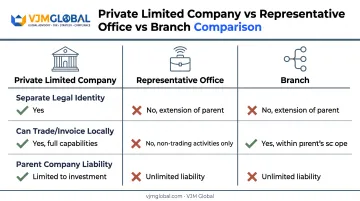
If your goal is liability protection and the ability to actually transact in Cambodia, a private limited company is generally the right call. A representative office only works for market research or liaison functions — it can't sign sales contracts.
Why US Businesses Are Choosing Cambodia for Expansion
Three factors keep coming up in conversations with US clients eyeing Cambodia:
- Full foreign ownership. Most sectors allow 100% foreign shareholding; the main exception is land, which foreigners lease rather than hold title to.
- Trade positioning. ASEAN and WTO membership give Cambodia-based companies preferential access that a purely US-based exporter doesn't get.
- Cost structure. Labor costs remain significantly below regional peers like Vietnam or Thailand.
Beyond the ownership rules, a Cambodia PLC gives you something a branch office never does: a legal wall between your US parent and local liabilities. If a Cambodia-based contract goes sideways, exposure generally stays with the Cambodian entity, not the US business.
The investment numbers back up the interest. Cambodia recorded $2.7 billion in FDI inflows in 2023 (measured in fixed assets), with US FDI stock reaching $1.4 billion by year-end, per the State Department's investment climate reporting.
Requirements and Documents for US Businesses Setting Up a PLC
Before you file anything, line up these requirements:
Company name. Must include "Private Limited Company" or "Ltd," and must be registered in both Khmer and English. On signage and documents, the Khmer name must appear larger than any other language version.
Directors and shareholders.
- Minimum one director, any nationality
- 2–30 shareholders (or one, under the single-member variant)
- No residency requirement for either
Registered office. This is where most US applicants get stuck. Cambodia requires a physical local address and a registered agent based in the country. If you don't have boots on the ground, you'll need to arrange this through a local partner or registered agent service before filing.
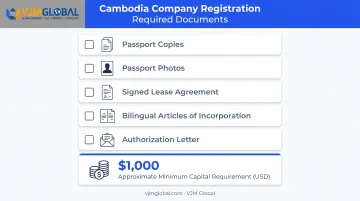
Document Checklist
Have these ready before submission:
- Passport copies for all directors and shareholders
- Recent passport-style photographs
- Signed lease agreement for the registered office
- Articles of Incorporation, drafted in both English and Khmer
- Authorization letter, if someone other than a director is filing on your behalf
Capital requirement. The statutory floor is 1,000 shares at a KHR 4,000 minimum par value, which works out to roughly USD 1,000 at current exchange rates.
Filing at the bare minimum is legal, but most advisors recommend a higher figure for banking and operational credibility. A bank manager takes a $50,000 capitalized company more seriously than a $1,000 one.
Step-by-Step Registration Process for US Businesses
Cambodia has consolidated its registration process into a single online system that routes data between the Ministry of Commerce (MOC), the General Department of Taxation (GDT), and the Ministry of Labour, using the CamDX data exchange.
- Reserve your company name through the online registration portal, submitting both Khmer and English versions for approval
- Submit your incorporation application, including SIC business activity codes, your lease agreement, and identity documents for all shareholders and directors
- Receive approvals from MOC, GDT, the Ministry of Labour, and, where applicable, the National Social Security Fund (NSSF)
- Open a corporate bank account and finalize tax registration
The official target for the integrated system is 8 working days, provided your documents are complete and correct on the first submission. Cambodia's Registration Services portal confirms this timeline explicitly.
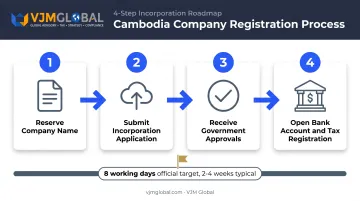
Most advisory firms still plan for 2–4 weeks once you factor in document corrections and sector-specific approvals.
For US applicants coordinating across a 12-hour time difference, that timeline often stretches further. Several steps, particularly tax registration meetings, require in-person presence in Cambodia.
This is where a local partner earns their fee: they can attend GDT meetings, catch document errors before submission, and keep the process moving while you sleep.
VJM Global's cross-border formation specialists work with US businesses navigating unfamiliar regulators like this, helping structure the paperwork and coordinate with local partners so the process doesn't stall on document mismatches or missed windows.
Costs and Post-Registration Compliance Obligations
What You'll Pay Upfront
- Minimum capital: around $1,000 (KHR 4 million), though higher is advisable
- Government registration fees: vary by activity and licenses; confirm current totals at filing (no fixed public schedule)
- Tax registration fees: bundled into the integrated registration process
- Professional or agent fees: for document prep, translation, and registered office arrangement
Ongoing Compliance Calendar
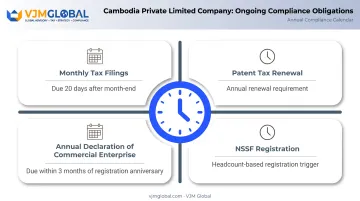
Once registered, you must handle:
- Monthly tax filings: due within 20 days after month-end (CIT prepayment, withholding, and salary tax as applicable)
- Patent tax renewal: annual registration tax based on turnover and business category
- Annual Declaration of Commercial Enterprise (ADCE): confirms office, directors, and shareholders; generally due within three months of your registration anniversary
- NSSF registration: required above a set employee headcount; confirm the current threshold with NSSF before hiring
If you are not ready to incorporate, an Employer of Record (EOR) lets you hire in Cambodia without a local entity. That path works well while you test the market. VJM Global supports EOR hiring across a wide international network for this kind of staged entry.
Frequently Asked Questions
How much does it cost to open a company in Cambodia?
Budget at least $1,000 in minimum capital, plus government registration and tax fees that vary by business activity. Add professional service fees if you're using a local agent, which most US applicants need for the registered office requirement.
What is the equivalent of a private limited company in the USA?
A Cambodia private limited company is comparable to a US LLC or C-corp: both offer limited liability and separate legal identity. The key difference is Cambodia's shareholder cap of 30, and the mandatory local registered office.
How do I check if a company is registered in Cambodia?
Use the Ministry of Commerce's online Search Entity portal. Search by entity name or registration number, filter by register type, and export results as a PDF or spreadsheet.
How many types of companies are there in Cambodia?
Cambodia recognizes sole proprietorships, partnerships, private limited companies, and public limited companies, plus foreign-business options like representative offices, branches, and subsidiaries.
Can a US business own 100% of a Cambodia private limited company?
Yes. There's no local shareholder requirement in most sectors. The main exception is land ownership, which is restricted to Cambodian nationals. Foreign companies typically lease instead.
Do I need to travel to Cambodia to incorporate?
Not necessarily for every step, but some parts of tax registration require in-person presence. Most US businesses use a local registered agent or advisory firm to handle these steps rather than flying out themselves.