Common challenges Malaysian founders raise: unclear permit timelines, confusion over which Danish entity to pick, and worry about double taxation between Kuala Lumpur and Copenhagen.
Denmark's fully digital company registration system and stable legal environment make it an attractive entry point, but the process looks different for a Malaysian national than for an EU citizen. This guide walks through entity choice, permits, registration, tax, and compliance from a Malaysian founder's perspective.
TL;DR
- Pick ApS, A/S, a branch, or a sole proprietorship—capital and liability rules differ by type
- Non-EU Malaysians need a residence/work permit and MitID before online registration
- Register on Virk.dk with the Danish Business Authority to get a CVR number
- Plan for 25% VAT, 22% corporate tax, annual reporting, and payroll compliance
- Budget local help for banking, entity setup, and Malaysia–Denmark tax filings
What Is Involved in Starting a Business in Denmark from Malaysia?
Starting a business in Denmark from Malaysia means setting up a legally recognised Danish entity, or branch, that a Malaysian individual or company can own and operate under Danish and EU/EEA rules.
This covers three distinct scenarios:
- A Malaysian individual relocating (or planning to) to found a standalone Danish company (ApS or A/S)
- An existing Malaysian company opening a branch in Denmark rather than a new legal entity
- Remote cross-border trading into Denmark without establishing a Danish entity at all
Each path carries different permit, tax, and reporting consequences. Choosing correctly at the outset saves months of rework later.
What to Know Before You Start (Malaysia-Specific Considerations)
Many Malaysian founders assume registration works the same way it does for EU citizens. It doesn't. The permit and digital ID steps are the parts most often underestimated.
Sort these Malaysia-specific constraints before you pick an entity or file anything:
- Residency status: Malaysians are non-EU/EEA nationals and usually need a residence/work permit before MitID (Denmark’s digital ID) is issued for online registration
- Timeline gap: Permit processing can take weeks to months; registration itself often finishes within days once your ID is ready
- Relocation decision: Moving to Denmark versus running remotely changes both entity choice and permit route
- Local support level: Decide how much you’ll rely on agents or nominees for registration before you become a resident
- Documentation: Portals default to Danish or English, but articles of association may still need certified translation
Why Start a Business in Denmark? (When It Makes Sense for Malaysian Founders)
Denmark isn't a guaranteed win for every Malaysian business. It makes sense under specific conditions.
It's a strong fit if you're:
- An exporter needing tariff-free access to the EU/EEA single market
- A tech or e-commerce founder who wants a low-bureaucracy, digital-first jurisdiction
- An R&D-heavy founder who can use Denmark's innovation incentives
The World Bank's final Doing Business report (2020, now archived) ranked Denmark 4th globally—a benchmark founders still use when comparing easy-entry markets.
Other advantages worth weighing:
- Flat 22% corporate tax for resident companies
- Registration is done almost entirely online, cutting the paperwork overhead foreign founders usually dread
- Strong logistics infrastructure and a largely English-proficient workforce
- Access to R&D tax incentives that suit export-oriented or tech-driven Malaysian businesses
Denmark still rewards preparation. Online company registration is fast, but residence and work permits are where most foreign founders hit delays.
Early Decisions That Matter for Malaysian Founders
Most early-stage problems come from underestimating permit timelines and juggling compliance across two jurisdictions at once. It's rarely a lack of effort.
Decisions to make before you file anything:
- Budget realistically. Factor in the residence/work permit fee (around DKK 3,060 under Start-up Denmark), registration costs, and share capital of DKK 20,000 minimum for an ApS.
- Plan for MitID and CVR. Digital ID and company registration follow the permit; as a non-EU/EEA applicant, expect the permit stage to take longer than registration itself.
- Weigh branch vs. new entity. A branch keeps your Malaysian company's legal identity; a new ApS or A/S creates a separate Danish legal person.
- Check the tax treaty. Denmark and Malaysia’s double tax agreement (in force since 1971, updated 2003) generally allows treaty relief on cross-border income. Confirm current terms before you finalise structure.
- Plan for local support. Nominee directors, agents, or accountants often bridge the gap until you secure residency.
How to Start a Business in Denmark from Malaysia – Step by Step
The biggest mistakes Malaysian founders make: assuming EU-resident processes apply to them, delaying the permit application until after they've started registration, or trying to register before MitID access is sorted. Fix the order, and the rest moves quickly.
Step 1 – Choose the Right Business Structure
| Structure | Capital requirement | Best suited for |
|---|---|---|
| ApS (private limited) | DKK 20,000 | Most Malaysian founders (lower capital, limited liability) |
| A/S (public limited) | DKK 400,000 | Larger operations planning to raise capital publicly |
| Branch | None (parent liable) | Malaysian companies extending an existing legal entity |
| Sole proprietorship | None | Generally requires Danish/EU residency, so rarely viable for Malaysians |
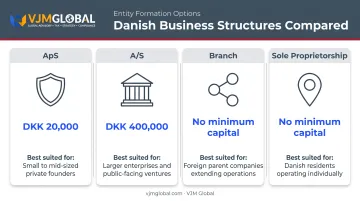
For most Malaysian founders, it comes down to ApS versus branch. If you want a standalone Danish legal entity with limited liability, ApS is the standard route. If you'd rather extend your existing Malaysian company's identity into Denmark, a branch skips separate incorporation but makes the parent company liable for the branch's obligations.
Step 2 – Secure Permits and Danish Digital ID
Non-EU/EEA nationals generally need a residence/work permit before they can register a company. The Start-up Denmark scheme is the relevant route for innovative, scalable businesses. Note that it explicitly excludes ordinary import/export or retail operations.
Under this scheme:
- The Danish Business Authority's expert panel must approve your business plan first
- Standard processing takes 2 months, extending to 4 months if more documentation is requested
- Permits run for up to 2 years initially, extendable in further blocks
Once your permit is granted, you can apply for MitID, and later MitID Erhverv for business use. Without a CPR number, non-citizens use an 8-digit P-code to complete the process. Note that a private MitID obtained through standard Citizen Service channels does not automatically meet MitID Erhverv's stricter business security requirements — plan for that extra step.
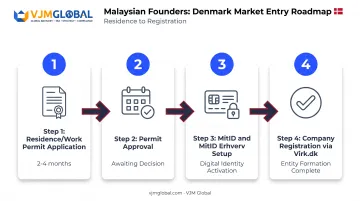
Step 3 – Register the Company via Virk.dk
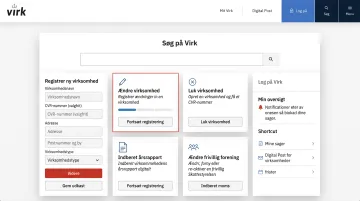
With MitID in hand, registration happens through Virk.dk, the Danish Business Authority's online portal. You'll typically need:
- Proof your Malaysian company legally exists (if forming a branch)
- Articles of association and formation documents (for ApS/A/S)
- Passport and identification for owners/directors
- A business plan (especially relevant if tied to your Start-up Denmark approval)
Once approved, you're issued a CVR number, Denmark's business registration number used for tax, banking, and other official interactions.
Most registrations complete automatically. Cases flagged for manual review currently take one week for sole traders and 2-4 weeks for ApS, A/S, and branches.
Step 4 – Register for Tax, VAT, and Employer Obligations
Your CVR number triggers tax registration obligations. Key figures to know:
- Corporate tax: flat 22% on resident company profits
- VAT: standard rate of 25%, required once annual turnover exceeds DKK 50,000
- Employer registration: mandatory if you plan to hire staff in Denmark, covering payroll withholding and social contributions
Most businesses report VAT quarterly or twice yearly, depending on turnover. If you're building an e-commerce operation selling across the EU, VAT compliance becomes a recurring administrative task, not a one-off filing.
Step 5 – Open a Danish Business Bank Account and NemKonto
Danish banks apply strict know-your-customer checks, especially for foreign-owned companies. Expect to provide:
- Passport or driving licence for owners and signatories
- A shareholder register identifying beneficial owners
- A group ownership chart if your Danish entity sits under a Malaysian parent
Processing can take up to two weeks, sometimes longer if the bank requests further documentation.
Once you have a CVR number, you must nominate a NemKonto (the account Danish authorities use for payments and refunds). A foreign account can serve as NemKonto if you prefer not to open a Danish account immediately, but only after separate approval from the Danish Agency for Digital Government.
Step 6 – Set Up Compliance and Ongoing Reporting
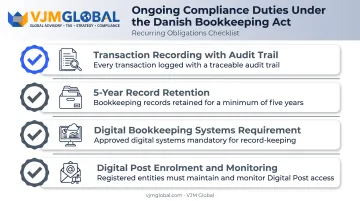
Registration isn't the finish line. Danish companies face ongoing bookkeeping and reporting duties under the Danish Bookkeeping Act:
- Accurate, prompt transaction recording with a clear audit trail
- Accounting records retained securely for 5 years
- Digital bookkeeping systems required for annual-reporting entities, and for other businesses once turnover crosses DKK 300,000 in two consecutive years
- Automatic enrolment in Digital Post, Denmark's official government communication channel, which businesses are obligated to monitor
This is where most Malaysian founders realise they're running compliance in two jurisdictions at once. Malaysian obligations don't disappear just because you've incorporated in Denmark.
VJM Global supports founders with entity formation, tax filings, and multi-country accounting, coordinating the Malaysia side while Danish local filings run through the appropriate in-market channels.
Conclusion
Starting a business in Denmark from Malaysia is entirely achievable, but it hinges on getting the sequence right: permit first, MitID second, registration third. Founders who treat these as parallel tasks, rather than a strict sequence, lose months.
Denmark's transparent, digital-first system rewards preparation. Get your documentation, capital, and timelines sorted before you file, and registration itself moves fast.
The harder part is staying compliant with Malaysian and Danish tax rules at the same time. A cross-border advisor such as VJM Global can shorten setup and cut the risk of a compliance misstep in either country.
Frequently Asked Questions
How much does it cost to start a business in Denmark?
Budget for the Start-up Denmark permit fee (around DKK 3,060), plus ApS minimum share capital of DKK 20,000. Add registration processing and any professional support fees on top of those base amounts.
Is it easy for a Malaysian to start a business in Denmark?
Denmark’s registration system is fast and digital. Malaysians still need a residence/work permit and MitID as non-EU/EEA nationals before they can use the registration portal.
Do I need to relocate to Denmark to own a Danish company?
Not necessarily. You can own an ApS or A/S without living in Denmark, though running day-to-day operations without residency is harder. A branch structure or remote arrangement can often avoid relocation altogether.
What is a CVR number and why do I need one?
A CVR number is Denmark's official business registration ID, issued once your company is approved on Virk.dk. It's used for tax registration, banking, and virtually every interaction with Danish authorities.
Is there a double tax treaty between Malaysia and Denmark?
Yes, a treaty has been in force since 1971, updated by a 2003 protocol. It generally prevents the same income being taxed twice, but always confirm current treaty status and how it applies to your specific structure before filing.
Can a Malaysian company open a branch in Denmark instead of a new entity?
Yes. A branch extends your Malaysian company’s legal identity into Denmark without separate share capital, but the parent remains fully liable for the branch’s obligations. That route often suits a quicker entry when you do not want a new legal entity.