
Interest comes from several directions: international startup founders seeking an EU base, expats already resident in Finland, and established businesses from the UK, US, and Australia looking for a Nordic market foothold. Whatever the starting point, the process requires getting a specific sequence right.
This guide covers what it actually costs, which business structures are available, and what legal requirements foreign entrepreneurs must meet before they can begin operating.
Key Takeaways
- Registration goes through the Finnish Trade Register (PRH) and Tax Administration, and can take as little as two weeks
- Five business structures are available; the Limited Company (Oy) is the standard choice for foreign founders
- Trade Register filing fees start at €300 online for a Limited Company
- Non-EU/EEA founders must secure a residence or Startup Permit before beginning registration
- Ongoing obligations include VAT registration, YEL pension insurance, and annual financial statement filing
Why Start a Business in Finland?
Finland's appeal for foreign founders goes beyond general Nordic reputation. According to Business Finland, the country ranks #1 for business and labour landscape on the Global Talent Competitiveness Index 2023 and #1 for innovation internationally on the Consumer Technology Association Innovation Scorecard 2023.
The sectors drawing the most foreign interest include:
- Software and Data — active government programmes and funding pipelines
- Health and Wellbeing — supported by the Health 360 Finland programme
- Energy and Built Environment — tied to Finland's electrification ambitions
- Games and Immersive — a thriving cluster centred around Helsinki, home to studios like Supercell and Rovio
- Circular economy — backed by Business Finland's Circular Transition for Zero Waste Mission
Statistics Finland reports that the stock of inward FDI reached €83.5 billion at the end of 2024, with net capital inflows of €3.9 billion that year — a clear signal of sustained foreign investor confidence.
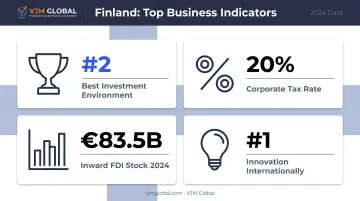
Basing a business in Finland gives you access to the EU single market, a corporate income tax rate of 20%, and free setup advisory through Business Finland's Invest in Finland service and the Enterprise Finland Advisory Service.
Business Structures Available in Finland
Your choice of business structure determines tax exposure, personal liability, and registration requirements. For foreign founders, getting this right early matters — it shapes everything from day-to-day operations to how profits are distributed.
Sole Proprietorship (toiminimi)
The simplest structure to register. Best suited to solo operators and freelancers. The founder and the business are treated as the same legal entity — meaning full personal liability for all debts, and income reported alongside personal taxes. Fast to set up, but the liability exposure is a significant drawback for most international founders.
Limited Company (osakeyhtiö – Oy)
The most widely used structure in Finland and the default choice for foreign entrepreneurs. Key features:
- Company liabilities are separate from the founder's personal assets
- Shareholders are not personally responsible for company debts beyond their investment
- Minimum share capital is €0 — the requirement was removed and the Trade Register now records share capital as zero euros if none is contributed
- Suitable for businesses of any size and compatible with international operations
From 1 January 2026, most company types must file registration notifications online with the Trade Register.
Partnerships and Limited Partnerships
Two partnership formats exist under Finnish law:
- General partnership (avoin yhtiö) — requires two or more founders; all partners carry full personal liability for business debts
- Limited partnership (kommandiittiyhtiö) — adds a silent investor role with capped liability, but the active partners remain fully exposed
Both are uncommon among foreign founders due to that liability risk.
Cooperative Association (osuuskunta)
Member-owned, with each member's liability capped at their investment. This structure suits community or collective models — it's not a practical fit for most foreign founders pursuing commercial growth. If none of the above structures fit your situation, the Limited Company (Oy) remains the strongest starting point for international entrants.
How to Start a Business in Finland: Step by Step
Finland's registration process is well-structured and largely digital. That said, non-EU founders must resolve their residency status before anything else — skipping it is the single most disruptive early error.
Step 1: Confirm Your Eligibility and Secure the Right Permit
Your permit requirement depends on where you're from:
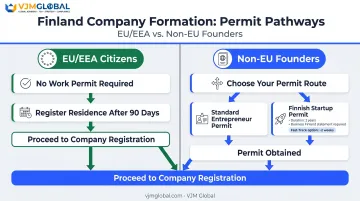
- EU/EEA citizens: No work permit required, but must register the right of residence if staying longer than 90 days
- Non-EU founders: Need either a standard entrepreneur's residence permit or the Finnish Startup Permit
- The Startup Permit is valid for 2 years and requires a Business Finland Eligibility Statement plus a business plan demonstrating clear international growth potential
- The Fast-Track option can deliver a permit decision in approximately two weeks for qualifying startup founders
Step 2: Choose Your Company Name and Structure
The company name must be unique and is verified through the PRH online service before filing. Once registered, the name carries exclusive rights. Check availability at the PRH portal before committing to any branding or contracts.
Step 3: Open a Finnish Business Bank Account
A Finnish bank account is required before formal registration of a Limited Company can be completed. This step surprises many foreign founders. Banking timelines vary and can introduce delays. Start this process early, running it in parallel with other steps where possible.
Step 4: File Your Start-Up Notification and Register with Tax Administration
The start-up notification is filed through the Business Information System at ytj.fi. A single notification covers both the Trade Register and the Tax Administration. On successful processing, the company receives a Business ID (Y-tunnus).
Founders without a Finnish personal identity code must submit a separate identification form for foreign persons, available through PRH.
You'll also need to assess which Tax Administration registers apply to your business:
| Register | When Required |
|---|---|
| VAT register | Turnover exceeds €20,000 per calendar year |
| Prepayment register | Recommended — shows the company handles its own advance taxes |
| Employer register | When paying regular wages to two or more permanent employees |
Step 5: Set Up Ongoing Compliance Before You Begin Operating
YEL pension insurance is mandatory for entrepreneurs who:
- Are aged 18–69 or 18–70 (depending on birth year)
- Earn an estimated €9,423.09 or more annually (2026 threshold)
- Operate for at least four months
It must be arranged within six months of starting the business.
Additional ongoing obligations:
- Annual financial statement filing with the Trade Register
- Quarterly or monthly VAT filings depending on turnover level
- Payroll reporting through the Incomes Register (for employers)
What Does It Cost to Start a Business in Finland?
Costs depend on structure, whether you use professional support, and what your specific operations require. Here's a breakdown across the main categories.
Registration Fees
| Filing Type | Fee |
|---|---|
| Limited Company (Oy) — guided online process | €300 |
| Limited Company (Oy) — standard online notification | €400 |
| Sole Proprietorship (toiminimi) | €75 |
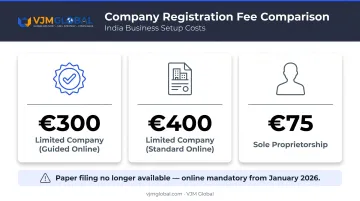
Paper filing is no longer available for Limited Companies — online filing became mandatory from 1 January 2026. Always verify current fees at the PRH price list before filing.
Accounting and Legal Setup
Not mandatory, but foreign founders typically budget for professional fees across three areas:
- Company formation — incorporating the entity and filing with the Trade Register
- Contract drafting — shareholder agreements, employment contracts, terms of service
- Tax advisory — initial structuring, VAT registration, and residency questions
Non-EU founders navigating permit applications alongside tax residency queries should expect higher advisory costs, given the added complexity of both tracks running simultaneously.
Share Capital
A Limited Company (Oy) currently has no minimum share capital requirement. The Trade Register records €0 if no capital is contributed. This removes a historical barrier that once required €2,500 upfront.
YEL Pension Insurance
- 2026 contribution rate: 24.4% of confirmed annual working income
- At the minimum income threshold of €9,423.09, the approximate contribution is:
- ~€2,299/year (~€192/month) before any new-entrepreneur discount
- New entrepreneurs receive a 22% discount on YEL contributions for the first four years
This is a recurring annual cost, not a one-time fee.
VAT
The standard Finnish VAT rate is 25.5% (effective from 1 September 2024). Reduced rates apply:
- 13.5% — groceries, restaurant and catering services
- 10% — newspapers, magazines, and certain other categories
VAT registration itself carries no direct fee but creates ongoing quarterly or monthly reporting obligations once your turnover crosses €20,000.
Start-Up Grant (Starttiraha)
Eligible founders can apply for a start-up grant through local Employment Services. Key details:
- Paid for five days per calendar week, equivalent to the basic daily allowance rate
- Available for up to 6 months initially, extendable to a maximum of 12 months
- Eligibility conditions: must be starting full-time business activity, be resident in Finland, not already have sufficient income, and have a viable business plan
At the basic daily allowance rate, the grant covers roughly €33–€37 per day — a practical income buffer while revenue builds in the first year.
Legal and Compliance Tips for Foreign Entrepreneurs
Finland's regulatory system is transparent, but it carries specific traps for founders unfamiliar with EU compliance standards or Finnish corporate law — especially those who also hold business interests in another country.
Permanent Establishment (PE) Risk
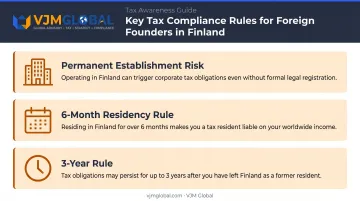
A foreign company operating in Finland may trigger a permanent establishment even without formally registering a branch. This matters because PE status creates Finnish income tax obligations on profits attributable to that presence.
The Finnish Tax Administration provides an online helper tool to estimate whether your operations create a PE. Use it early. If the assessment is unclear, seek an advance ruling before committing to an operating structure.
The 6-Month Residency Rule
Staying in Finland continuously for more than 6 months generally makes you a resident taxpayer in Finland. At that point, all global income — not just Finnish income — may be subject to Finnish tax.
For international founders with income streams or business ownership in their home country, this is a serious consideration. Verify how Finnish residency status interacts with any applicable bilateral tax treaty before that 6-month mark passes.
The 3-Year Rule (for Founders Who May Later Leave)
Finnish citizens — and in some cases long-term residents — who leave Finland remain subject to Finnish tax for 3 calendar years after departure, unless they can demonstrate no significant ties to Finland. Founders who plan to return to their home country after building a business in Finland should understand this before committing to the structure.
For example, a founder who registers an Oy, operates it for two years, then relocates back to India may still face Finnish tax obligations on worldwide income for up to three additional years.
When to Seek Professional Guidance
Cross-border compliance gets complicated fast when a Finnish business structure intersects with obligations in another country. Common problem areas include:
- PE determination and profit attribution
- VAT treatment across EU and non-EU jurisdictions
- Corporate reporting where the founder has simultaneous obligations in India, the UK, the US, or Australia
- DTAA (Double Taxation Avoidance Agreement) analysis where Finland and another jurisdiction both assert taxing rights
For founders with business interests in India, VJM Global can provide advisory at the India-facing end of multi-jurisdiction structures — covering DTAA analysis, FEMA compliance, NRI and expatriate taxation, and entity structuring for cross-border operations. If India is one of the jurisdictions involved, getting this advisory in place early can prevent costly compliance gaps later.
Conclusion
Starting a business in Finland is genuinely accessible for foreign entrepreneurs — the registration system is digital, well-documented, and can move quickly once the groundwork is in place. The sequence matters: secure permits first, choose the right structure, register correctly, and understand compliance obligations before operations begin.
For non-EU founders, complexity concentrates in four specific areas:
- Permit sequencing — residence and work authorization must precede registration
- Permanent establishment risk — activity in Finland can trigger tax obligations before formal setup
- Tax residency timing — when you become a Finnish tax resident affects your global liability
- Mandatory insurance — YEL contributions apply from day one of self-employment activity
None of these are issues to resolve retrospectively. Getting qualified cross-border advice before committing to a structure reduces costly mistakes down the line.
Frequently Asked Questions
How much does it cost to start a business in Finland?
The Trade Register filing fee for a Limited Company filed online is €300 (guided process) or €400 (standard notification). Total startup costs vary depending on structure, professional fees for legal or accounting support, and YEL pension insurance contributions. There is no minimum share capital requirement for a private limited company.
Is it easy to start a business in Finland as a foreigner?
EU/EEA citizens face minimal barriers beyond standard registration. Non-EU founders must first obtain a residence or Startup Permit, but once that's in place, the process is largely digital and can be completed within a few weeks. Business Finland and Enterprise Finland offer advisory support to help foreign entrepreneurs navigate the process.
What is the 3-year rule in Finland?
Under this Finnish tax rule, individuals who leave Finland are still treated as tax residents for 3 calendar years after departure, unless they can demonstrate no significant ties to Finland. Founders returning home after running a Finnish business should factor this into their tax planning.
What business structure is best for foreign entrepreneurs in Finland?
The Limited Company (Oy) is the most commonly chosen structure. It separates personal and business liability, has no minimum share capital requirement, suits businesses of any size, and is compatible with international operations and multi-jurisdiction corporate structures.
How long does it take to register a company in Finland?
Online registration through the Trade Register takes approximately two weeks. Non-EU founders should factor in additional time for permit applications, though the Fast-Track Startup Permit — available to founders with a Business Finland Eligibility Statement — can also be decided within that window.
Is YEL pension insurance mandatory for entrepreneurs in Finland?
Yes. YEL insurance is mandatory for entrepreneurs who work in their own company, earn above the €9,423.09 annual threshold (2026), and have been operating for more than four months. It must be arranged within six months of starting, and the 2026 contribution rate is 24.4% of confirmed working income.